Hello! Welcome back to our pronunciation workshop.
Introduction
In our last lesson, we focused on creating a smooth flow by connecting words with consonant-to-vowel linking (e.g., "set up an" becomes "se-tu-pan"). This helps eliminate pauses and makes your speech more fluid.
Today, we'll tackle another essential linking technique: connecting words where an identical consonant sound occurs back-to-back. Think of phrases like "social life" or "IP phone." Learning to handle these connections will remove any slight hesitation or stutter between words and bring you another step closer to natural, fluent speech. By the end of this lesson, you will know how to apply this rule to make your professional and casual conversations sound even smoother.
1. The Core Rule: One Sound, Not Two
The main principle is simple: when one word ends with a consonant sound and the next word begins with the exact same consonant sound, you don't say the sound twice. Instead, you merge them into a single, slightly longer sound.
Let's watch a quick video that explains this very clearly.
Linking Consonant to Consonant -- American English Pronunciation
This clip from Rachel's English demonstrates the core idea using the common phrase 'gas station'.
Watch from 00:52 to 01:25. Pay close attention to how she pronounces 'gas station' and 'some might'. Notice it's not 'gas-station' with two separate /s/ sounds, but 'ga-station' with one continuous /s/.
As Rachel explains, you connect the two words with a single consonant sound. This prevents a choppy some...might and creates a smooth some-might.
This rule applies to two main types of consonants, and the technique is slightly different for each. Let's break them down.
2. Linking Continuous vs. Stop Consonants
To master this skill, it's helpful to understand the difference between continuous consonants and stop consonants.
- Continuous consonants are sounds you can hold, like /s/, /f/, /l/, /m/, /n/. You can say "ssssssss" for as long as you have breath.
- Stop consonants are sounds made by stopping the airflow completely and then releasing it in a puff, like /p/, /t/, /k/, /b/, /d/, /g/. You can't hold these sounds.
The following text explains the rules for linking both types.
Consonant to Consonant Linking
This guide from Baruch College's 'Tools for Clear Speech' provides excellent, clear rules for linking identical consonants. We'll focus on the first two rules.
Read 'Rule 1: Linking between the same stop consonants' and 'Rule 2: Linking between the same continuous consonants'. Pay attention to the different actions: 'holding for extra time' for stops versus pronouncing the linked sound 'slightly longer' for continuous sounds.
Let's review and expand on those two rules.
Rule 1: Linking Continuous Consonants (s, z, f, v, m, n, l, r, th)
As the article and the image below show, you connect these by holding the sound for a bit longer than you would for a single consonant.
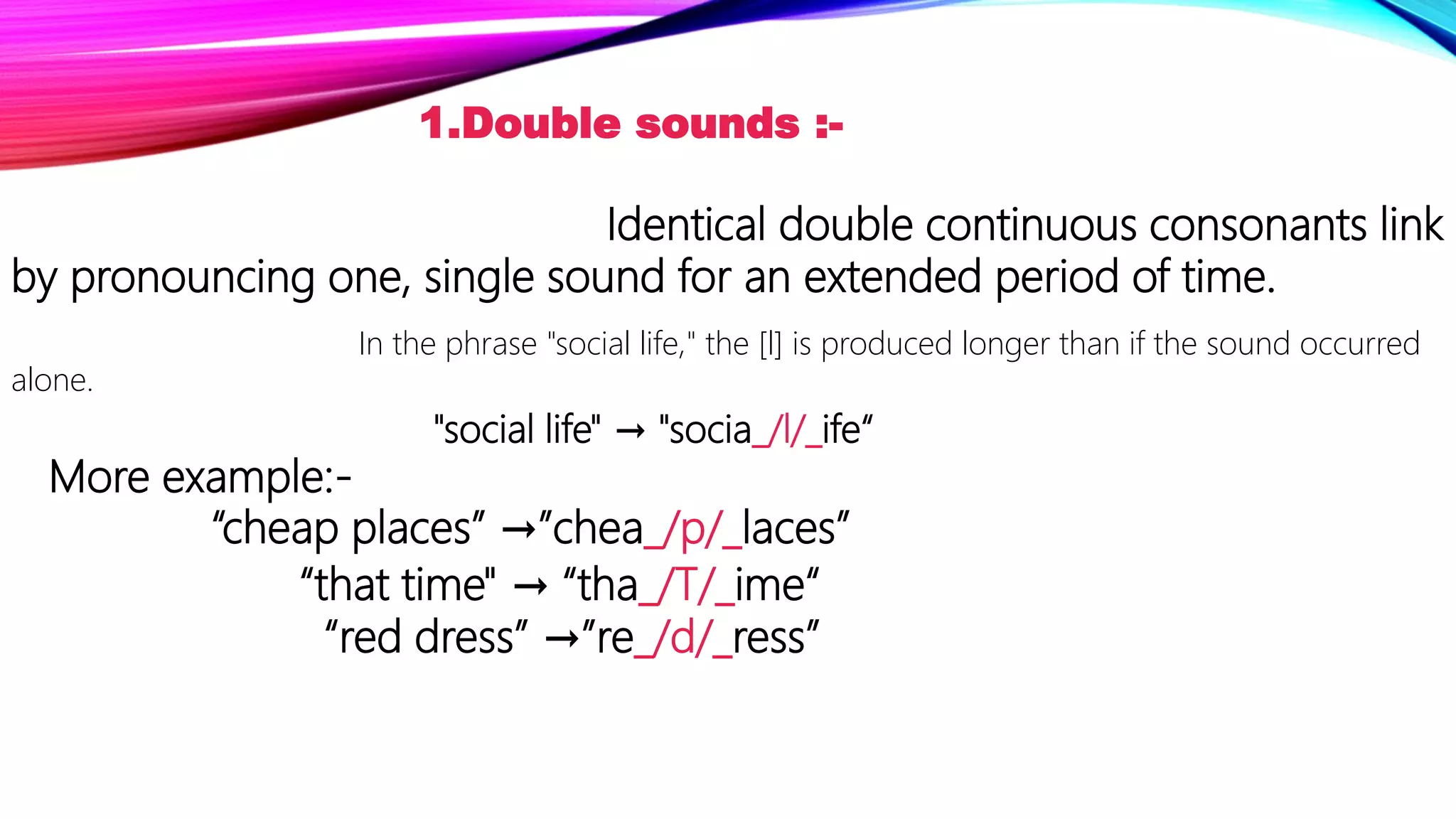
Practice saying these aloud:
- social‿life (hold the /l/ sound)
- this‿server (hold the /s/ sound)
- some‿money (hold the /m/ sound)
- fail‿log (hold the /l/ sound)
Rule 2: Linking Stop Consonants (p, t, k, b, d, g)
For stop consonants, you don't make two separate "puffs" of air. Instead, you get your mouth into position for the sound, hold the stop for a moment, and then release the sound only once as you begin the second word.
Practice saying these aloud:
- hot‿today (form the /t/ at the end of 'hot', hold it, then release it into 'today')
- black‿cat (form the /k/ position, hold, then release into 'cat')
- good‿day (form the /d/ position, hold, then release into 'day')
- stop‿playing (form the /p/ with your lips, hold, then release into 'playing')
3. Application in a Technical Context
This linking technique is very common in the language you use at work. Mastering it will make your explanations and instructions sound more professional and confident.
Try reading these sentences aloud, focusing on creating one smooth sound at the link (‿).
Continuous Consonants:
- "We need to check the fail‿log for more information." (fai-log)
- "This common‿network issue is easy to fix." (commo-network)
- "Can you configure this‿switch for the new VLAN?" (thi-switch)
- "She's responsible for our‿remote access." (ou-remote)
Stop Consonants:
- "The backup‿plan is our top‿priority." (backu-plan, to-priority)
- "I need a black‿cable for the new server rack." (bla-cable)
- "Please check the Red‿Hat documentation." (Re-dhat)
- "We have a big‿gateway configuration project." (bi-gateway)
Test your understanding!
You need to tell a junior engineer that they made a common mistake. How would you pronounce the phrase "bad decision" using the linking rule for stop consonants?
Show answer
You would pronounce it as "ba-decision". You bring your tongue to the position for the /d/ sound at the end of "bad," hold the airflow for a moment, and then release it directly into the word "decision" without making a second /d/ sound.
4. Guided Practice: Listen and Repeat
Now it's time for some intensive practice. The best way to make this skill automatic is to listen to a native speaker and imitate them.
The following video provides a long list of phrases for you to practice with. Don't just listen—say them out loud and try to match the speaker's rhythm and flow. This aligns perfectly with your preferred "learn-by-doing" approach.
Linking: consonant sound + same consonant sound
This video from Eva Easton's American English Pronunciation channel is a fantastic 'listen and repeat' exercise that covers many different identical consonant links.
Watch from 01:10 to 07:00. The speaker will say a phrase, and you should repeat it in the pause. Pay attention to how the linked sounds connect smoothly. Feel free to pause the video to repeat phrases several times.
For additional practice, you can also use the lists from the "Consonant to Consonant Linking" article and the examples under "Linking Type – Two of the same consonants become one sound" in the "Connected Speech" resource (LINK). Try recording yourself and comparing it to the video examples.
Conclusion
Well done! Today you've learned another key technique for connected speech that will significantly improve your fluency.
Key Takeaways:
- When a word ends in the same consonant sound that the next word begins with, connect them into a single, elongated sound.
- For continuous consonants (like /s/, /l/, /m/), you hold the sound a little longer (e.g.,
this‿server). - For stop consonants (like /t/, /d/, /k/), you hold the mouth position and release the sound only once (e.g.,
hot‿today). - This rule is frequently used in both everyday language and specialized technical terms.
Preview of the next lesson:
We've learned to add links between words. But sometimes, to speak faster, native speakers actually remove sounds. In our next lesson, we will explore elision, the process of dropping sounds in common phrases, such as the /t/ in "next door" (nex-door).