Hello! Welcome to your first lesson in the "Getting the Basics about Hydroponics" course.
I'm excited to guide you on this journey. Your goal of starting a small hydroponic business is a fantastic one, and this course is designed to give you the solid scientific and practical foundation you'll need for success. We'll start by focusing on "the why" behind the "how," beginning with the most fundamental topic: plant biology.
Today's lesson is the first step. We will focus on identifying the essential nutrients that plants need to grow. Understanding these building blocks is the absolute foundation for mixing nutrient solutions and troubleshooting plant health issues later on.
The Plant's "Diet": An Overview
Just like people, plants require a balanced diet of essential nutrients to live, grow, and be productive. While in traditional gardening the soil provides many of these elements, in hydroponics, we become fully responsible for delivering a complete and balanced meal to our plants through the water.
These essential nutrients are divided into three main groups.
- Basic Nutrients: Obtained from air and water.
- Macronutrients: Needed in large quantities.
- Micronutrients: Needed in very small quantities.
This image gives you a quick visual overview of all the elements we'll be discussing.

The most important distinction for us in hydroponics is between macronutrients and micronutrients. It's crucial to understand that this distinction is about the quantity required by the plant, not the nutrient's importance. A deficiency in a micronutrient can be just as damaging as a deficiency in a macronutrient.
To start, let's get a clear definition of these categories. Please watch the first part of the following video.
A Beginners Guide: Hydroponic Nutrients
This clip from ZipGrow's 'A Beginners Guide: Hydroponic Nutrients' provides a concise introduction to the 13 essential mineral nutrients and how they are classified.
Watch from 00:40 to 01:43. Focus on how the narrator differentiates between primary, secondary, and micronutrients.
To solidify this concept, let's look at it from another angle. The following reading from Penn State Extension offers a clear, text-based explanation.
Hydroponics Systems and Principles Of Plant Nutrition: Essential ...
This article, 'Hydroponics Systems and Principles Of Plant Nutrition', clearly defines essential nutrients and their categories.
Read the section titled 'Essential Nutrients'. Pay attention to the distinction between how plants get carbon, hydrogen, and oxygen versus the other mineral nutrients.
The Macronutrients: Primary and Secondary
Macronutrients are the heavy lifters of plant nutrition. They are required in the largest amounts and form the core components of plant structures and metabolic functions. They are typically divided into two sub-groups: primary and secondary.
Primary Macronutrients: N-P-K
You will see the letters N-P-K on almost every package of fertilizer. They stand for Nitrogen, Phosphorus, and Potassium, the three nutrients plants consume in the greatest amounts.
- Nitrogen (N): The main driver of vegetative, leafy growth. It's a core component of chlorophyll, the molecule that makes plants green and enables photosynthesis.
- Phosphorus (P): Crucial for energy transfer, root development, flowering, and fruiting. Think of it as supporting the plant's reproductive and structural foundations.
- Potassium (K): An all-around contributor to plant health and vigor. It helps regulate water movement, nutrient transport, and strengthens the plant against diseases and stress.
Secondary Macronutrients: Ca, Mg, S
These are needed in smaller amounts than N-P-K, but are still considered macronutrients and are vital for plant health.
- Calcium (Ca): A key structural component of cell walls. It's like the mortar holding the plant's cellular bricks together, ensuring strong stems and new growth.
- Magnesium (Mg): The central atom in the chlorophyll molecule. Without magnesium, plants cannot photosynthesize effectively, leading to a loss of green color and energy production.
- Sulfur (S): An essential component of some amino acids and proteins, contributing to plant growth and the formation of flavor compounds in certain vegetables.
To see what these nutrients do and, just as importantly, what happens when they are missing, please watch the following segments from Epic Gardening. The visual examples of deficiencies are excellent for understanding the real-world role of each nutrient.
Plant Nutrition 101: All Plant Nutrients and Deficiencies Explained
In 'Plant Nutrition 101', Kevin from Epic Gardening explains the function of each macronutrient and shows clear visual examples of deficiency symptoms.
Watch from 01:36 to 07:56. First, you'll see the primary nutrients (N, P, K), followed by the secondary nutrients (Ca, Mg, S). Notice how different deficiencies affect different parts of the plant.
The Micronutrients: Small but Mighty
Micronutrients, also known as trace elements, are required in tiny amounts. However, they are absolutely essential for specific enzymatic and metabolic functions. Think of them as the spark plugs of the plant's engine—small, but the engine won't run without them.
The key micronutrients include:
- Iron (Fe)
- Manganese (Mn)
- Boron (B)
- Zinc (Zn)
- Copper (Cu)
- Molybdenum (Mo)
- Chlorine (Cl)
- Nickel (Ni)
A lack of any one of these can halt critical processes, leading to stunted growth, discoloration, and crop failure. This is why a good hydroponic nutrient formula is "complete," meaning it contains all of these trace elements in the correct proportions.
The following infographic provides a great side-by-side comparison of macro- and micronutrients.
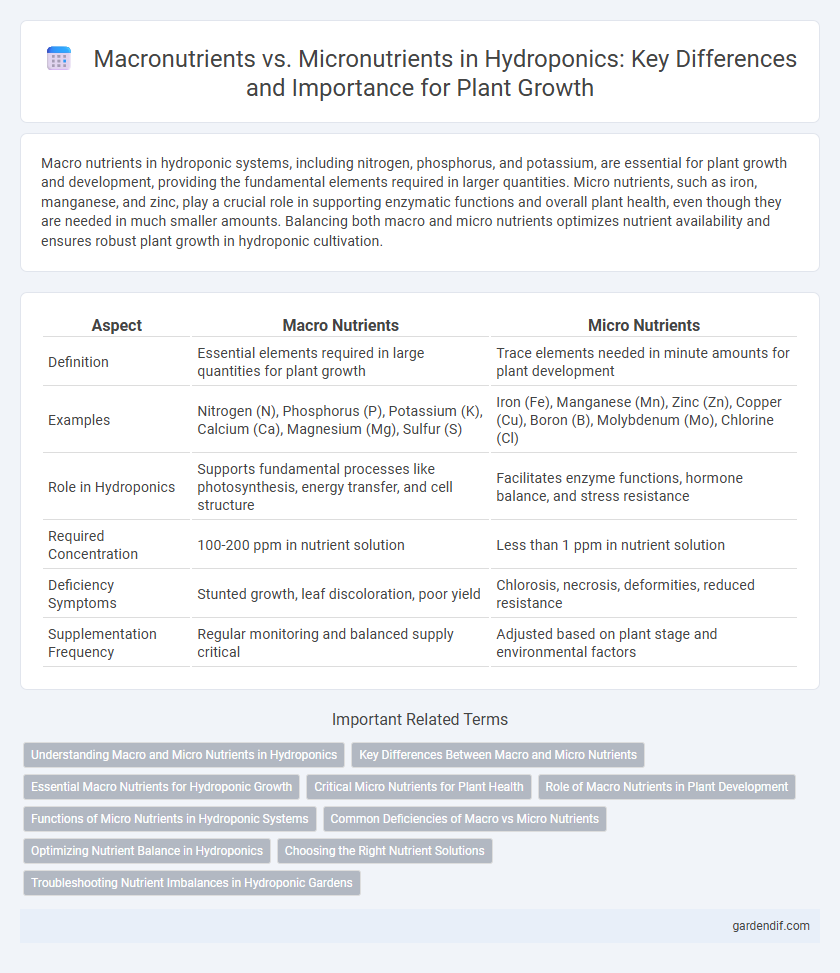
To appreciate the specific roles these trace elements play, let's return to the Epic Gardening video. You don't need to memorize every deficiency symptom, but focus on understanding that each nutrient has a unique and critical job.
Plant Nutrition 101: All Plant Nutrients and Deficiencies Explained
This final segment of the video covers the trace elements, or micronutrients. It reinforces the idea that 'micro' does not mean 'unimportant' and shows the dramatic effects of their absence.
Watch from 07:56 to 15:09. Observe the variety of functions these nutrients have, from aiding photosynthesis to helping the plant use other nutrients like nitrogen.
Your Nutrient Reference Guide
To bring everything together, the table in the Penn State Extension article we looked at earlier is an invaluable resource. It lists every essential nutrient, its chemical symbol, its specific role in the plant, and the form the plant absorbs it in. I highly recommend bookmarking this page for future reference.
Hydroponics Systems and Principles Of Plant Nutrition: Essential ...
This table is an excellent, comprehensive summary of every essential plant nutrient. It will be a very useful reference for you throughout this course.
Review 'Table 1' in the article. You can use it as a cheat sheet to quickly look up the function of any nutrient we've discussed today.
Conclusion
Great work on completing your first lesson! You've taken a critical step toward understanding how to successfully grow plants hydroponically.
Here are the key takeaways from today:
- Plants require 17 essential nutrients to thrive. Three (Carbon, Hydrogen, Oxygen) come from air and water, while the other 14 mineral nutrients must be provided in your hydroponic solution.
- These mineral nutrients are categorized by the amount plants need: macronutrients (primary N-P-K and secondary Ca-Mg-S) and micronutrients (like Iron, Boron, and Zinc).
- All 14 mineral nutrients are equally essential. A deficiency in any single one, no matter how small the required amount, can negatively impact plant health and your final yield.
- Each nutrient plays one or more specific roles, from building green leafy matter (Nitrogen) and strong cell walls (Calcium) to enabling photosynthesis (Magnesium) and activating enzymes (Manganese).
In our next lesson, we will build directly on this knowledge. Now that we've identified the "what" of plant nutrition, we'll explore the "how" by examining the process of photosynthesis, and see how plants use light, water, and CO₂ to create their own energy.