Introduction
Welcome to your next lesson! In our previous session, we created a complete "shopping list" of the equipment needed to build a small-scale Deep Water Culture (DWC) system. You now know what components are required to get started.
Today, we will dive deeper to address the learning outcome: Explain the specific function of each component in a DWC system. We'll move beyond the list and explore the specific role each part plays. Understanding the "why" behind each piece of equipment is fundamental, not just for assembly, but for operating, optimizing, and troubleshooting your system effectively—skills that are essential for your goal of running a hydroponic business.
Let's begin by quickly revisiting the scientific principles that make DWC such a powerful growing method. This will provide the context for understanding how each component contributes to the system's success.
Deep Water Culture (DWC) Hydroponics Starter Guide
This guide from Atlas Scientific provides a concise explanation of the science that makes DWC so effective. Understanding these principles is key to appreciating the function of each component.
Please read the section titled 'The Science Behind DWC'. Focus on the three key principles mentioned: optimal oxygen availability, direct nutrient access, and perfect hydration. We will see how each component we discuss contributes to one or more of these principles.
As you just read, a successful DWC system excels at providing roots with constant access to water, nutrients, and, most importantly, oxygen. Now let's break down how each component accomplishes this.
1. The System's Structure: Containment and Support
These components form the physical "house" for your plant and the nutrient solution. Their design is simple but serves critical functions.
The Reservoir
The reservoir, which for a small system is often a bucket, is the foundation. Its function goes beyond simply holding water.
Deep Water Culture (DWC) Hydroponics System Tutorial
In this short clip, the 'Epic Gardening' channel explains the primary role of the nutrient reservoir.
Watch from 00:27 to 01:01. Note the two functions: housing the nutrient solution and providing the space for the roots to be suspended.
As the video highlights, the reservoir's main function is to contain the nutrient solution. However, a crucial secondary function is light-blocking. Your reservoir must be opaque. Why? Because if light penetrates the nutrient-rich water, you create a perfect breeding ground for algae. Algae will compete with your plants for nutrients and oxygen, dirtying your system and potentially harming your roots.
The Lid and Net Pot
The lid and net pot work together to support the plant and separate it from the outside environment.
- Lid Function: The lid serves three purposes:
- Support: It holds the net pot, keeping the plant securely in place.
- Light Blocking: It prevents light from entering the reservoir from the top.
- Environmental Barrier: It reduces evaporation of the nutrient solution and prevents debris from falling in.
- Net Pot Function: This is more than just a simple cup. Its slotted mesh design is engineered specifically for hydroponics.
Let's watch a clip that explains why its design is so effective.
Deep Water Culture (DWC) Hydroponics System Tutorial
This clip, also from 'Epic Gardening', clearly explains the function of a net pot and how its design promotes a healthier root system compared to a standard cup.
Watch from 03:38 to 04:21. Focus on how the mesh design allows roots to grow in all directions, creating a more vigorous and robust root system.
The Growing Medium
The growing medium's function in DWC is purely structural. It provides no nutrition.
Deep Water Culture (DWC) Hydroponics System Tutorial
To understand the role of the growing medium, let's look at a common example: Hydroton (clay pellets).
Watch from 02:50 to 03:38. The key functions to note are that it's inert (pH neutral), reusable, and provides physical support for the seedling in the net pot.
To summarize, the growing medium's job is to anchor the young plant within the net pot until its root system is developed enough to support itself. Its inert nature ensures it doesn't alter the carefully balanced chemistry of your nutrient solution.
2. The System's Engine: The Aeration System
This is the "deep water culture" part of DWC. While the structure we just discussed can be used in passive methods (like the Kratky method), the active aeration is what defines DWC and drives its rapid growth rates. Plant roots require oxygen for respiration, the process they use to convert sugars into energy for nutrient uptake. Without a constant supply of dissolved oxygen, the roots would quickly suffocate and "drown."
The following clips explain why this system is so vital and how its parts function together.
Deep Water Culture (DWC) Hydroponics System Tutorial
The 'Epic Gardening' tutorial provides an excellent explanation for why aeration is non-negotiable in DWC and breaks down the function of each component.
Please watch the video from 01:16 to 02:50. Pay close attention to: Why Aeration is Needed (01:16-02:13): The explanation of roots consuming oxygen and the function of the air pump and air stone in replenishing it. The Airline Tubing (02:13-02:50): The simple but important function of the tubing as a delivery mechanism and why its opacity matters.
Let's break down the function of each part of the aeration system:
- Air Pump: This is the heart of the system. Its sole function is to act as a motor, pulling in ambient air and pushing it with pressure through the airline tubing.
- Airline Tubing: This is simply a conduit. Its function is to transport the air from the pump (which must remain dry outside the reservoir) to the air stone at the bottom of the reservoir.
- Air Stone: This is the most crucial part for efficiency. Its function is to act as a diffuser. The stone is porous, so as air is forced through it, the single stream of air is broken up into thousands of tiny bubbles. This dramatically increases the surface area where air contacts water, allowing oxygen to dissolve into the solution much more effectively.
This constant oxygenation directly prevents root rot, a deadly fungal disease that thrives in stagnant, low-oxygen water.
3. The DWC System in Action
Now, let's visualize how these components, each with its specific function, work together to create an ideal growing environment.
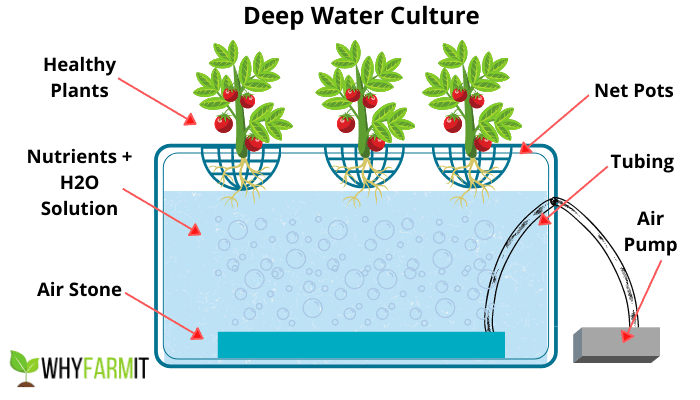
As the diagram illustrates:
- The plant is anchored by the growing medium in the net pot.
- The lid supports the net pot and seals the reservoir from light.
- The roots grow down into the nutrient solution.
- The air pump pushes air through the tubing into the air stone.
- The air stone releases fine bubbles, enriching the water with dissolved oxygen.
The result is a synergistic system where the roots have everything they need, 24/7, allowing the plant to devote all its energy to vegetative growth, flowering, and fruiting.
Conclusion
Today you've moved beyond simply identifying the parts of a DWC system to understanding their specific purpose. This foundational knowledge is crucial as you prepare to build and run your own system.
Key Takeaways:
- The Reservoir, Lid, and Net Pot create a light-proof, supportive structure that contains the nutrient solution and allows roots to access it.
- The Growing Medium provides inert physical stability for the plant in its early stages.
- The Aeration System (Pump, Tubing, Air Stone) is the active engine of DWC. Its function is to continuously dissolve oxygen into the water, which is essential for root respiration and preventing root rot.
- Every component works in concert to fulfill the three scientific principles of DWC: perfect hydration, direct nutrient access, and optimal oxygen availability.
In our next lesson, we will finally get hands-on. You will learn how to follow the steps to assemble a basic DWC system from these individual components, bringing together everything we've learned in a practical build.