Welcome to the first lesson of your course on People Management for IT B2B Products. Your goal is to refine your team's development processes to create a more structured, efficient workflow suitable for a high-pressure startup environment.
This first module, "Agile Foundations for Startups," is designed to build the conceptual groundwork for this change. You've mentioned your team currently uses a Waterfall-style methodology. The first logical step, therefore, is to critically examine this approach.
In this lesson, you will focus on identifying the limitations of the Waterfall methodology, particularly within the dynamic context of a B2B startup. Understanding why your current process might be causing friction or inefficiency is the essential first step before we can build a better alternative.
1. The Core Problem: Planning in the Face of Uncertainty
The fundamental premise of the Waterfall model is that a project can be fully planned upfront, with requirements gathered, a design finalized, and then development executed in a linear sequence.
However, how much do you really know at the very beginning of a project? Let's explore this idea.
3 Reasons WHY Waterfall Doesn't Work
To start, watch this short segment from the video '3 Reasons WHY Waterfall Doesn't Work' by Christopher Okhravi. It introduces a powerful visual model that contrasts the timing of requirement-setting with the growth of knowledge over a project's lifecycle.
Watch the section from 00:27 to 02:00. Pay close attention to the graph shown at the beginning. It illustrates the inverse relationship between when requirements are defined and when project knowledge is at its peak.
As the video argues, we make the most critical decisions when we know the least. Think about your own experience:
- How often do client requirements or your understanding of their needs evolve after the initial project kickoff?
- How many crucial insights about a feature emerge only after your developers start building it?
This mismatch leads to a different perspective on software development, one that many modern teams have adopted.
The WORST Way to Develop Software
The video 'The WORST Way to Develop Software' by Modern Software Engineering elaborates on this point, reframing software development not as a predictable production process, but as one of discovery.
Watch from 09:47 to 12:00. The speaker contrasts the Waterfall assumption (that all answers are known upfront) with the reality of software development as a 'process of learning and discovery'.
The key takeaway is that for innovative or complex products, the plan itself is a hypothesis, not a fixed blueprint. The goal of the development process should be to test and refine that hypothesis as quickly and cheaply as possible. A rigid, linear process actively works against this goal.
2. Frameworks for Analyzing Your Projects
Not all software projects are the same. The Waterfall model's flaws become particularly apparent when we're building certain types of systems. Let's look at two mental models that can help you categorize your work and understand why a one-size-fits-all approach is ineffective.
a) Lehman's Classification of Systems
First, consider the nature of the software itself and its relationship with the real world.
3 Reasons WHY Waterfall Doesn't Work
The '3 Reasons WHY Waterfall Doesn't Work' video introduces a useful classification of systems from a 1980 paper by Manny Lehman. This will help you formalize the type of product you are building.
Watch from 02:00 to 06:37. Focus on the definitions of S-type (specifiable), P-type (problem-solving), and E-type (embedded) systems. Think about where your B2B product fits.
Most B2B software, especially in a startup, is a classic E-type system: it's embedded in the reality of your clients' businesses. The very act of them using your product changes their workflow, which in turn creates pressure for your product to change. This creates a continuous feedback loop. Trying to freeze requirements for an E-type system is like trying to freeze a living organism; it fundamentally misunderstands its nature.
b) The Stacey Matrix
Next, let's consider the levels of certainty involved in your projects. The Stacey Matrix is a powerful tool for mapping projects based on two axes:
- Certainty of Technology (The "How"): How well do you understand the technical implementation?
- Agreement on Requirements (The "What"): How clear and stable are the user and business needs?
3 Reasons WHY Waterfall Doesn't Work
Let's return to the same video to explore the Stacey Matrix. This model maps different types of projects and suggests which kind of management approach is most suitable for each.
Watch from 06:37 to 11:17. Pay attention to the four zones: Simple, Complicated, Complex, and Anarchy. Note the distinction between 'known unknowns' and 'unknown unknowns'.
Where do your projects typically fall on this matrix?
- Simple: (Known knowns) e.g., building a standard login form with a well-known tech stack. Waterfall can work here.
- Complicated: (Known unknowns) e.g., integrating with a new but well-documented third-party API. You know what questions to ask.
- Complex: (Unknown unknowns) e.g., developing a novel optimization algorithm for a client whose needs are still being discovered. You don't even know what you don't know. Cause and effect are only clear in hindsight.
Startups building new B2B products almost always operate in the complex domain. Here, a predictive plan is bound to fail. The only viable strategy is to probe, sense, and respond—which requires an iterative, adaptive process.
3. The Practical Consequences of Rigidity
When you apply a rigid, linear process to a complex, E-type system, what are the tangible results? Let's look at the common failure modes.

These four points manifest in very specific, costly ways.
a) Absence of Feedback & The Cost of "Late Surprises"
One of the most damaging aspects of Waterfall is the structural separation of phases and the teams that perform them. This chokes off vital feedback loops.
The WORST Way to Develop Software
This clip from 'The WORST Way to Develop Software' explains how the sequential nature of Waterfall prevents effective learning and feedback, using the analogy of 'Chinese Whispers' to describe communication breakdowns.
Watch from 05:54 to 09:01. Notice how the process makes it difficult for developers to feed back issues to analysts or designers, and how this can lead to workarounds and divergence from the original plan.
This lack of feedback has a measurable business impact. When feedback is delayed until the end of the project, the results can be disastrous.
Agile vs. Classic Project Management: The Hybrid Approach for ...
For some hard data on this, please read a section from the article 'Agile vs. Classic Project Management'. It quantifies the 'hidden costs' of strictly following the Waterfall method.
Read the section titled 'The Hidden Costs of Rigid Methodological Adherence'. Focus on the statistics related to 'late surprises,' 'requirements half-life,' and the percentage of unused features.
A "requirements half-life" of just 6 months in a fast-moving market is a particularly stark data point for a startup. It means that in a year-long project, 75% of the original requirements could be irrelevant by the time you launch. This is a massive waste of resources your startup can't afford.
b) Key Disadvantages in a B2B Startup Context
To summarize, let's consolidate the key limitations from a practical standpoint using this excellent article from Automios.
Disadvantages of the Waterfall Model in Software Development
The article 'Disadvantages of the Waterfall Model in Software Development' provides a concise list of the major drawbacks. We'll focus on the three most relevant to your startup environment.
Please read the subsections under 'Major Disadvantages of the Waterfall Model': '4. Limited User and Stakeholder Feedback', '6. Delayed Time-to-Market', and '7. Assumes Perfect Planning (Which Never Happens)'.
- Limited User Feedback: This leads to building products that are technically correct but functionally wrong. In a B2B context, where deep domain problems are being solved, this is a recipe for low adoption and dissatisfied clients.
- Delayed Time-to-Market: Startups thrive on speed and learning. Long development cycles mean you're not getting a Minimum Viable Product (MVP) into the hands of users, not validating your assumptions, and not generating revenue or feedback.
- Assumes Perfect Planning: As we've established, this assumption is fundamentally flawed for the type of work you do.
4. A Quick Self-Assessment
Based on what we've covered, here is a simple litmus test to apply to your current process.
-
The Change Test: As suggested in the video "The WORST Way to Develop Software," ask yourself: How easy is it for my team to change the requirements if we discover they are wrong? How easy is it to change the plan if a more important client request comes in? If the answer is "difficult" or "it requires a lot of rework and approvals," you are feeling the rigidity of Waterfall.
-
The Decision Rule: The Automios article provides a clear decision rule. Answer "yes" or "no" to the following for your typical projects:
- Will requirements evolve?
- Is speed-to-market critical?
- Do users need to validate the product early?
- Is scalability (of features, team, or codebase) a priority?
If you answered "yes" to any of these, the Waterfall model is introducing significant risk and inefficiency into your process.
Conclusion
In this lesson, we've deconstructed the Waterfall methodology and identified its core limitations, especially in a B2B startup context.
Key Takeaways:
- Waterfall forces you to make binding decisions with the least amount of knowledge.
- B2B software is typically an "E-type" system, existing in a feedback loop with its users, which makes a linear process unsuitable.
- Most startup projects operate in the "complex" domain, where outcomes are unpredictable and require an adaptive, not a predictive, approach.
- The practical consequences of this mismatch are a lack of feedback, high cost of change, slow time-to-market, and a high risk of building the wrong product.
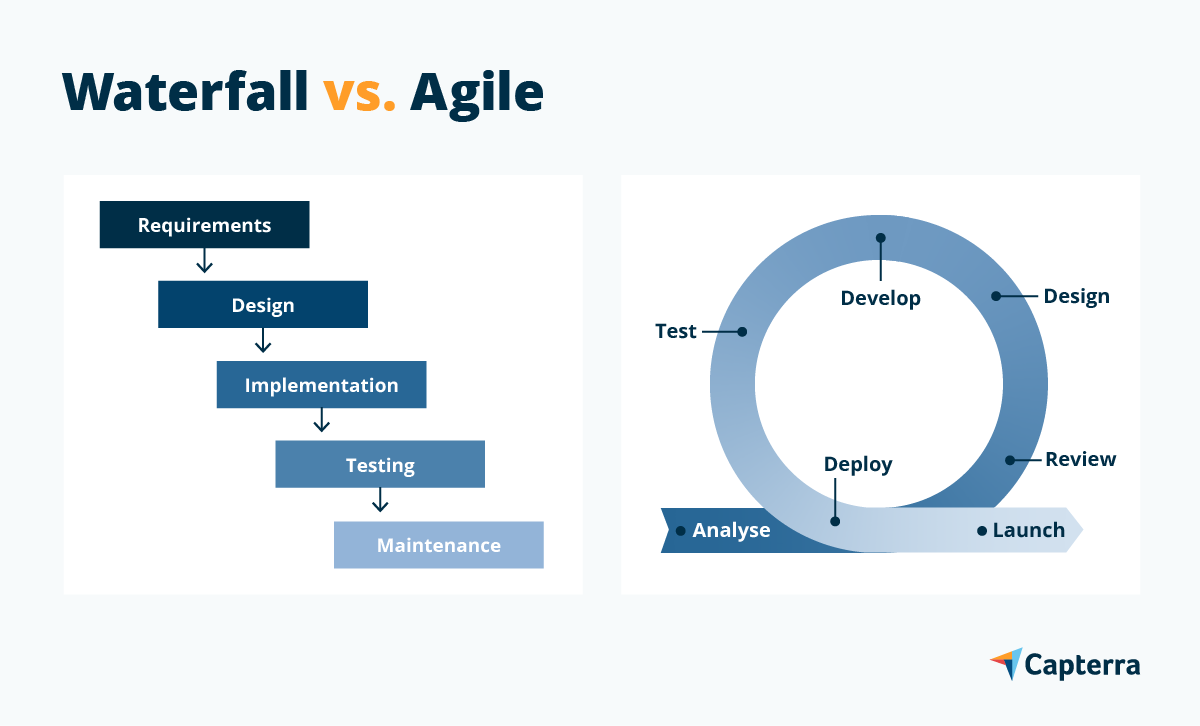
This image provides a glimpse of where we are headed. We've just analyzed the left side of this diagram. Our next step is to understand the principles behind the right side.
In the next lesson, "Describe the core values and principles of the Agile Manifesto," we will explore the foundational mindset that was created specifically to address the failures of Waterfall. We'll move from analyzing the problem to understanding the philosophy of the solution.