Hello! Welcome to your personalized IELTS preparation course. I'm your AI tutor, and I'll be guiding you through the key skills you need to achieve your goal of a band score of 4.0 or higher on the General Training test.
Given your background in applied mathematics and software engineering, you likely have a strong aptitude for understanding systems and rules. We will leverage this by breaking down the IELTS tasks into clear, logical components.
Introduction
This first lesson marks the beginning of our journey into IELTS Writing Task 1: The General Training Letter. Your ability to write an effective letter is crucial for your overall writing score.
Today's lesson focuses on a fundamental aspect of letter writing: tone. By the end of this 60-minute session, you will be able to identify the appropriate tone—whether formal, semi-formal, or informal—for any given Task 1 prompt and select the correct opening and closing phrases. Mastering this is essential, as using the wrong tone can significantly lower your score.
Let's begin.
1. Understanding Tone in Letter Writing
Just as you would use different language when speaking to a close friend versus a manager at work, your writing must also adapt to your audience. This adaptation is called tone or register. In the IELTS General Training letter, there are three main tones you need to master:
- Formal: Used when writing to someone you don't know, or to an institution (e.g., a company, a bank, a local council). The language is polite, professional, and impersonal.
- Semi-formal: Used when writing to someone you know by name but do not have a personal relationship with (e.g., your boss, your landlord, a colleague, a neighbour). The tone is respectful and polite but can be slightly more direct than a formal letter.
- Informal: Used when writing to a close friend or family member. The language is casual, friendly, and conversational.
To get a clear overview of these categories, please read the following short text.
Task 1 (General Training) letters - Formal, semi- ...
This article from Past Paper Hero provides clear definitions for each letter tone and explains how to determine which one to use based on the person you are writing to (the recipient).
Please read the sections titled 'Introduction' (including the Key Term boxes for each letter type) and 'Identifying Letter Tone'. Focus on the questions you should ask yourself to decide on the correct tone.
2. How to Identify the Correct Tone from the Prompt
The IELTS task prompt always contains clues that tell you who you are writing to and why. Analyzing these clues is the first step to choosing the correct tone.
To see how this works in practice, let's watch a short video segment.
Essential PHRASES for IELTS General Training Writing Task 1 | FORMAL vs INFORMAL Letters
This video from Fastrack IELTS demonstrates how to analyze two different IELTS prompts to determine whether a formal or informal tone is required.
Watch the section 'Identifying Formality from Task Details' from 01:21 to 02:29. Pay attention to how the recipient ('your friend' vs. 'an event management company') completely changes the required tone, even when the topic ('an event') is similar.
As you saw, the key is to ask: "Who am I writing to?"
- A friend or family member? -> Informal
- A manager, neighbour, or colleague? -> Semi-formal
- A company, an unknown person, or an official? -> Formal
3. Essential Opening and Closing Phrases
Once you have identified the tone, you must use the correct phrases to open and close your letter. Using an informal greeting in a formal letter is a major error.
This table provides a clear, structured summary of the key phrases for each tone. It's a useful reference you can return to throughout your preparation.
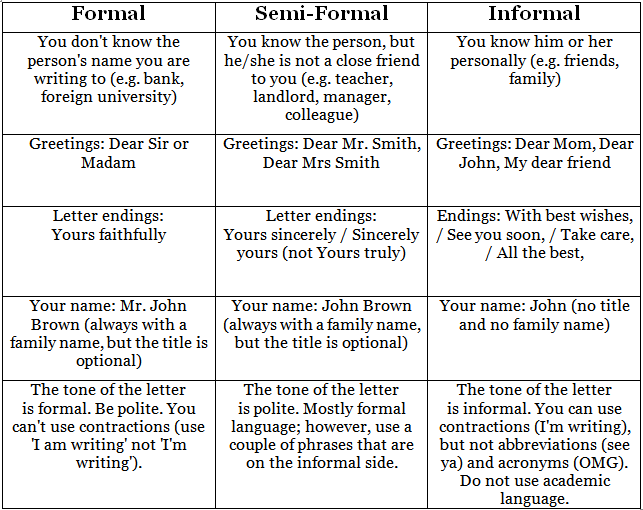
Now, let's explore a wider range of these phrases. The following video provides excellent examples of language for formal and informal letters.
Essential PHRASES for IELTS General Training Writing Task 1 | FORMAL vs INFORMAL Letters
This Fastrack IELTS video offers a bank of useful phrases. We will focus on the specific language for starting and ending your letters correctly.
Please watch the following segments: Informal Openings (03:17 - 04:36): Notice the friendly greeting and use of contractions (e.g., 'it's'). Formal Openings (04:36 - 05:57): Note the direct, polite phrases like 'I am writing to you in regard to...'. Informal & Formal Closings (07:34 - 08:28): Compare the casual closing remarks for a friend with the standard formal phrases. Sign-offs (08:28 - 09:31): Pay close attention to the rules for using 'Yours faithfully' vs. 'Yours sincerely'.
To consolidate this, here is a final reading that clearly matches the opening greeting (salutation) with the final sign-off.
IELTS Letter Writing Tips: Essential Top 10 Tips
This guide from IELTS Liz is a trusted resource. This section provides a clear, rule-based approach to matching your letter's beginning with its end.
Read section '5. Signing Off'. Focus on the five examples that show how the 'Dear...' part of the letter dictates the 'Yours...' or 'Best...' part at the end.
4. Practice Exercise
Let's apply what you've learned. For each of the following IELTS-style prompts, please:
- Identify the required tone (Formal, Semi-formal, or Informal).
- Write an appropriate opening (e.g.,
Dear [Name],). - Write an appropriate closing (e.g.,
Best regards,).
Prompt 1:
You have recently moved to a new city. Write a letter to your friend. In your letter:
- describe your new apartment
- explain what you like about the city
- invite your friend to come and visit
Your Answer:
- Tone:
- Opening:
- Closing:
Prompt 2:
You are a student at a language school and are not happy with your accommodation. Write a letter to the accommodation officer. In your letter:
- introduce yourself and state your problem
- describe the issues with your accommodation
- say what you would like them to do
Your Answer:
- Tone:
- Opening:
- Closing:
Prompt 3:
Your manager at work has asked you to do a training course. Write a letter to your manager. In your letter:
- thank them for the opportunity
- explain why you think the course will be useful
- ask for information about the dates and costs
Your Answer:
- Tone:
- Closing:
- Opening:
(You can take about 10-15 minutes for this exercise. Once you're ready, I will provide feedback on your answers.)
Conclusion
In this lesson, we established the critical importance of tone in IELTS Writing Task 1.
Key Takeaways:
- There are three main tones: Formal, Semi-formal, and Informal.
- The correct tone is determined by your relationship with the recipient (the person you are writing to).
- You must use appropriate and consistent opening and closing phrases that match the tone of your letter. For example:
- Formal:
Dear Sir or Madam,...Yours faithfully, - Semi-formal:
Dear Mr. Jones,...Yours sincerely, - Informal:
Hi Alex,...Best wishes,
- Formal:
Next Lesson Preview:
In our next session, we will move beyond openings and closings to focus on the overall structure of the letter. You will learn how to organize your ideas into clear paragraphs that address all parts of the task prompt, ensuring your letter is logical, coherent, and easy for the examiner to read.