Hello! Welcome to your fourth lesson in the "Essential Grammar Foundations" module.
Introduction
In our last lesson, you learned how to spot and correct common article errors, a crucial skill for improving your writing and speaking accuracy. We focused on the logic behind choosing 'a/an', 'the', or no article, which is a fundamental part of English grammar.
Today, we shift our focus to another vital grammatical structure: conditionals. This lesson will cover the first conditional. The learning outcome is to form and use the first conditional (if + present simple, will + infinitive) to talk about real future possibilities.
Mastering the first conditional is essential for the IELTS exam. You will use it to discuss future plans in the Speaking test, describe potential outcomes in Writing Task 2 essays, and understand situations presented in the Reading and Listening sections. For example, you might say, "If I get the required IELTS score, I will apply for my visa."
1. What is the First Conditional?
The first conditional is used to talk about things that are likely or possible to happen in the future. It describes a real possibility, where a specific future action or event will happen if a certain condition is met.
Let's start with a short, clear video that explains this core idea.
First Conditional – Grammar & Verb Tenses
This video from Ellii provides a concise definition of the first conditional and its basic structure.
Please watch from the beginning until 01:30. Pay attention to the definition and the two common sentence patterns.
As the video explained, the first conditional connects a condition with a probable result.
- Condition: If she studies hard...
- Result: ...she will pass the test.
2. The Structure of the First Conditional
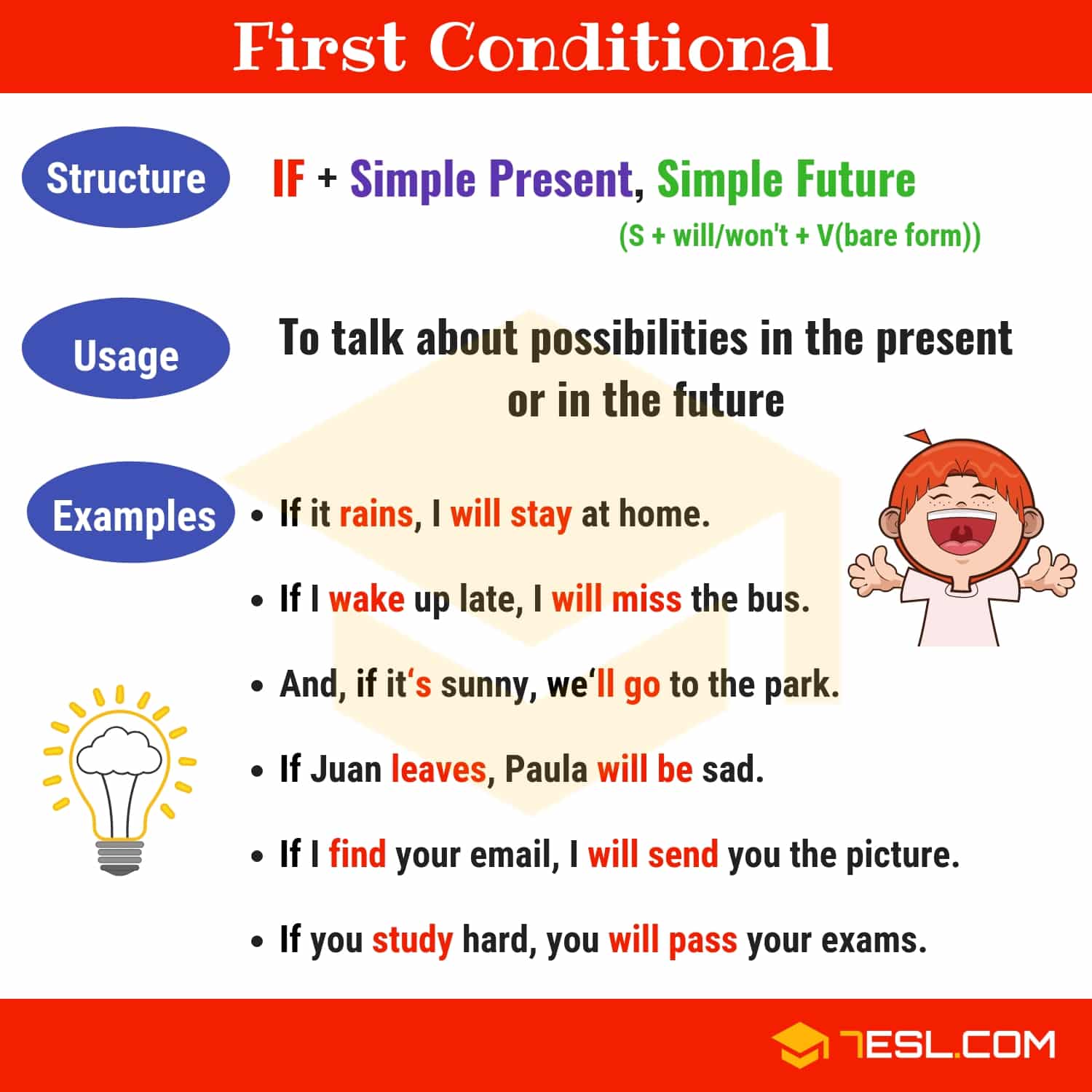
The structure is quite logical. It consists of two parts, or clauses: the 'if' clause (the condition) and the main clause (the result).
The Formula:
- 'If' clause:
If + subject + present simple verb - Main clause:
subject + will + base form of the verb
There are two ways to structure the sentence:
-
'If' clause first:
If it rains tomorrow, we will stay at home.- Notice the comma (,) after the 'if' clause.
-
Main clause first:
We will stay at home if it rains tomorrow.- When the main clause comes first, no comma is needed.
A Crucial Rule: A very common mistake is to use 'will' in the 'if' clause. Remember, the 'if' clause always uses the present simple tense, even though it refers to a future possibility.
- Incorrect: If I will finish work early, I will call you.
- Correct: If I finish work early, I will call you.
3. Expanding the First Conditional: Variations
While will is the most common verb in the main clause, you can use other modal verbs to express different shades of meaning. This will make your English sound more precise and natural.
Let's explore these variations in a short reading.
First Conditional: Examples, Sentences, Exercises
This article from Espresso English provides a clear breakdown of the first conditional, including important variations. It will help you move beyond the basic structure.
Please read the section titled 'Variations in first conditional sentences'. Focus on the tables that explain alternatives to 'if' (like 'unless') and alternatives to 'will' (like 'can', 'might', 'should').
Let's summarize the key variations from the article:
-
Using
canfor ability or permission:- If you pass the exam, you can apply for the advanced course.
-
Using
mayormightfor a less certain possibility:- If the traffic is bad, I might be a few minutes late.
-
Using
shouldfor advice:- If you want to get a good score, you should practice every day.
-
Using
unlessto mean 'if not':- You won't pass the exam unless you study. (This means: You won't pass the exam if you don't study.)
Using these variations will significantly improve the quality of your language in the IELTS test.
4. Practice Exercise
Now, let's put this into practice. Complete the following sentences by putting the verbs in brackets into the correct form for the first conditional.
- If you (send) ______ this letter now, she (receive) ______ it tomorrow.
- If I (do) ______ this test, I (improve) ______ my English.
- Simon (go) ______ to London next week if he (get) ______ a cheap flight.
- If her boyfriend (not/phone) ______ today, she (leave) ______ him.
- You (not/be able) ______ to sleep if you (watch) ______ this scary film.
- If it (rain) ______ tomorrow, I (not/have to) ______ water the plants.
Take a moment to write down your answers before checking the solutions below.
.
.
.
.
.
Answers:
- If you send this letter now, she will receive it tomorrow.
- If I do this test, I will improve my English.
- Simon will go to London next week if he gets a cheap flight.
- If her boyfriend does not phone (or doesn't phone) today, she will leave him.
- You will not be able (or won't be able) to sleep if you watch this scary film.
- If it rains tomorrow, I will not have to (or won't have to) water the plants.
How did you do? Notice the use of the simple present (sometimes with an '-s' for he/she/it) in the 'if' clause and 'will + verb' in the main clause.
Conclusion
Excellent work today! You have learned how to form and use the first conditional, a key structure for discussing real future possibilities.
Key Takeaways:
- The first conditional is for real and likely future situations.
- The structure is: If + Present Simple, ... will + base verb.
- Remember the comma rule: use a comma after the 'if' clause when it comes first.
- A critical point is to never use 'will' in the 'if' clause.
- You can use other modal verbs like can, may, might, should in the main clause to add nuance to your meaning.
Next Lesson Preview:
In our next lesson, we will continue with conditionals by exploring the second conditional. While the first conditional deals with real possibilities, the second conditional is used to talk about hypothetical or unreal situations in the present or future (e.g., "If I had a million dollars, I would travel the world."). Understanding the difference between these two is crucial for grammatical accuracy.