Welcome back. The previous lesson distinguished checks on TEFA purchases from audits and enforcement after a problem is found. This lesson asks a different accountability question: what must participating private schools demonstrate about student learning, what becomes public, and how much authority does the state retain over those schools? The useful comparison is not “accountability versus none,” but two different systems with different tests, reporting units, and legal limits.
The legal provisions below come from the 2025 enrolled text of Senate Bill 2. The public-school explanation uses a Texas Education Agency (TEA) parental-rights handbook. Because implementation and accountability releases can change, treat these as identified source versions rather than proof of what has been published for every subsequent school year.
Assessment: a requirement to test is not a common rating system
Texas public schools administer state-required assessments at specified grades and subjects, alongside other assessments used to identify learning needs. Parents receive their own child’s results. The TEA handbook is a useful starting point for the parent-facing part of that system; it does not, by itself, describe every measure in the state’s public accountability reports.
PARENTAL RIGHTS HANDBOOK | Texas Education Agency
Read the Texas Education Agency’s account of how public schools measure learning. Focus on which information goes to a parent, rather than assuming that an individual child’s score is published.
In “How Student Learning is Measured” (printed pp. 14–15), read the assessment overview. It runs from the introductory explanation through “Access to State Tests,” “Progress Reports After State Tests,” and the opening of “Early Reading and Math Assessments.” Note the distinction between state tests and other instruments.
TEFA sets a different condition for an approved private school. Under Senate Bill 2, it must demonstrate accreditation by a recognized organization, annual administration in grades 3–12 of a nationally norm-referenced assessment or the appropriate assessment required under Texas Education Code Chapter 39, and ordinarily at least two preceding school years of campus operation. A participating parent must agree to share, or authorize the assessment administrator to share, required results with the child’s certified educational assistance organization. The administrator must give the parent the child’s results, including a percentile rank if available.
Read the enrolled bill to separate the parent’s information-sharing obligation from the school’s approval conditions. Pay particular attention to what the assessment provision does—and does not—require a private school to administer.
In §29.357, around printed pp. 11–12, read the participation terms, ending with the confidentiality provision just before §29.358. Then, in §29.358(b)(2), around printed p. 13, read the private-school criteria, from accreditation through the campus-operation condition. Stop before the criteria for districts and other provider types.
This yields an important limit on comparisons. A TEFA private school need not administer the same test as a Texas public school: the statute allows a nationally norm-referenced assessment as an alternative to the specified state assessment. Even where two schools report scores, different tests, student populations, and reporting practices can make a simple score comparison misleading. Nor does the private-school test condition mean that every child using TEFA— including a child educated outside an approved private school—falls under that particular school-approval requirement.
Public reporting: schools and districts versus a program-wide report
Texas public-school accountability makes performance information available at the campus and district level, including state-reported academic measures and, where applicable, graduation-related measures and accountability ratings. Check the release for the particular school year before citing a rating: what has been calculated or publicly released can vary. Public reports are not a release of named children’s test results.
Senate Bill 2 instead requires the comptroller, working with TEA and certified educational assistance organizations, to produce an annual longitudinal report about TEFA. Its specified subjects include applications accepted and wait-listed, participant satisfaction, assessment results shared under the program, school capacity, and estimated state savings. It also specifies later-outcome measures and particular reporting about participating children with disabilities. The report must describe its data and methodology, cover a period of at least five years, be provided for posting on the program website, and undergo state-auditor review.
Read the enrolled bill’s reporting provision as a specification for a future public report—not as evidence that five years of TEFA outcomes already exist. Look for the difference between reporting on the program and issuing a comparable rating for each participating private school.
In §29.371, around printed pp. 35–36, read the required measures, from application counts through the disability-related outcomes. Continue in the same section with publication and review, covering confidentiality, the report’s time span and methodology, website posting, and state-auditor verification. Stop before §29.3715.
The distinction is the unit of accountability. A public campus report can help someone examine that campus’s state-reported performance. The TEFA provision creates a report on the program; it does not, simply by requiring test results and a longitudinal report, establish an identical campus-by-campus public rating system for participating private schools. Also, a legal requirement to report graduation or later outcomes is not an observed finding about those outcomes. A new program cannot supply a five-year history on its first day.
Privacy: information may be collected without becoming public
The comparison has a common boundary: accountability reporting is not permission to publish a child’s identifiable record. For federally funded public educational agencies, the Family Educational Rights and Privacy Act (FERPA) generally limits disclosure of education records while giving parents rights to inspect their child’s records, subject to the law’s rules and exceptions. The federal student-privacy infographic captures that basic distinction between protected records and limited permitted disclosures.
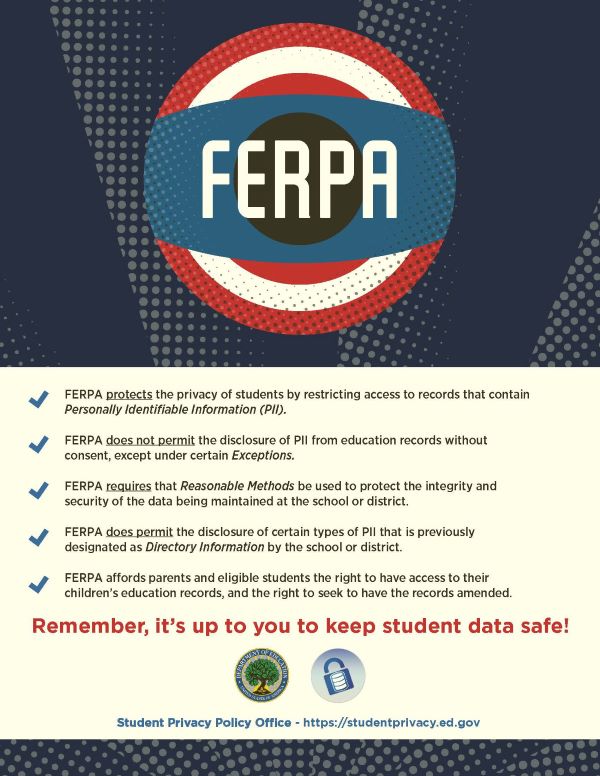
PARENTAL RIGHTS HANDBOOK | Texas Education Agency
Use the TEA handbook to establish the public-school privacy baseline, then note its separate statement about records used for an education savings account.
Under “Right to Privacy” (beginning at printed p. 36), read the FERPA explanation, from disclosure limits through parents’ record-access and notice rights. Later, under “Records for Education Savings Account Participation,” read the ESA records note. Stop before “Rights Regarding Data Collection.”
Senate Bill 2 supplies TEFA-specific protections. It makes the participating child’s assessment results and available percentile rank confidential and outside disclosure under the Texas Public Information Act. It also makes student records held by the comptroller or a certified educational assistance organization confidential. Organizations and providers obtaining a child’s information must comply with applicable confidentiality law; they may not sell that information or otherwise distribute it without participant consent as specified in the statute. A public school must, on the stated parental request, provide records it holds to the parent or, where applicable, the child’s private school.
Read the TEFA-specific rules for records moving from a public school and for information subsequently held by program organizations or providers. Distinguish an authorized transfer from public disclosure.
In §29.369, around printed pp. 33–34, read the records provisions. Begin with the parent-requested copy, continue through eligibility verification and limits on retaining information, and end with confidentiality of records held by the comptroller or a certified organization. Stop before §29.370.
Do not collapse these rules into “FERPA applies identically to every TEFA private school.” FERPA’s direct application depends on its own conditions; receiving TEFA payments alone does not establish that a private school receives federal education funding. Texas’s TEFA-specific confidentiality duties still matter, whether or not a particular provider is directly subject to FERPA. Equally, a confidential individual result is consistent with a lawful public report of program-level findings.
The boundary of state control
The state can condition TEFA participation on specified approval and assessment requirements, and it can oversee program transactions, as the previous lesson showed. But Senate Bill 2 also protects provider and participant autonomy. It bars program-related state or certified-organization actions that impose requirements contrary to specified religious or institutional values or restrict covered parties’ freedom to determine educational methods, curriculum, admissions and enrollment practices, and other listed matters. Receiving TEFA money alone does not make a provider a state actor or a recipient of federal financial assistance under the bill’s provision.
Read the autonomy provision to identify the precise limit on program-related control. Avoid turning it into either “the state controls the private school like a public campus” or “the school has no legal obligations.”
In §29.368, around printed p. 32, read the autonomy limits. Start with the rule about receiving program money and continue through the listed decisions about curriculum, admissions, and institutional practices. Stop before §29.369.
This provision does not erase the approval criteria you read earlier, nor does it exempt a school from every otherwise applicable law. It does mean that a proposal to hold TEFA private schools accountable in exactly the same way as public campuses needs a legal check: is the proposed requirement actually in the program, and is the state permitted to impose it? Admissions discretion is also relevant to access, a question the course will examine more directly later.
What to retain
TEFA has private-school assessment conditions, protected sharing of individual results, program-wide public reporting, and financial oversight. Texas public schools operate under a different structure of state assessments and publicly reported campus and district performance. Neither structure makes a child’s identifiable results public, and neither “tests are required” nor “a report is required” proves that outcomes are comparable—or already known. The state’s specified TEFA conditions coexist with statutory limits on directing participating private schools’ curriculum and admissions.
The next lesson examines another distinction that can disappear in broad accountability claims: why a larger disability-related TEFA award does not, by itself, give a child in a parentally chosen private school the same entitlement to special-education services as a child in public school.