Welcome. This first lesson establishes a vocabulary for the Texas school-choice debate. An education savings account can sound like a family’s own savings account, while a voucher can be used loosely to describe several different policies. Those labels obscure the most useful distinctions: who supplies the money, who decides how it is used, and who receives payment.
We will use Texas’s 2025 Senate Bill 2 to see how one education savings account program is structured, then compare it with tuition-only vouchers, tax-credit scholarships, privately funded 529 plans, and ordinary public-school funding. The aim is to recognize the arrangements in news reports—not to work through an application.
Start with the funding arrangement, not the label
The infographic below offers a quick visual map. It includes public charter schools alongside three school-choice funding arrangements. That is a useful contrast: a charter school is itself a public school, whereas a voucher or education savings account concerns funding for specified educational choices outside ordinary full-time public-school enrollment.
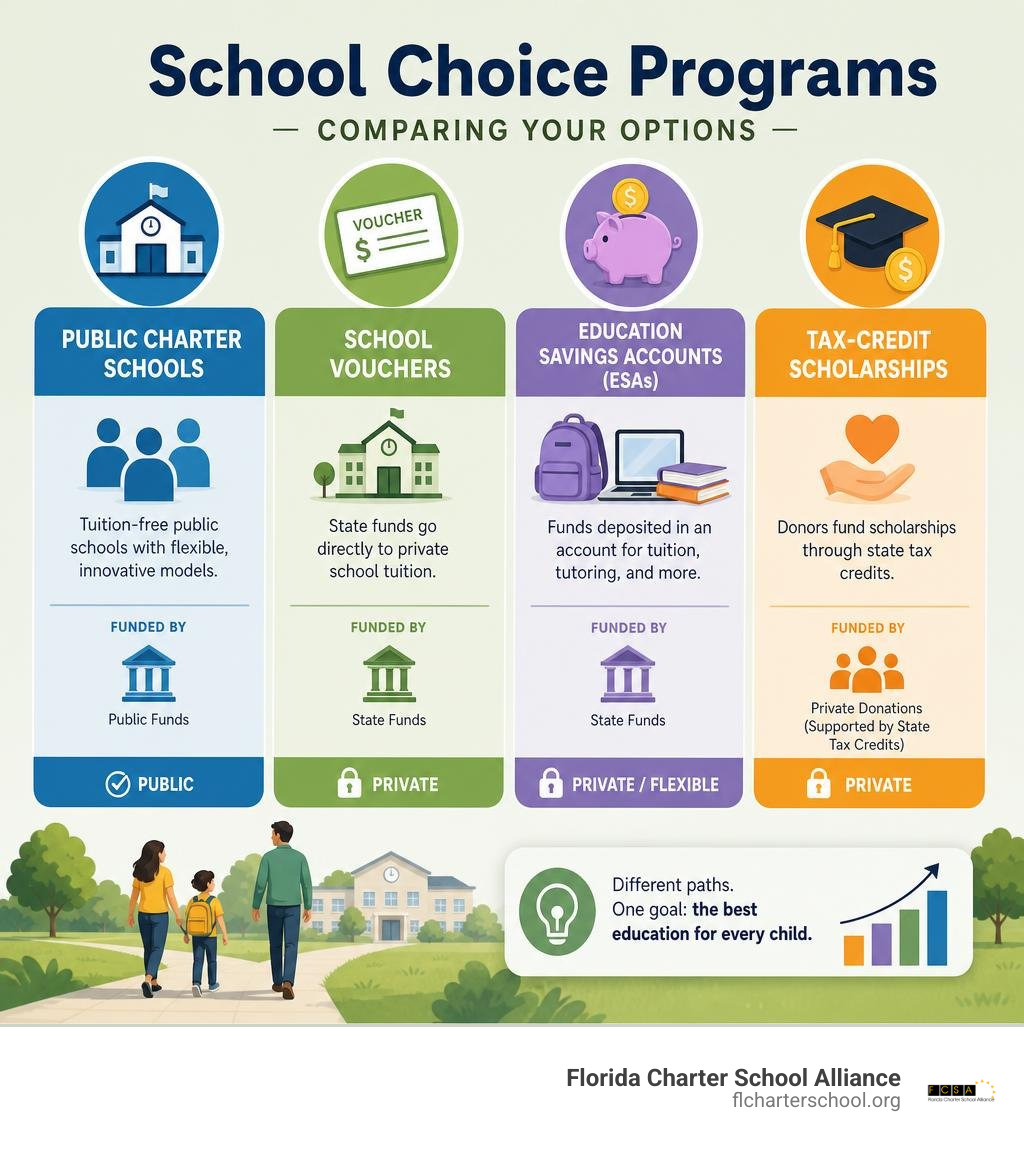
The graphic is a starting point, not a legal definition. Its “private/flexible” label for education savings accounts does not mean families receive unrestricted cash. Its depiction of vouchers describes a common tuition-payment model, not every program called a voucher. It also leaves out 529 plans, whose word account makes them particularly easy to confuse with education savings accounts.
A reliable way to classify any example is to check three separate decisions:
| Decision | What to look for |
|---|---|
| Funding | Is the money supplied through a government program, contributed by a private person, or raised as a donation supported by a tax credit? |
| Control | Does a family choose among approved expenses, does a scholarship organization award aid, or does a public school decide how to use its budget? |
| Payment | Does an approved provider receive program money, does a school receive tuition aid, or does a family spend from its own savings? |
The source of funds and the recipient are not the same thing. Public money can pay a private provider without becoming a private contribution. Conversely, a privately funded 529 plan can pay a qualifying school expense without becoming a government-funded education savings account.
Texas’s education savings account: choice within a public program
In the 2025 enrolled text of Senate Bill 2, Texas calls its arrangement an education savings account program. The statute assigns administration to the state comptroller and provides program funding for approved education-related expenses. A participating parent can choose among permitted expenses, but that choice operates inside statutory and administrative limits.
Read the relevant statutory passages with the three decisions—funding, control, and payment—in mind. This is the 2025 enrolled bill text; later lessons will show how to check it against rules and guidance applicable to a particular school year.
89(R) SB 2 - Enrolled version - Bill Text
Read the Texas Legislature’s enrolled Senate Bill 2 text to identify what the statute calls an account, who administers the program, and where its program fund sits.
In Section 2, Subchapter J, begin at Sec. 29.351, “DEFINITIONS.” Read the definitions of “Account” and “Certified educational assistance organization,” from the definitions. Then read Sec. 29.352, “ESTABLISHMENT OF PROGRAM,” from program establishment. Finally, find Sec. 29.353, “PROGRAM FUND,” and read its subsections (a)–(c), from the fund provisions. Focus on the distinction between a state-administered program fund and a participating child’s account.
The program fund is an account in the state’s general revenue fund, administered by the comptroller. It can contain general revenue, legislative appropriations, and other sources specified in the statute. That is different from saying every family deposits its own savings into the program. A child’s education savings account is a program account for that child’s benefit, not an ordinary personal bank account that a parent can empty.
The word savings describes the account format, not unrestricted ownership of the funds. Texas’s statute specifies both the types of expenses a parent may request and the payment procedure.
89(R) SB 2 - Enrolled version - Bill Text
Continue in Senate Bill 2 to see what makes this account more flexible than a tuition-only voucher—and why “flexible” still does not mean cash in hand.
In Section 2, Subchapter J, go to Sec. 29.359, “APPROVED EDUCATION-RELATED EXPENSES.” Read subsection (a), from approved expenses. Notice both the range of categories and the requirement concerning preapproved providers or vendors. Then read Sec. 29.360, “PROGRAM EXPENDITURES,” especially subsections (a)–(f), from payment rules. Track who submits a request, who verifies it, who receives payment, and who cannot receive cash or reimbursement.
The statutory list reaches beyond private-school tuition. It includes specified instructional materials, tutoring, assessments, certain educational therapies, and other listed expenses, subject to conditions. Under the payment provisions, the parent requests a payment; the certified educational assistance organization verifies an approved expense and pays the provider or vendor. The payment system may not let a participant withdraw cash or receive direct reimbursement.
That combination is the key to the Texas example: publicly supplied program money, family direction among approved uses, and controlled payment to providers. The existence of several expense categories distinguishes it from a tuition-only voucher. It does not establish that any desired purchase—or any desired provider—is approved.
What changes with a voucher, a scholarship, or a 529?
A tuition-only voucher is also a government-funded school-choice benefit. In the simple version used for comparison here, a family selects an eligible private school, and the benefit can be used for that school’s tuition. The family directs a school choice, but does not allocate an account balance among tutoring, materials, and therapies. Actual voucher programs differ in their payment mechanics and rules; tuition-only describes the narrower permitted use in this comparison.
A tax-credit scholarship starts with a different funding event. A donor contributes money to a scholarship-granting organization and receives a tax credit under the applicable program. The organization then awards aid under that program’s rules. The scholarship is funded by donations rather than a direct deposit of state program money into a child’s education savings account. The tax credit still matters to public finances because it reduces tax revenue that otherwise might have been collected. Calling the scholarship “privately donated” does not mean it has no public fiscal effect. What the scholarship can pay for depends on the particular program; its name alone does not make it either tuition-only or an ESA.
A 529 plan presents the opposite naming trap: it really is a savings arrangement, but not the government-funded school-choice benefit described in Senate Bill 2. A state or eligible institution establishes and maintains the qualified tuition program; contributors put money into an account for a beneficiary. An account owner generally directs use of those contributed funds, subject to plan terms and tax rules. Some elementary and secondary education expenses can qualify under federal tax rules, so “a 529 is only for college” is not a sound distinction. The decisive point here is who contributes the money, not whether a school expense appears on the allowable list.
Topic no. 313, Qualified tuition programs (QTPs) | Internal Revenue Service
Read the Internal Revenue Service’s explanation of 529 plans to separate a state-maintained savings plan from a state-funded education benefit.
In the opening explanation before the “Contributions” heading, read from the plan description. Focus on who may contribute and the fact that qualifying elementary and secondary expenses extend beyond tuition. Then find the “Contributions” subsection and read from the contribution rules. Expense limits and tax rules can change, so do not treat a figure on a later version of this page as an enduring feature of all 529 plans.
A state’s role in maintaining a 529 plan therefore does not mean the state supplies each family’s balance. Nor does a tax advantage turn a contributor’s deposit into a Texas education savings account award.
Public-school funding is another arrangement
In ordinary public-school funding, state and local revenues—and, for some purposes, federal funds—support a public school or district. The school or district uses its budget to operate the school and buy goods and services under applicable public rules. A family may choose to attend a public school, including an available public charter school, but it does not thereby gain control of a personal slice of the school’s budget to spend on outside providers.
That is why “both use taxpayer money” is not enough to identify a program. A district buying textbooks for its classrooms and a Texas ESA paying an approved vendor for one participating child may both involve public funds. The decision-maker and payment arrangement differ. Texas’s statute also lists a limited category of classes or services from a public school as potential approved ESA expenses; buying such a service is not the same as handing the parent control of that school’s general operating budget.
These short examples put the distinctions together:
- A family contributes its own money to an account in a state-maintained 529 plan and later uses it for a qualifying expense. Privately contributed 529 savings are being spent, subject to the plan and tax rules.
- A family receives a government tuition benefit usable at an eligible private school, with no account balance available for other categories. That is the tuition-only voucher model.
- A donor gives to a scholarship organization and claims an applicable state tax credit; the organization awards a student aid. That is a tax-credit scholarship, even though the credit has a public fiscal consequence.
- Under the Texas statute, a participating parent requests payment for an approved tutor from the child’s program account, and the administering organization pays the approved provider after verification. That illustrates an education savings account, not a cash withdrawal.
- A public school uses its operating budget to hire a tutor for its students. That is public-school spending, not a family-directed account payment.
The same tutor or school could appear in more than one example. Classify the funding and control arrangement, not just the educational service purchased.
Key takeaways
An education savings account is not defined merely by having the word account in its name. In Texas’s 2025 statutory design, public program funds support a child’s account, a parent requests spending from a list of approved educational uses, and an administering organization controls payment to providers. A tuition-only voucher has a narrower use; a tax-credit scholarship is awarded from tax-incentivized donations; a 529 plan draws on contributions to a savings arrangement; and ordinary public-school funds remain under public-school budget control.
This lesson used the 2025 enrolled Senate Bill 2 text to explain the program’s basic structure, not to certify that every provision is unchanged for every later school year. Next, you will learn how to verify a specific Texas Education Freedom Accounts claim against the dated statute, adopted rules, official guidance, and any applicable court orders.