Welcome back. In our last lesson, you practiced using downward inflection—the "power drop"—to land your sentences with conviction and finality. You've started to build the muscle memory for signaling certainty at the end of your thoughts.
Today, we're going to add color, life, and energy to the rest of the sentence. This lesson is about moving beyond a single inflection point to using your voice like a musical instrument. Our goal is to apply vocal variety (pitch, volume, and emphasis) to avoid monotone delivery and maintain listener engagement. A monotone voice can signal disinterest or a lack of confidence, causing listeners to disengage. By learning to vary your voice, you make your speech more dynamic, memorable, and persuasive, which is essential for building rapport in both social and professional settings.
We'll explore the core components of vocal variety, drawing on practical frameworks from communication coach Vinh Giang and grounding them in communication science.
1. What is Vocal Variety and Why Does it Matter?
Vocal variety is the art of modulating your voice to create interest and convey meaning beyond the words themselves. It's often broken down into three main components: pitch, volume, and pace (or emphasis).
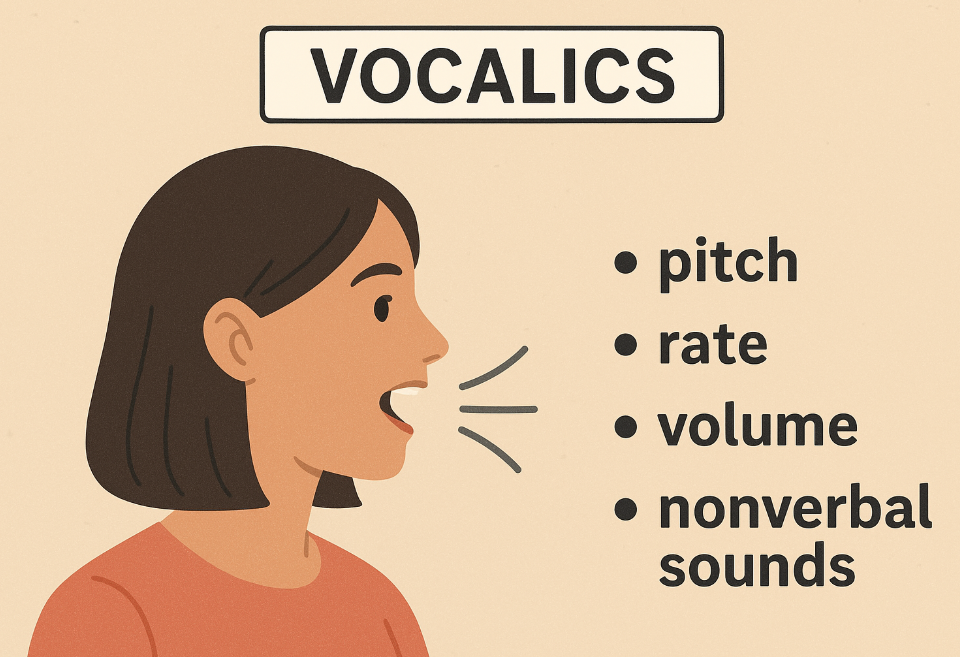
A flat, unchanging delivery—a monotone—is cognitively demanding for your listener. Their brain has to work harder to stay focused. Variety, on the other hand, acts as a guide, telling the listener what's important, what's a side note, and how they should feel about the information.
Vinh Giang offers a powerful analogy for this.
How To Give a Great Speech with Vinh Giang - Creating your Vocal Image
In this clip from 'How To Give a Great Speech,' Vinh Giang explains why melody is crucial for making your message memorable. He calls this one of the core vocal foundations.
Watch from 18:48 to 21:05. Pay close attention to his thought experiment comparing your ability to recall a page from a book versus a song. This perfectly illustrates the power of melody in communication.
The takeaway is clear: adding melody to your voice makes you more memorable and, therefore, more influential. This isn't just an intuitive idea; it's backed by research. The academic paper "Paralinguistic Features Communicated through Voice" confirms that listeners make a vast range of judgments about a speaker's competence, confidence, and credibility based on these vocal cues. When you vary your voice, you are actively managing these perceptions.
2. The Three Levers of Vocal Variety
Think of your voice as having three main control levers: Pitch, Volume, and Emphasis. Mastering these will allow you to "orchestrate" your speech rather than letting it fall flat.
Lever 1: Pitch (Melody)
Pitch is the highness or lowness of your voice. As you just saw in Vinh Giang's video, varying your pitch creates the "melody" that makes speech engaging. A wider pitch range generally conveys more energy and expressiveness.
How to practice: A great way to expand your pitch range is the "siren" technique.
How to Trick Your Brain Into Speaking Better INSTANTLY!
Let's watch a short clip from Vinh Giang's video 'How to Trick Your Brain Into Speaking Better INSTANTLY!' for a practical vocal warm-up.
Watch from 04:55 to 05:25. Focus on his demonstration of the 'siren technique.' Try it along with him. The goal is to glide your voice smoothly from its lowest note to its highest and back down, exploring the full range of your instrument.
Lever 2: Volume (Power)
Volume is the loudness or quietness of your voice. It's the "lifeblood" of your voice and a primary indicator of conviction. Speaking too quietly can signal a lack of belief in what you're saying.
How To Give a Great Speech with Vinh Giang - Creating your Vocal Image
Next, let's hear Vinh Giang explain the importance of volume.
Watch from 16:39 to 18:00. Notice his description of volume as showing confidence, authority, and belief. He demonstrates how, without adequate volume, the words 'I believe it' lose all their power.
Varying your volume is also a powerful tool for emphasis. Lowering your volume can draw a listener in for an important point, creating intimacy and suspense. Increasing it can signal excitement or urgency.
Lever 3: Emphasis (Focus)
Emphasis is about making certain words stand out to convey a specific meaning. You achieve this by subtly changing the pitch, volume, and duration of a word. Changing the emphasized word can change the entire meaning of a sentence.
The Toastmasters guide, "YOUR SPEAKING VOICE," gives a perfect example of this.
To understand emphasis, let's look at a practical guide from Toastmasters.
Find the section titled 'Do You Agitate or Orchestrate?' and read the example sentences starting with 'I was born in Australia.' Notice how emphasizing a different word in each sentence completely changes the implied meaning.
Here's the breakdown from the guide:
- I was born in Australia. (Implying: You were born somewhere else.)
- I was born in Australia. (Implying: How dare you suggest I wasn't?)
- I was born in Australia. (Implying: I'm a native, not a newcomer.)
- I was born in Australia. (Implying: Not outside of it.)
- I was born in Australia. (Implying: Not in New Zealand.)
This shows that emphasis isn't random; it's how you direct the listener's focus to the most critical part of your message.
Test your understanding!
Imagine you are at a networking event discussing market trends. You want to convey that while many factors are important, the central bank's policy is the single most critical one to watch right now. How would you use vocal variety to deliver this sentence for maximum impact?
"While inflation and supply chains are significant, the central bank's policy is what really matters."
Show answer
Here’s one effective way to apply vocal variety:
- "While inflation and supply chains are significant...": Say this at a moderate pace and volume, with a neutral pitch. You are acknowledging these points but not highlighting them.
- "...the central bank's policy...": Slow down your pace slightly, and increase your pitch and volume on the word "policy". This combination creates emphasis, flagging it as the key phrase.
- "...is what really matters.": After a brief pause, deliver this phrase with a lower pitch and a firm downward inflection on "matters," using the technique from our last lesson to signal a confident conclusion.
The combination of slowing down, raising pitch/volume for emphasis, and then landing the conclusion with a power drop makes your point clear, confident, and engaging.
3. Your Daily Drills for Vocal Variety
Theory is useful, but vocal variety is a physical skill that requires practice. Here are two drills to incorporate into your routine.
Drill 1: Reading Aloud with "Sliding Bars"
This drill trains you to become comfortable with moving your voice around deliberately.
How to Trick Your Brain Into Speaking Better INSTANTLY!
In this final clip from Vinh Giang, he shares a simple but highly effective way to practice vocal variety.
Watch from 05:50 to 06:40. Internalize his idea of treating volume, pitch, and rate of speech as 'sliding bars' that you can adjust as you read.
Your Action (5-10 minutes daily):
- Open a financial news website (like Bloomberg, The Wall Street Journal, or The Economic Times) and find an article.
- Read a few paragraphs aloud.
- As you read, consciously play with the "sliding bars."
- Read one sentence in a lower pitch, and the next in a higher one.
- Start a sentence loud and end it quietly.
- Emphasize a different keyword in each sentence.
- Record yourself. The goal isn't to sound perfect, but to get used to the feeling of an agile, flexible voice.
Drill 2: Masterpiece Interpretation
Legendary speeches are legendary in part because of their masterful use of vocal variety. Practicing with them is like a musician playing a classical masterpiece.
The Toastmasters guide includes an excerpt from Dr. Martin Luther King Jr.'s 'I Have A Dream' speech, which is a masterclass in vocal variety, especially volume.
Find the section '4. Loudness or Volume Variety' and locate the excerpt from the 'I Have A Dream' speech. Read it aloud, and as the instructions suggest, interpret which words should be spoken loudly and which ones softly. Try it multiple times with different interpretations.
Your Action (5 minutes daily):
Read the provided excerpt. On your first pass, try building your volume on each "I have a dream." On the second pass, try starting loud and then dropping to an intense whisper on key phrases like "content of their character." This will help you feel the emotional impact of volume changes.
4. Mindset: From "Fake" to "Full-Range"
As you practice, you might feel that you sound unnatural or "fake." This is a common and normal feeling when learning any new skill. You are consciously performing actions that you hope will one day become unconscious and automatic.
You've spent years using a limited part of your vocal instrument. Expanding that range will feel unfamiliar at first, but "unfamiliar" is not the same as "inauthentic."
How To Give a Great Speech with Vinh Giang - Creating your Vocal Image
To close, let's address this feeling head-on. Vinh Giang has a brilliant reframe for this, using the analogy of a piano.
Watch from 46:10 to 47:30. Listen to his argument about the difference between being 'fake' and being 'unfamiliar.'

Your voice has 88 keys. The most inauthentic thing you can do is to only play the 12 you're used to. By practicing vocal variety, you are learning to access your entire instrument, allowing you to express your thoughts and feelings with more nuance, precision, and authenticity.
Conclusion
Today, you've learned that vocal variety is not an abstract talent but a concrete skill built on three levers: pitch, volume, and emphasis. A monotone delivery bores your listener, while a varied, musical delivery engages them, signals confidence, and makes your message more memorable.
Key Takeaways:
- Vocal variety is the strategic use of pitch, volume, and emphasis to avoid monotony and maintain listener engagement.
- Pitch creates melody, making your speech more memorable.
- Volume projects power, confidence, and belief.
- Emphasis directs your listener's focus to what's most important.
- Mastery comes from daily drills like reading aloud with "sliding bars" and interpreting powerful speeches.
- Feeling "fake" is part of the process. Reframe it as moving from the "unfamiliar" to the "familiar" as you learn to use all 88 keys of your vocal instrument.
Preview of the Next Lesson:
In this lesson, we explored how to vary your volume to create engagement. In the next lesson, we'll get more specific. We will learn how to adjust your overall vocal volume to match the context, from intimate one-on-one conversations to small group discussions at a networking event. This is about calibrating your delivery to your environment to build comfort and rapport.