Hello! Welcome back.
In our last lesson, we focused on transforming nervous energy into purposeful hand gestures, giving you more control over your own nonverbal signals. This was about managing your internal state and how you project it. Today, we shift our focus outward to the person you're speaking with.
This lesson addresses the learning outcome: Apply subtle mirroring of posture and gestures to build subconscious rapport.
Mirroring is one of the most powerful, yet subtle, techniques for creating a feeling of connection. It's the art of nonverbally communicating, "I'm with you" or "We're in sync." For your goal of moving beyond surface-level conversations, mastering this skill is crucial. It helps bridge the gap between two separate individuals and creates a shared conversational space where people feel comfortable and willing to open up.
1. What is Mirroring and Why Does It Work?
Mirroring is the subconscious—or in our case, conscious—and subtle mimicking of another person's behavior. This isn't about becoming a copycat. It's a sign of engagement and respect. When done correctly, the other person won't even notice it consciously, but they will feel more connected to you.
The psychological basis for this is rooted in our innate desire for belonging and validation. When someone subtly reflects our posture, tone, or gestures, it signals that they are aligned with us. Our brain interprets this as safety and familiarity, which builds trust. This process is partly driven by what are known as "mirror neurons"—brain cells that fire both when we perform an action and when we see someone else perform that same action.
To begin, let's watch a video where communication expert Vanessa Van Edwards breaks down the concept.
Body Language Expert: How To Overcome Awkwardness | Vanessa Van Edwards | EP 565
Vanessa Van Edwards, a practitioner you're interested in, provides a comprehensive overview of mirroring. She explains it as a form of nonverbal respect and breaks it down into three channels.
Please watch from 00:31:19 to 00:35:12. Focus on her definition of mirroring and the three ways it can be applied: non-verbally, vocally, and verbally.
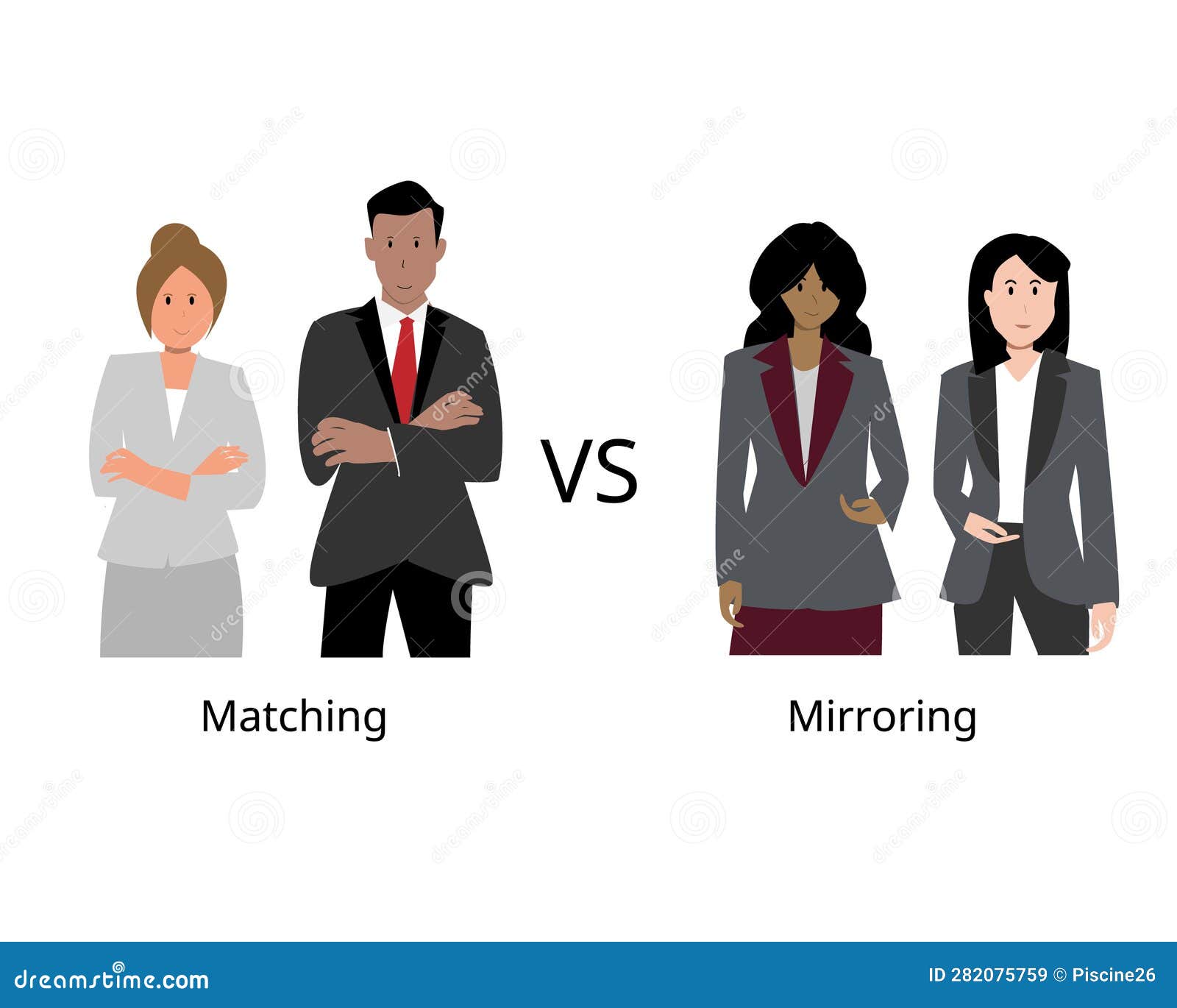
Matching vs. Mirroring
It's helpful to distinguish between matching and mirroring.
- Matching is doing the exact same thing (e.g., they cross their left arm over their right, and you do the same).
- Mirroring is creating a reflection (e.g., they lean on their right elbow, and you, facing them, lean on your left elbow).
Mirroring often feels more natural and is less likely to be detected than direct matching.
2. The Three Channels of Mirroring
As Vanessa Van Edwards explained, you can mirror across three distinct channels. Breaking it down this way turns it into a set of micro-skills you can practice individually.
a) Physical Mirroring (Body Language)
This is the most common form of mirroring. It involves subtly reflecting another person's posture, gestures, and head movements.
- Posture: If they are leaning forward with interest, you can lean forward slightly as well. If they have a relaxed, open posture, you can adopt a similar one.
- Gestures: If they gesture with their hands to explain something, you can use a similar (but not identical) gesture when you respond.
- Head Tilts: A simple head tilt shows you're listening. If they tilt their head while listening to you, you can mirror this when it's your turn to listen.
b) Vocal Mirroring
This is an incredibly powerful and often underestimated technique. It involves aligning your vocal characteristics with the other person's.
- Pace: As Van Edwards noted, if someone is a slow, deliberate talker, speeding through your sentences can feel jarring. Slowing your pace to better match theirs shows respect for their communication style.
- Volume: In a quiet, intimate conversation, speaking loudly can break the connection. Conversely, speaking too softly in a loud environment will make you seem unconfident. Match their volume to the context.
- Tone: If someone is speaking with excitement and energy, a flat, monotone response can feel like a dismissal. Match their emotional energy (within authentic bounds).
Vinh Giang, another coach you've mentioned, explains this beautifully.
How to Build INSTANT Rapport With Strangers!
Vinh Giang provides a practical example of how matching vocal foundations (like pace and volume) can make someone feel instantly more comfortable.
Watch from 01:26 to 02:30. Notice how he contrasts a jarring, high-energy response with a more attuned, rapport-building one by matching the energy of a shy student.
c) Verbal Mirroring
This is a more advanced technique that involves using some of the other person's specific words or phrases. When you repeat their key words, it proves you were listening intently and value their way of framing things.
For example, at one of your financial markets mixers, you might be talking to a portfolio manager who says:
"Right now, the biggest challenge is navigating the macro headwinds."
When you respond, instead of saying, "Yes, the economic situation is difficult," you could use verbal mirroring:
"That's interesting. When you talk about those macro headwinds, are you more concerned about inflation or supply chain issues?"
Using their specific terminology creates an instant sense of shared understanding.
3. The Golden Rules: Subtlety and Authenticity
Mirroring is a delicate tool. If it's detected, it backfires and makes you seem manipulative or strange. Here are the two most important rules to follow.
- Be Subtle. Do not mimic everything. Pick one or two things to mirror. A great way to ensure subtlety is to introduce a delay. If they cross their arms, wait a few seconds before you adopt a similar posture. Don't be a "Simon Says" player.
- Be Authentic. Never adopt a posture or tone that feels fake or uncomfortable for you. If someone is being aggressive and jabbing their finger, mirroring that would be a terrible idea. Mirroring should only be used to align with positive or neutral cues. The goal is to be a more dynamic communicator, not to be an inauthentic one.
The Power of Mirroring: Using Nonverbal Cues to Build Trust
This article, 'The Power of Mirroring,' reinforces these rules and provides strategies for skill development.
Please read the sections titled 'Common Mistakes to Avoid with Mirroring' and 'Strategies for Developing Effective Mirroring Skills.' Focus on the warnings against 'Overdoing the Technique' and the advice on training your observation skills.
4. A Practical Framework: Match, Mirror, Lead
Vinh Giang offers a simple yet powerful framework that takes mirroring a step further.
How to Build INSTANT Rapport With Strangers!
Let's return to Vinh Giang's video to understand his full 'MML' framework.
Watch from 02:57 to 04:24. He explains how once you've built rapport by matching and mirroring, you can then gently 'lead' the interaction.
The Match, Mirror, Lead (MML) framework works like this:
- Match/Mirror: You first attune yourself to the other person by matching their energy and mirroring their cues (vocal, physical). This builds rapport and trust.
- Lead: Once you feel that connection has been established, you can gently guide the conversation's energy. For instance, if you've been mirroring someone's low energy, you might offer a slightly bigger smile or a more enthusiastic tone. If they follow your lead and their energy lifts, you've successfully deepened the engagement. This is how you can help steer a conversation from pleasantries to a more dynamic exchange.
Test your understanding!
You're at a networking event talking to an executive from a private equity firm. She is speaking in a very direct, no-nonsense tone and has a confident, upright posture.
- Match/Mirror: What specific vocal and physical cues would you try to mirror to build initial rapport?
- Verbal Mirroring: She says her firm is focused on "identifying undervalued assets with strong fundamentals." How could you use verbal mirroring in your follow-up question?
- Lead: After establishing a good connection, you want to see if the conversation can become a bit more relational and less transactional. What's a subtle 'lead' you could attempt?
Show answer
- Match/Mirror: You would adopt a similarly upright posture (not slouching). Vocally, you would make your own speech clear and direct, avoiding filler words and getting to the point, matching her pace and directness.
- Verbal Mirroring: You could ask, "When your team is looking for strong fundamentals in these undervalued assets, what are the top three metrics you prioritize?" This shows you've listened carefully to her exact phrasing.
- Lead: You could shift the topic slightly by adding a more personal element. For example, after she answers your question, you could offer a genuine smile and ask, "Aside from the analytics, what's the most rewarding part of finding one of those hidden gems?" The shift in topic and the warmer nonverbals (the smile) are an invitation to a more personal level of conversation. You would then watch to see if she follows your lead.
5. Daily Drills: Building Your Mirroring Muscle
This skill requires practice. You need to train your observation first, then your execution.
-
Drill 1: Observational Practice (10 minutes)
- When you're at a cafe, in a meeting, or even watching a talk show on TV, focus on a pair of people interacting.
- Your only goal is to observe. Notice their postures. Are they similar? Does one person shift and the other follow? Who is leading and who is following? Pay attention to head nods, gestures, and energy levels. This trains your brain to see the nonverbal dance of conversation.
-
Drill 2: The One-Cue Mirror (Daily Practice)
- In your next low-stakes conversation (e.g., buying coffee, a brief chat with a classmate), choose just one cue to mirror.
- For example: If the other person smiles, you return the smile. If they use a specific hand gesture, you use a similar one a bit later in the conversation. If they nod while listening, you do the same.
- Starting with just one cue makes the practice manageable and keeps it subtle.
-
Drill 3: The Vocal Shadow (5 minutes)
- Listen to a short audio clip of someone speaking (a podcast, an audiobook).
- Try to repeat what they are saying out loud just a split-second behind them.
- Focus on matching their pace, rhythm, and intonation exactly. This drill builds vocal flexibility, making it easier for you to adapt your voice to match others in real conversations.
Conclusion
Mirroring is a powerful expression of empathy. It communicates on a deep, subconscious level that you are attentive, respectful, and aligned with the person you are talking to. This is fundamental to building the kind of rapport that makes conversations feel natural and engaging.
Key Takeaways:
- Mirroring Builds Rapport: It's the subtle reflection of another's nonverbal, vocal, and verbal cues to create a subconscious sense of connection.
- Three Channels: You can mirror physically (posture, gestures), vocally (pace, volume), and verbally (key words).
- Subtlety and Authenticity are Crucial: Avoid obvious imitation and never adopt a cue that feels inauthentic. Introduce a delay to ensure subtlety.
- Use the MML Framework: First Match/Mirror to build trust, then gently Lead the interaction's energy to deepen engagement.
Preview of the Next Lesson:
Now that you can synchronize with another person's body language, we will explore the space between you. In our next lesson, we will focus on how to align body orientation and proximity to signal interest without intrusion, adding another critical layer to your nonverbal communication toolkit.