Hello! In our last lesson, we focused on "mirroring"—repeating the last few words of a sentence to encourage someone to elaborate. It's a fantastic micro-skill for getting more information when you don't have much to work with.
Today, we move from reflecting a small fragment to demonstrating that you've understood the entire picture. This is a critical step in building the genuine connections you're aiming for, as it proves you are not just hearing words, but truly listening. Our goal is to paraphrase and summarize key points to demonstrate comprehension and build trust.
This lesson will equip you with two distinct but related skills. Paraphrasing acts as a real-time checkpoint to ensure you're on the right track, while summarizing is the "final report" that tells the other person they have been thoroughly heard and understood.
1. The Core Idea: Paraphrase vs. Summary
Before we dive in, let's establish the difference between these two powerful tools. They are both essential active listening techniques, but they serve different functions.
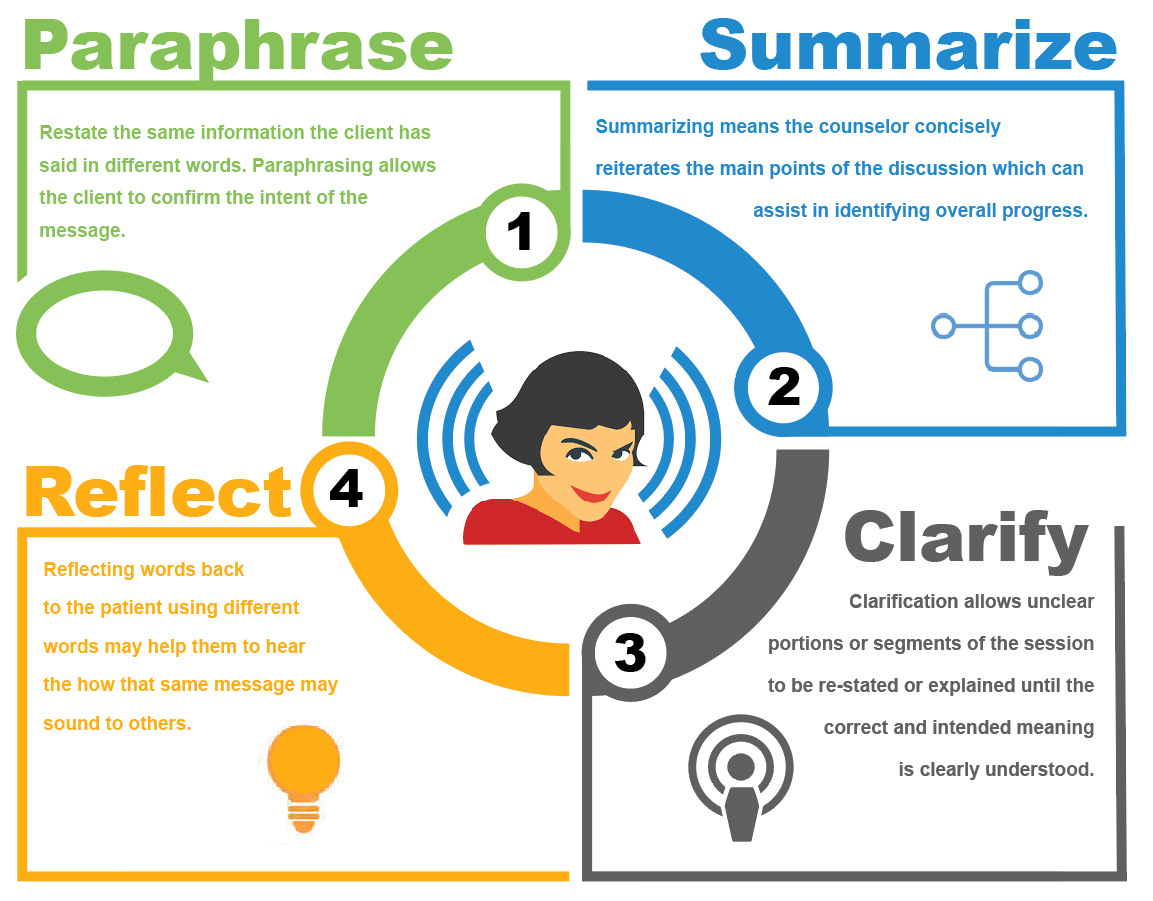
- Paraphrasing is restating a specific thought or idea someone just shared, but in your own words. It’s like holding up a mirror to a single point to say, "Is this what you mean?" It's tactical and used frequently throughout a conversation.
- Summarizing is pulling together several key ideas, emotions, and themes from a longer stretch of conversation—or even the entire interaction. It’s like presenting the executive summary of the conversation to say, "Here is the big picture I've understood from our discussion." It's strategic and used less frequently, often at topic transitions or at the end.
Let's get a more formal definition to solidify this distinction.
Therapeutic Encouraging, Paraphrasing, Summarizing, Active Listening and Cognition
This video, from a counseling skills context, offers a clear academic distinction between paraphrasing and summarizing.
Please watch these two clips: Paraphrasing (09:44 - 10:25): Notice how it's defined as distilling the essence of what was said in the last several sentences. Summarizing (13:15 - 14:24): Pay attention to how this covers a longer period of conversation, organizing the discussion and often including emotions.
With that foundation, let's break down how to use each skill effectively.
2. The Art of Paraphrasing: Proving You Understand
Paraphrasing is more than just avoiding repetition; it's an act of empathy. When you correctly paraphrase, you send a powerful signal: "Your perspective matters, and I'm working to understand it fully." This is fundamental to building rapport and preventing the misunderstandings that can cause conversations to fizzle out.
To learn how to do this well, we can look at a few practical techniques.
Paraphrasing Skills: Your Guide to Effective Communication
The article 'Paraphrasing Skills: Your Guide to Effective Communication' from Pathwise.io provides an excellent framework. It breaks down paraphrasing into three concrete methods.
Read the section titled 'The Three Core Paraphrasing Techniques.' Focus on understanding the difference between: Synonym Swap: The most basic form. Structural Reorganization: Changing the sentence structure. Conceptual Translation: The most sophisticated form, where you explain the idea in a new way.
Let's see what this looks like in a real conversation.
Attending,Paraphrasing and Summarizing
This video role-play provides excellent examples of paraphrasing in a natural, conversational flow.
Watch these two short clips: Clip 1 (00:36 - 00:54): The speaker says she has to manage school, learning English, and translating for her parents. The listener paraphrases: "It sounds like you have a lot of responsibilities, and not just for yourself but for your parents as well." This is a great example of Conceptual Translation. Clip 2 (03:03 - 03:22): The speaker describes a conflict between her parents' traditions and her new life. The listener paraphrases: "The picture I'm getting is your parents are really trying to keep your traditions alive, and you'd actually like the opportunity to learn more about Canadian ways of life." This is another strong example of Structural Reorganization and Conceptual Translation.
Notice the listener often starts with a softening phrase like "It sounds like..." or "The picture I'm getting is...". These stems signal that you are offering your interpretation, inviting correction if needed.
Test your understanding!
Imagine you're at a networking event and someone from a venture capital firm tells you:
"We're seeing a lot of hype in the AI space right now, and while we're definitely investing, we're being extremely cautious to separate the genuinely disruptive technologies from the solutions that are just wrapping a basic algorithm in a fancy UI."
How would you paraphrase this statement to show you understand their point? Try creating one paraphrase using Structural Reorganization and another using Conceptual Translation.
Show answer
Here are a few possible answers:
-
Structural Reorganization: "So while you're actively investing in AI, you're also making a clear distinction between companies with truly foundational tech and those that are more surface-level." (This changes the sentence structure but keeps the key concepts).
-
Conceptual Translation: "It sounds like your core strategy is to look past the marketing noise and find the companies with a real technological moat, not just a good-looking product." (This uses different concepts like "marketing noise" and "technological moat" to express the same core idea, showing a deeper level of business understanding).
Both demonstrate you've grasped the nuance of their statement far better than a simple "uh-huh" or nod.
3. The Power of the Summary: Getting to "That's Right!"
While paraphrasing handles the moment-to-moment understanding, the summary is your tool for consolidating the entire conversation. This is where you connect the dots between different points the person has made, showing you haven't just heard their words, but you've understood their world.
Building on what we've learned from Chris Voss, his organization, The Black Swan Group, treats the summary as a strategic tool designed to elicit one specific response: "That's right!"
Summary™ and Paraphrase: What, How, When
This article from The Black Swan Group explains the strategic purpose of a 'Summary™'. It's not just about recapping; it's about articulating their perspective so perfectly that they feel a wave of recognition and trust.
Read the first few paragraphs of the article, down to the end of the paragraph that mentions 'Tactical Empathy®'. Pay close attention to the purpose of a Summary™: to let your counterpart know you understand their perspective and concerns, and to get them to say 'that's right!'
A good summary weaves together facts, feelings, and motivations that have been discussed. Let's see a textbook example.
Attending,Paraphrasing and Summarizing
Let's return to the role-play video. After several back-and-forths, the listener provides a perfect summary that ties everything together.
Watch from 01:49 to 02:26. The listener says, "Just so I make sure I'm following..." and then recaps the speaker's entire situation: arriving in Canada, learning English, interpreting for parents, unfulfilled hopes, and academic struggles. She finishes by asking, "Is that correct?" which is the 'checkout' for accuracy.
In your world of financial markets and networking, a well-placed summary can be incredibly effective. After listening for a while, you could say:
"Okay, just so I'm tracking with you: it sounds like the big picture is that while the macro-economic indicators are pointing towards a slowdown, you believe there are still undervalued opportunities in the mid-cap logistics sector, specifically because you feel the market hasn't fully priced in the efficiency gains from their recent tech adoption. Is that a fair summary?"
A summary like this demonstrates high-level comprehension and respect for their viewpoint, making them far more likely to see you as a peer and continue the connection.
4. Daily Drills
To make these skills second nature, you need to practice them consciously until they become automatic.
-
The Post-Meeting Summary (5 minutes): After your next class lecture or a meeting, take five minutes to write a one-paragraph summary of the key arguments or decisions. This trains your brain to distill and synthesize information.
-
The Conversational Paraphrase (1-2 times a day): In a low-stakes conversation (with a friend, classmate, or at a coffee shop), make it a goal to use one good paraphrase. Start with a stem like "So, if I'm hearing you correctly..." or "It sounds like you're feeling...". Just do it once and observe the effect.
-
The "That's Right!" Hunt (Weekly Goal): In a deeper conversation with someone you trust, try to construct a summary of their perspective on a topic. Your goal is not just to be accurate, but to be so insightful that their genuine response is "Exactly!" or "That's right!". This is the ultimate test of a good summary.
Conclusion
You've now added two of the most powerful active listening skills to your toolkit. They build directly on the foundation of mirroring and labeling, allowing you to move from simply gathering information to truly demonstrating understanding.
Key Takeaways:
- Paraphrasing is restating a specific point in your own words to confirm understanding in real-time. Use it often.
- Summarizing is condensing the big picture—facts, themes, and feelings—to show you've grasped the totality of their perspective. Use it at key moments.
- The goal of a paraphrase is clarity and immediate rapport. The goal of a strategic summary is to earn a "That's right!"—the ultimate sign of trust and connection.
- Start your paraphrases and summaries with stems like "It sounds like...", "So what you're saying is...", or "Let me see if I've got the big picture..." to invite collaboration.
Preview of the Next Lesson:
We've now covered several active tools: labeling, mirroring, paraphrasing, and summarizing. But what about the moments in between? Often, the most powerful way to encourage someone to share more is to do nothing at all. In our next lesson, we will focus on how to practice comfortable silence to give others space to think and continue speaking.