Welcome to the final lesson of your course. I want to acknowledge the significant effort and commitment you've shown over the past twelve weeks. You have systematically built a comprehensive toolkit for communication, moving from diagnosis and grounding techniques to the nuances of delivery, conversation flow, and application in real-world scenarios.
In our last lesson, you designed a personal practice routine—the engine for your continued growth. You now have a structured way to turn knowledge into instinct through daily, weekly, and monthly habits.
Today, we complete the system. An engine needs a navigation system to be effective. This lesson provides that navigation by focusing on your final learning outcome: to create a long-term strategy for seeking feedback and continuing to grow your social confidence. We will establish a sustainable feedback loop that will guide your practice, uncover your blind spots, and ensure your growth continues long after this course is complete.
1. Why Self-Awareness Isn't Enough
Throughout this course, we've emphasized self-analysis, from recording your voice to identifying your triggers. This is a powerful foundation. However, even the most self-aware individuals have blind spots. We can't see the label from inside the jar. To truly understand how we land with others—the gap between our intent and their perception—we need external perspectives.
You noted a preference for practical, no-nonsense frameworks. The idea that you can be your "own worst critic" is often a barrier to growth. Even top performers in fields requiring immense precision and self-correction rely on external feedback.
How to Receive Feedback: 6 Tips for ...
The article 'How to Receive Feedback' from Radical Candor makes a compelling case for why external feedback is non-negotiable for growth, even for elite performers. It will help you reframe seeking criticism from a vulnerability to a strength.
Read section 4, 'Don’t Rely on Being Your Own Worst Critic.' Pay close attention to the Rory McIlroy analogy. The key takeaway is that your manager, peers, and team are paid to provide the same value a coach provides—it's your job to learn how to extract it.
2. The Art of "Pulling" Feedback
Waiting for feedback to be "pushed" to you often means it arrives too late, too vaguely, or during a high-stakes moment. A core part of your long-term strategy will be to proactively "pull" feedback. This puts you in control of the timing, the topic, and the framing.
The secret to giving great feedback | The Way We Work, a TED series
In this TED talk, LeeAnn Renninger explains the difference between 'push' and 'pull' feedback. This distinction is key to taking ownership of your growth.
Watch the section from 04:18 to 04:53. The central idea is that 'pulling' feedback establishes you as a continual learner and puts the power in your hands.
Pulling effective feedback requires asking precise questions. A vague "How did I do?" invites a vague "You did great!" Instead, structure your questions to solicit specific, behavioral observations. You can adapt the SBI (Situation-Behavior-Impact) model, which is often used for giving feedback, to ask for it.
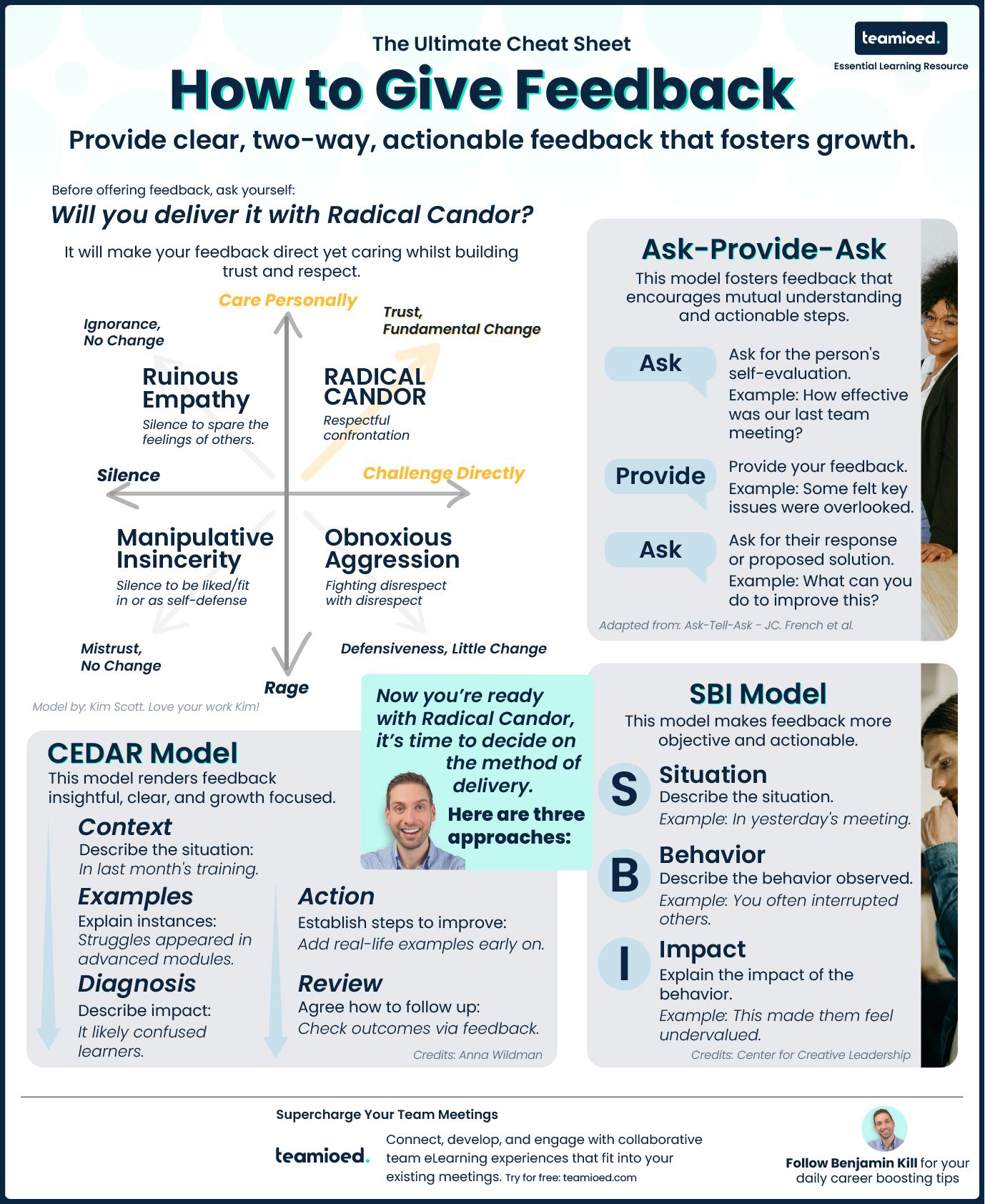
Here’s how to frame your "pull":
- Vague: "Any feedback for me on that presentation?"
- SBI-based "Pull": "In the presentation just now (Situation), when I was explaining the Q3 projections, what did you observe about my delivery (Behavior), and what was the Impact on the clarity of the message for you?"
This targeted approach gives the other person a clear framework to respond and provides you with data you can actually use.
Test your understanding!
Imagine you've just finished a networking conversation at one of the industry mixers you attend. You want to get feedback from a trusted colleague who observed the interaction. How would you rephrase the vague question, "Did that seem to go well?" into a specific, SBI-based "pull" question?
Show answer
An effective SBI-based question could be: "During my conversation with Mr. Sharma just now (Situation), I noticed he looked a bit distracted when I was explaining my interest in private markets. Did you notice any specific things I was doing with my hands or a change in my speech pace (Behavior), and what do you think the Impact was on his engagement?"
This question is specific, focuses on observable behavior, and is far more likely to yield a useful insight than a general inquiry.
3. Receiving Feedback: Creating Psychological Safety
How you react in the moment you receive criticism determines whether you will ever receive it from that person again. Your goal is to make the other person feel safe and valued for their input. This requires managing your own internal, emotional response.
The article from Radical Candor you reviewed earlier provides an excellent, psychologically-grounded toolkit for this.
How to Receive Feedback: 6 Tips for ...
Let's return to the 'How to Receive Feedback' article. It offers practical techniques for managing your emotional response and turning feedback into a productive, problem-solving conversation.
Please review the following sections: Section 1: 'Prepare Your Mind and Ask for It': Understand how asking for feedback proactively prepares you to receive it. Section 2: 'Don’t Get Mad Get Curious': Internalize this mantra. Curiosity short-circuits defensiveness. Section 3: 'Label and Reappraise': This is a powerful cognitive technique. Acknowledge your brain's threat response (e.g., feeling defensive) and consciously reframe the situation as helpful. Section 6: 'Check for Understanding': Learn to paraphrase what you heard and state your next action, even if it's just to reflect. This provides a 'payoff' to the feedback giver.
The key is to separate hearing from evaluating. Your goal in the moment is to listen with the intent to understand, not to immediately agree or disagree. Thank the person, confirm your understanding, and then take time later to evaluate the feedback and decide what action to take.
4. Your Long-Term Strategy: Embracing Deliberate Practice
You now have the two core components of a continuous growth system:
- A Practice Routine (from the last lesson)
- A Feedback Mechanism (from this lesson)
When combined, these elements form a powerful methodology known as Deliberate Practice. This concept, researched by Anders Ericsson, is the true engine of expert performance in any field, from finance to music to communication. It’s the perfect capstone framework for your journey, as it is structured, methodical, and focused on systematic improvement.
The Ultimate Deliberate Practice Guide: How to Be the Best
The article 'The Ultimate Deliberate Practice Guide' from Farnam Street provides a deep dive into this concept. Understanding its principles will give you a master framework for your communication development for years to come.
This is a comprehensive article. Focus your attention on two key parts: Start with 'What is deliberate practice?' to grasp the core definition. Then, skim the main headings under 'The elements of deliberate practice'. You will see that everything we've worked on in this course maps directly to this framework: it's structured, challenging, requires feedback and measurement, and is most effective with a coach (or in your case, a trusted feedback circle).
Your long-term strategy is to apply the principles of Deliberate Practice to your communication skills:
- Structured & Methodical: Use the monthly/weekly/daily practice plan from our last lesson.
- Challenging: Consistently push yourself into your "learning zone" (e.g., initiating a conversation you'd normally avoid, trying a new humor technique).
- Constant Feedback: Actively "pull" feedback from trusted peers and mentors using the SBI method.
- Measurement: Use a combination of self-review (the monthly recording analysis we've practiced) and external feedback to track your progress. You might find a simple tracking sheet helpful.

- Rest & Recovery: Recognize that social engagement is metabolically expensive. Build in time to recharge to avoid burnout.
Conclusion: The Journey Continues
This lesson concludes your formal course, but it marks the true beginning of your journey as a lifelong student of communication. You began with a desire to align your external expression with your internal intent, to build genuine connections, and to speak with clarity and confidence.
You have not only addressed those goals but have also built a robust, self-sustaining system for continued growth. You now possess:
- A Diagnostic Toolkit: The ability to self-assess your communication patterns objectively.
- A Library of Micro-Skills: Targeted techniques for your nervous system, thoughts, voice, body, and conversational strategies.
- A System for Deliberate Practice: A feedback-driven routine to ensure you are always improving, not just performing.
Your social confidence will not come from motivational quotes, but from the quiet assurance that you have put in the work. It is the natural result of proven competence, built one deliberate practice session at a time. You have demonstrated the discipline and self-awareness needed to master this skill. Continue applying this system, and you will not only reach but far exceed the goals you set for yourself.
It has been a privilege to be your guide on this transformative journey. I wish you all the best in your continued practice and future success.