Introduction
Welcome to the ninth module of our course, "Quantitative Style Analysis." In the previous modules, we've explored the history of Bollywood bikinis, categorized core silhouettes, and analyzed how trends are driven by designers and viral phenomena. Our last lesson on the 'Besharam Rang' trend demonstrated how a single look can generate a massive, measurable wave of interest.
Now, we will shift from analyzing individual examples to building a systematic tool for analyzing all of them. This lesson directly addresses the learning outcome: Design a classification framework for cataloguing Bollywood bikini styles by silhouette, color, fabric, and embellishment.
Leveraging your background in statistics, we will approach this task by designing a formal data structure—a taxonomy—that will allow us to systematically collect and, in later lessons, analyze data on bikini styles. This framework will be the analytical backbone for the remainder of the course.
1. The Concept of a Fashion Taxonomy
Before we start listing bikini styles, it's crucial to understand the principles of a good classification system. In e-commerce and data analysis, this is known as a product taxonomy. It's a logical, hierarchical structure for organizing items based on their attributes. For our purposes, it's the rulebook we'll use to ensure every bikini we study is categorized consistently.
To understand this concept more deeply, please read the following article. It explains the core ideas behind building a structured classification system for fashion products.
Product Taxonomy in Fashion Ecommerce
This article from Okkular.io, 'Product Taxonomy in Fashion Ecommerce,' clearly explains what a taxonomy is, its key components, and the best practices for creating one. This will provide the theoretical foundation for our framework.
Please read the sections 'What is Product Taxonomy?', 'Key Components of Product Taxonomy', and 'Best Practices for Developing Product Taxonomy'. Focus on how categories, attributes, and consistent naming conventions create a powerful and scalable system.
As you've read, a robust taxonomy isn't just a list; it's a structured system with:
- Categories & Subcategories: Broad groupings (e.g., Two-Piece) and specific types within them (e.g., Triangle Top).
- Attributes: Details that describe an item within a category (e.g., Color: Yellow, Fabric: Lycra).
- Consistency: Using the same terms for the same styles every time. This is critical for accurate frequency analysis later.
Our goal is to create a taxonomy specifically for Bollywood bikinis, treating each on-screen appearance as a data point to be catalogued.
2. Defining the Core Categories and Attributes
The learning outcome specifies our four primary categories: silhouette, color, fabric, and embellishment. Let's break each one down and define the attributes we will track.
To help define these attributes, we will use two key resources: a detailed glossary of swimwear terms and a comprehensive visual guide.
The Underfashion Club provides a 'SWIMWEAR TERMINOLOGY' guide that will serve as our primary dictionary for defining silhouette styles with precision.
Skim the 'TOPS' and 'BOTTOMS' sections. You don't need to memorize every term, but familiarize yourself with the range of styles like Halter, Bandeau, Tri-Top, Hipster, and Tie-Side. We will be using these as our attributes.
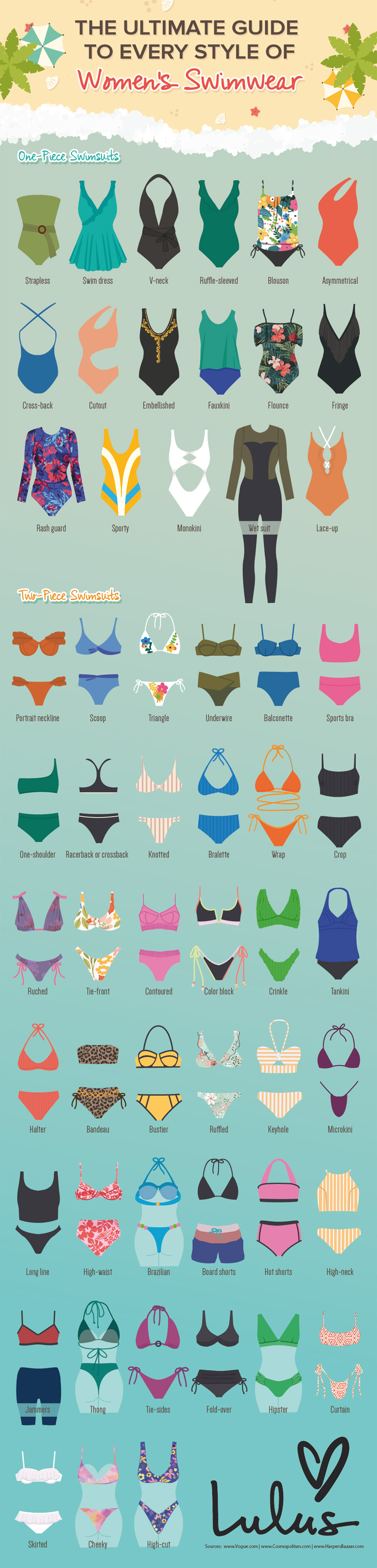
Based on these resources and the styles we've seen throughout the course, let's establish our framework's attributes.
Category 1: Silhouette
This is the most complex category and needs to be broken down. A single bikini has a top and a bottom, or it's a one-piece with specific characteristics.
- Overall Type:
Two-PieceOne-Piece (Monokini/Cutout)One-Piece (Maillot)Tankini
- Top Silhouette (for Two-Piece):
Triangle(sliding or stationary)Halter(includes banded, elongated)Bandeau(includes strapless, bandini)Underwire(includes bra top, bustier)Scoop Neck / Sport TopAsymmetrical / One-Shoulder
- Bottom Silhouette (for Two-Piece):
Tie-SideString(non-tying)Hipster / BriefHigh-WaistedBoy Shorts
- Bottom Coverage (can be a secondary attribute for bottoms):
Minimal / ThongCheeky / BrazilianModerateFull
Category 2: Color
This category describes the overall color scheme of the garment.
Solid(one single color)Color-Block(distinct blocks of solid colors)Print - Floral/TropicalPrint - Animal(leopard, zebra, etc.)Print - Geometric/AbstractMetallic(gold, silver, etc.)Ombré / Gradient
Category 3: Fabric
This describes the primary material, focusing on its visual texture on screen.
Lycra / Spandex(standard swimwear fabric)Sequin / GlitterMetallic(lame, foil fabric)Crochet / KnitVelvetNeoprene
Category 4: Embellishment
This captures any add-on decorative elements. We can list multiple if necessary.
NoneHardware(rings, clasps, chains)Beads / JewelsTassels / FringeEmbroidery / Mirror WorkRuffles / FlounceRuching(can also be a construction detail)
3. Assembling the Classification Framework
Now, let's combine these categories and attributes into a structured table. This table is our final classification framework. When you catalogue a bikini, you will create a new row and fill in each column.
Bollywood Bikini Classification Framework
| Film (Year) | Actress | Scene/Song | Overall Type | Top Silhouette | Bottom Silhouette | Bottom Coverage | Color | Fabric | Embellishment(s) |
|---|---|---|---|---|---|---|---|---|---|
Example in Practice
Let's populate the framework with an example from our last lesson: the yellow monokini from Pathaan.
| Film (Year) | Actress | Scene/Song | Overall Type | Top Silhouette | Bottom Silhouette | Bottom Coverage | Color | Fabric | Embellishment(s) |
|---|---|---|---|---|---|---|---|---|---|
| Pathaan (2023) | Deepika Padukone | 'Besharam Rang' | One-Piece (Monokini/Cutout) | Halter | N/A | Cheeky | Solid | Lycra/Spandex | Hardware |
- Overall Type: It's a
One-Piece (Monokini/Cutout)due to the large side cutouts. - Top Silhouette: It features a
Halterneck tie. - Bottom Silhouette: Not applicable (
N/A) for a one-piece. - Bottom Coverage: Based on visuals, it's
Cheeky. - Color: A vibrant
Solidyellow. - Fabric: Appears to be standard
Lycra/Spandex. - Embellishment: Features a metallic ring (
Hardware) connecting the bust pieces.
This structured approach transforms a subjective style analysis into the collection of objective, comparable data points.
4. Advanced Considerations: Granularity and Scalability
As the article on taxonomy mentioned, a good framework should be scalable. As you catalogue more bikinis, you might identify new styles. Our framework is designed to be flexible; you can add new attributes to the lists (e.g., a new print type like Print - Paisley).
For your statistician's mindset, we can even consider adding more granular, quantitative data. While this is an advanced step we won't require for now, it's a powerful concept for deeper analysis.
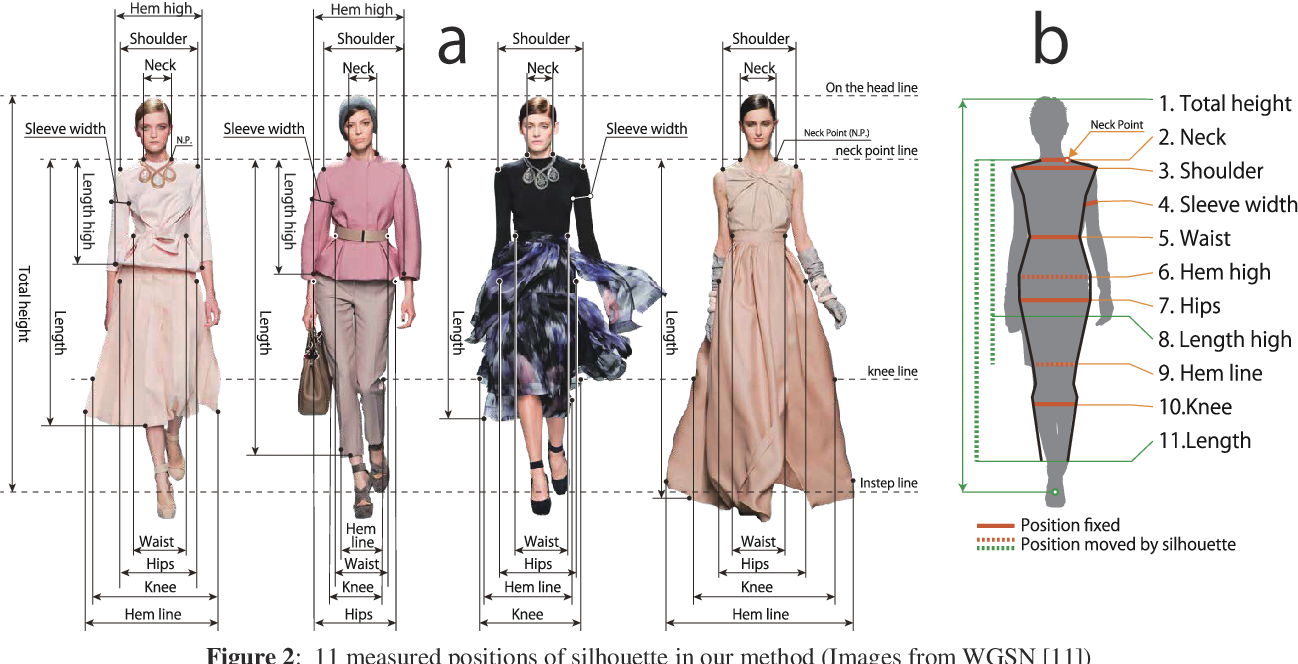
For example, we could enhance our framework with columns like:
Strap Width: (e.g., Spaghetti, Standard, Wide)Cutout Placement: (e.g., Side, Center, Underbust)Rise: (e.g., Low-Rise, Mid-Rise, High-Rise)
This level of detail allows for highly specific trend analysis, such as modeling the change in the average "rise" of bikini bottoms over time. For now, we will stick to our primary framework, but it's useful to see how it could be expanded for even more rigorous analysis.
Conclusion
In this lesson, we have moved from qualitative observation to quantitative preparation. You have learned how to structure a fashion taxonomy and applied those principles to design a detailed classification framework for Bollywood bikinis.
Key Takeaways:
- A taxonomy is a structured classification system that uses consistent categories and attributes to organize data.
- Our framework is built on four key categories: silhouette, color, fabric, and embellishment.
- The silhouette category is the most detailed, with separate attributes for the overall type, top style, and bottom style.
- Using a consistent framework allows us to convert visual styles into structured data, making quantitative analysis possible.
Preview of the Next Lesson:
You have successfully designed your analytical tool. In our next lesson, we will put it to immediate use. You will be given a sample of key bikini appearances from post-2004 Bollywood films. Your task will be to catalogue them using our new framework and then apply frequency analysis to identify the most common and dominant style combinations. This will be your first step in using statistics to decode Bollywood fashion trends.