Introduction
Welcome to the final lesson of our module on Quantitative Style Analysis. Over the past few lessons, we've built a powerful analytical toolkit. We started by creating a classification framework, then used it to conduct frequency analysis. Most recently, we explored time-series data to interpret and forecast the lifecycle of individual trends.
This lesson brings all these skills together to achieve our final quantitative learning outcome: Perform a comparative analysis of two distinct Bollywood style eras (e.g., 2004-2013 vs. 2014-2023) by comparing the distribution of bikini styles. Instead of tracking a single trend over time, we will now take a snapshot of two different decades to understand the fundamental shifts in the Bollywood bikini aesthetic.
This exercise is analogous to comparing two population distributions in statistics, a concept you'll be familiar with from your background. We will move beyond simply identifying trends to characterizing the entire "style zeitgeist" of each era through data, providing a macro-level view that is essential for strategic design thinking.
1. Defining the Eras and the Analytical Method
To perform a meaningful comparison, we first need to define our two periods of study. Based on the evolution of Bollywood and global fashion, we can delineate two distinct eras:
- Era 1 (2004-2013): The Rise of Glamour. This period begins after films like Dhoom (2004) cemented the bikini as a mainstream, high-glamour element in Bollywood. The aesthetic was heavily influenced by international pop culture, music videos, and a push towards a polished, "aspirational" look.
- Era 2 (2014-2023): The Age of Diversity and Social Media. This era is marked by the explosion of social media (especially Instagram), the rise of the actress-as-influencer, and a greater diversity in both body representation and fashion choices. Trends became faster, more varied, and more globally interconnected.
Our method will be to compare the distribution of style attributes across these two eras. We will use hypothetical data, based on the trends we've observed throughout the course, to see how the prevalence of different silhouettes, colors, and embellishments has shifted.
2. Comparative Analysis: Silhouette Distribution
The most fundamental element of a bikini is its silhouette. A change in dominant silhouettes often signals a broader shift in fashion ideals. Let's compare the proportional frequency of key silhouettes across our two eras.
| Silhouette Style | Era 1 (2004-2013) % Freq. | Era 2 (2014-2023) % Freq. | Change |
|---|---|---|---|
| Triangle / String | 45% | 25% | |
| Halter | 30% | 20% | |
| Bandeau | 10% | 20% | |
| Monokini / Cutout | 5% | 15% | |
| Underwire / Structured | 5% | 15% | |
| High-Waisted | 0% | 5% | |
| Total | 100% | 100% |
Analysis and Interpretation:
- Era 1's Signature: The first era was overwhelmingly dominated by classic, "soft" silhouettes. Triangle, string, and halter styles accounted for 75% of all appearances. This points to a relatively standardized ideal of the "bikini body," with an emphasis on minimalist cuts that had become global mainstays.
- Era 2's Diversification: The second era reveals a significant redistribution. While triangle and halter styles remain, their dominance has waned. We see a marked increase in more structured and fashion-forward silhouettes. Bandeaus, monokinis, and underwire tops collectively tripled their share, indicating a move towards more expressive and varied forms. The emergence of the high-waisted bottom is a key marker of this era's retro-revival trend.
- The Big Picture: The data shows a clear shift from a uniform ideal to a diversified portfolio of styles. The bikini in Era 2 is less of a standardized garment and more of a versatile fashion piece, offering a wider range of coverage, support, and aesthetic expression.
3. Comparative Analysis: Color Palette Distribution
Color is a powerful tool for conveying mood and tracking trends. A comparison of color palettes can reveal the changing emotional tone of Bollywood's on-screen aesthetic.
| Color Category | Era 1 (2004-2013) % Freq. | Era 2 (2014-2023) % Freq. | Change |
|---|---|---|---|
| Classic Solids (Black, White, Red) | 40% | 20% | |
| Brights / Neons (Pink, Yellow, Green) | 15% | 35% | |
| Earth Tones (Olive, Brown, Nude) | 20% | 15% | |
| Metallics (Gold, Silver) | 15% | 10% | |
| Pastels (Lilac, Baby Blue) | 5% | 15% | |
| Total | 100% | 100% |
Analysis and Interpretation:
- Era 1's Palette: This period leaned heavily on classic and sophisticated colors. Black, white, red, and metallics together constituted over half of the color palette. This reflects the "glamour" focus of the era—colors that signify timelessness, luxury, and high-impact drama.
- Era 2's Color Explosion: The second era is defined by a dramatic shift towards vibrant and expressive colors. Brights and neons more than doubled their share, becoming the dominant category. This is directly linked to the rise of Instagram, where bold, saturated colors perform well visually. The growth in pastels further supports a move towards a more playful, trend-driven palette.
- The Big Picture: The aesthetic moved from "cinematic glamour" to "social media-ready." The color choices in Era 2 are less about creating a timeless cinematic moment and more about capturing a fleeting, eye-catching, and shareable fashion trend.
4. Case Study: An Iconic Look from Each Era
Let's ground this data in two iconic visuals that perfectly encapsulate the aesthetic of their respective eras.
Era 1: Priyanka Chopra in Dostana (2008)
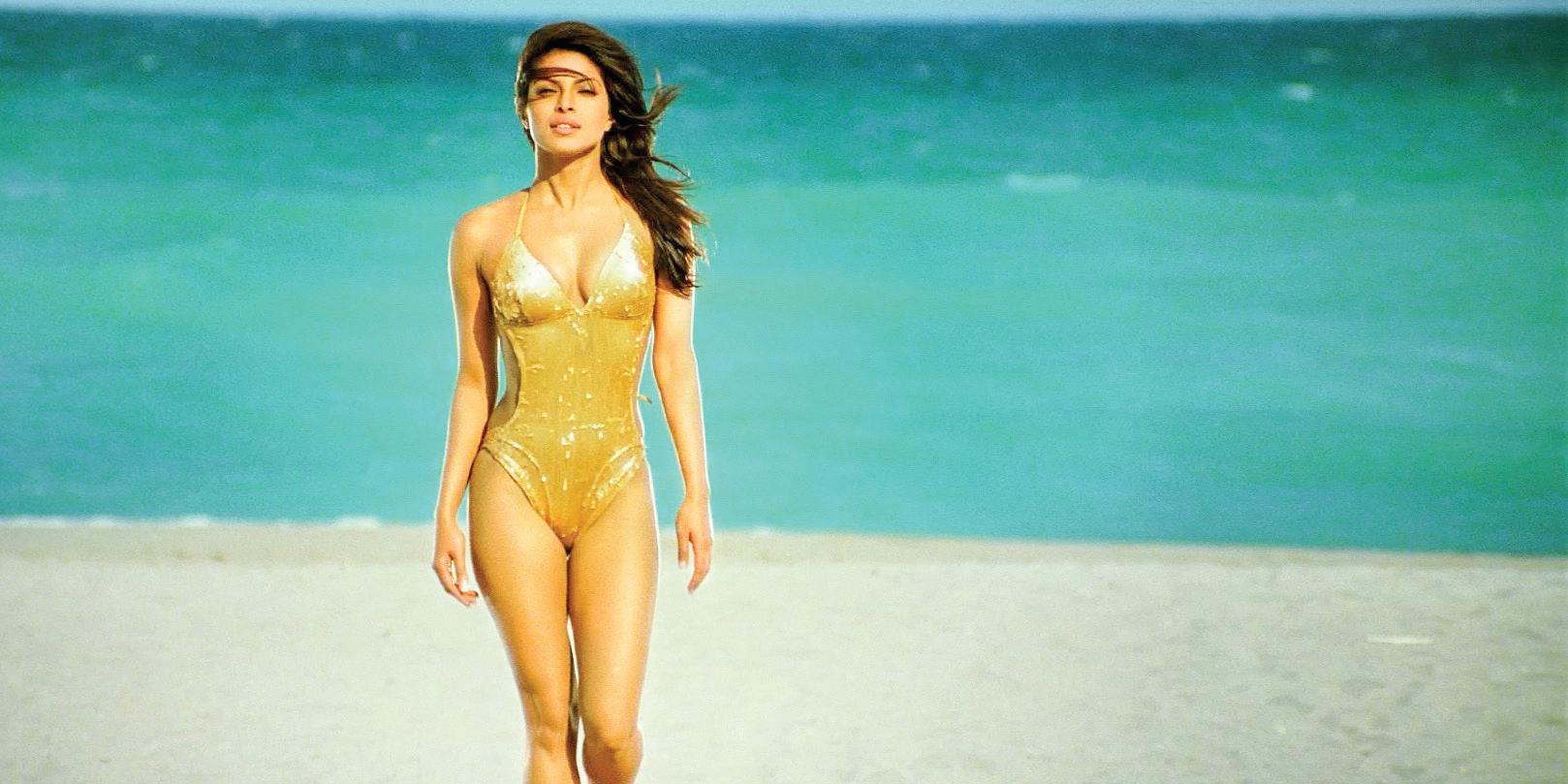
- Silhouette: The monokini was a high-fashion, statement choice for the time, a step beyond the basic bikini. It highlights the "glamour" and aspirational nature of the era.
- Color/Fabric: The shimmering metallic gold fits perfectly into the dominant color palette of Era 1. It's luxurious, dramatic, and designed for a high-impact cinematic reveal.
- Overall Vibe: This look is pure "aspirational glamour." It is meticulously styled, larger-than-life, and established a benchmark for on-screen swimwear that felt both exotic and luxurious.
Era 2: Alia Bhatt in Shaandaar (2015)

- Silhouette: A simple bandeau top. This represents the diversification of silhouettes in Era 2—less complex than a monokini, but a distinct move away from the default triangle top.
- Color/Fabric: The bright, hot pink is a perfect example of the color explosion in Era 2. It is youthful, energetic, and highly photogenic—an "Instagrammable" color.
- Overall Vibe: The feel is fresh, playful, and trend-aware. It's less about overwhelming glamour and more about embodying a current, accessible fashion moment. It reflects the shift towards looks that feel relatable and ready for social media.
5. Validating the Shift with Statistical Rigor
Our descriptive analysis strongly suggests a significant shift in style between the two eras. Given your background in statistics, you know that we can formally test this hypothesis.
To determine if the change in the distribution of silhouettes (or colors) is statistically significant, we would use a Chi-Squared (χ²) test of independence.
The logic is as follows:
-
Hypotheses:
- Null Hypothesis (): There is no association between the era and the distribution of bikini silhouettes. The proportions of each silhouette style are the same across both eras.
- Alternative Hypothesis (): There is an association between the era and the distribution of bikini silhouettes.
-
Contingency Table: We would create a contingency table of our raw observed counts (not percentages) for each silhouette in each era.
-
Expected Counts: Under the null hypothesis, we would calculate the expected count for each cell in the table. The expected count for a cell is (Row Total × Column Total) / Grand Total.
-
Chi-Squared Statistic: We would then compute the χ² test statistic, which summarizes the difference between the observed and expected counts:
-
Conclusion: By comparing our calculated χ² value to a critical value from the chi-squared distribution (with
(rows-1) * (columns-1)degrees of freedom), we could determine the p-value. A small p-value (e.g., < 0.05) would lead us to reject the null hypothesis, providing strong statistical evidence that the stylistic shift we observed is not due to random chance, but represents a genuine change in Bollywood fashion.
This method elevates our analysis from a simple description to a robust, evidence-backed conclusion about the evolution of style.
Conclusion
In this lesson, you have performed a comparative analysis of two distinct eras in Bollywood bikini fashion, a capstone skill for our quantitative module.
Key Takeaways:
- Comparative era analysis involves comparing the statistical distributions of style attributes (like silhouette and color) to identify macro-level shifts.
- Era 1 (2004-2013) was defined by "aspirational glamour," characterized by classic silhouettes (triangle, halter) and a palette of timeless, dramatic colors (black, white, metallics).
- Era 2 (2014-2023) ushered in an age of "diverse, trend-driven expression," marked by a wider variety of silhouettes (bandeaus, cutouts) and an explosion of bright, social-media-ready colors.
- The Chi-Squared test of independence is a formal statistical tool that can be used to validate these observed shifts in style distributions.
Preview of the Next Module:
This lesson concludes our module on Quantitative Style Analysis. You have successfully built a framework to classify styles, measure their frequency, track them over time, and compare entire eras.
In our final module, Capstone: Building Your Design Repertoire, you will synthesize everything you've learned throughout this course. You will move from analysis to creation by building your own style catalogue, identifying gaps in the current market, and developing a design brief for an original bikini concept inspired by the rich visual landscape of Bollywood.