Introduction
Welcome to the first lesson of Module 6. In the previous module, we concluded with two detailed case studies on fusion swimwear, deconstructing how traditional Indian embellishments and garment forms are integrated into modern bikini designs. We established a micro-analytical framework to break down individual looks by silhouette, fabric, color, and styling.
As previewed, this lesson will zoom out from that granular level to a "macro" perspective. We will now focus on identifying broader trends across multiple films and years. Your learning outcome for today is to categorize dominant color palettes in Bollywood bikinis, identifying shifts by era over the last two decades.
This lesson marks a shift toward the quantitative analysis you enjoy. We'll begin building a systematic approach to tracking style attributes, starting with color. By categorizing color trends and observing how they evolve, you'll be laying the groundwork for the more complex frequency and time-series analyses we'll conduct in Module 9.
The Two Decades of Color: A Tale of Two Eras
To understand the evolution of color in modern Bollywood bikinis, it's helpful to divide the last twenty years (approx. 2004-present) into two distinct periods. The first, spanning the mid-to-late 2000s, was defined by a very different aesthetic than the one that has characterized the 2010s and beyond.
To explore this, we'll consult an article that provides a visual timeline of many key looks.
Bollywood Bikini Evolution: 1960s-2010s
This article from Shilpa Ahuja, 'Bollywood Bikini Evolution: 1960s-2010s', contains an excellent visual catalogue of bikini looks from the 2000s and 2010s. We will use it to identify the dominant color palettes of each era.
Please read the sections titled 'Bollywood Bikini Babes of 2000s' and 'Best Bollywood Bikini: 2010s'. As you read the short descriptions, pay close attention to the colors and overall visual feel of the bikinis shown in the accompanying images for each decade. We will analyze the patterns you observe.
Now that you have a visual overview, let's deconstruct the dominant color stories of each period.
Era 1: The "Glamour & Shine" Palette (approx. 2004–2010)
As the article notes, the 2000s were about "sensationalist" glamour and experimentation. The color choices reflect this perfectly. This era's palette was designed for maximum on-screen impact, often prioritizing a high-gloss, aspirational look over realism.
Based on the examples in the article, we can identify three primary color categories:
-
Metallics: This is perhaps the most defining trend of the era. Gold, silver, and bronze tones were ubiquitous, creating a look of pure luxury and opulence.
- Example: Priyanka Chopra's iconic gold bikini in Dostana (2008). This look cemented the metallic swimsuit as a Bollywood glamour staple.
- Example: Antara Mali's silver bikini in Naach (2004).
-
Saturated Jewel Tones & Artificial Brights: When not metallic, colors were intensely saturated. These weren't subtle, sun-faded hues; they were bold, jewel-like, and sometimes almost synthetic in their brightness.
- Example: Kareena Kapoor's lime green string bikini in Tashan (2008). This particular shade of acidic green became famously associated with her "size-zero" look.
- Example: Mallika Sherawat's deep turquoise blue bikini in Murder (2004).
-
High-Contrast White: While white is a perennial swimwear color, in the 2000s it was often styled to look less sporty and more glamorous. It served as a stark, clean canvas against tanned skin, often paired with the era's signature heavy accessorizing.
- Example: Bipasha Basu's white bikini in Dhoom 2 (2006).
Era 2: The "Sophistication & Diversity" Palette (approx. 2011–Present)
The 2010s and beyond have seen a significant diversification of color palettes. The aesthetic shifted towards a broader range of expressions, from understated sophistication to playful, fashion-forward brights. As the article mentions, this was an era where personal style and confidence became more central than adhering to a single, monolithic trend.

This era's palette is much broader, but we can identify several key dominant groups:
-
Classic Neutrals (Black & White): While white was present before, the 2010s saw both black and white being used in more minimalist and structurally interesting designs. The color choice often emphasized the silhouette of the garment itself.
- Example: Anushka Sharma's black bikini in Ladies vs Ricky Bahl (2011).
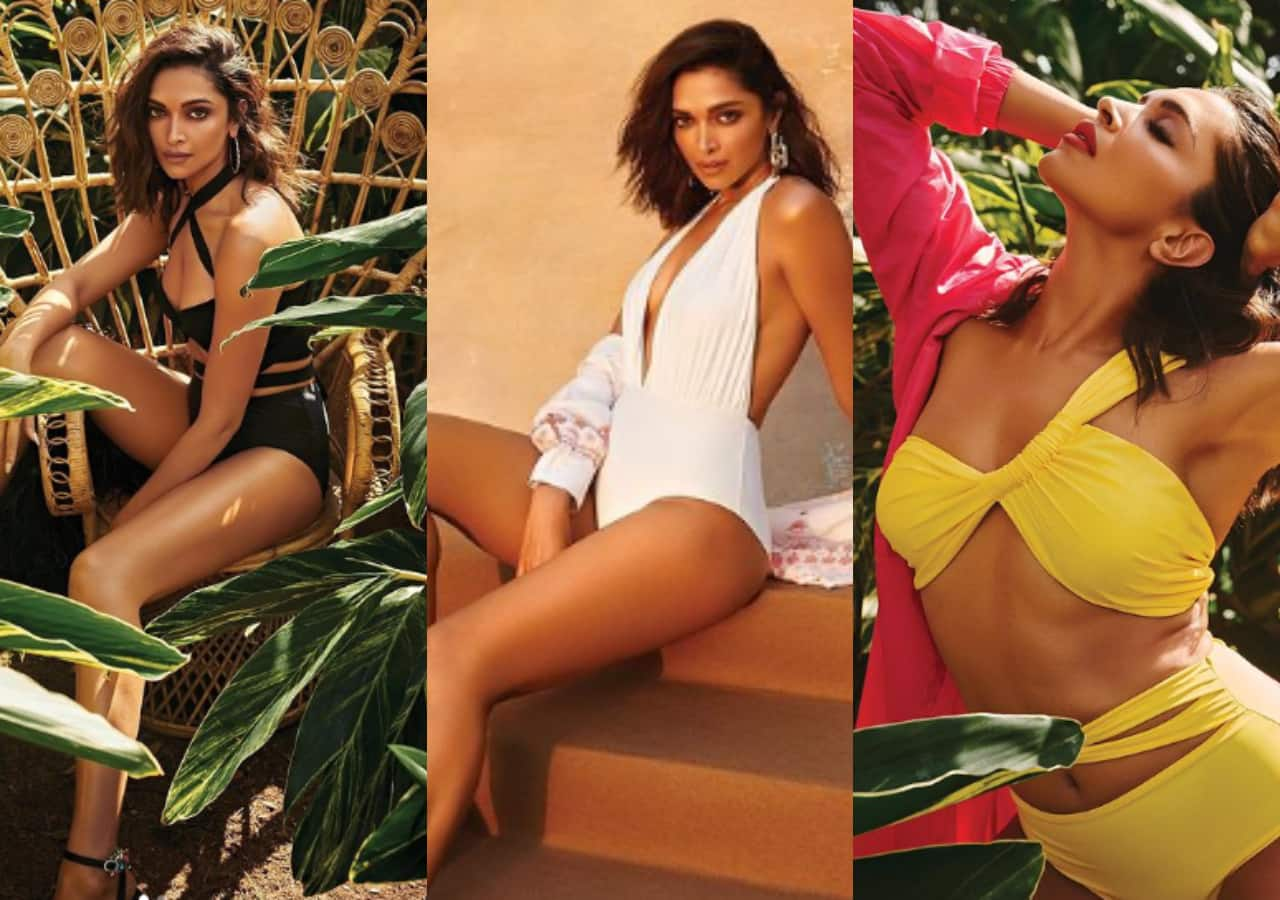
- Example: Deepika Padukone's black monokini in Pathaan (2023), seen in the image below.
-
Warm, Sunny Brights: The brights of the 2010s feel different from those of the 2000s. There's a strong emphasis on warm, optimistic, and energetic colors, with yellow being a standout trend.
- Example: Alia Bhatt's simple yellow bikini in Student of The Year (2012).
- Example: Deepika Padukone's red bikini in Cocktail (2012) and her yellow bikini from Pathaan (2023).
-
Pastels and Neons: This category represents the more fashion-forward end of the spectrum. Softer pastels offered a more romantic, feminine look, while bold neons provided a contemporary, high-energy alternative to the jewel tones of the past.
- Example (Pastel): Sonam Kapoor's and Alia Bhatt's pink bikinis in Bewakoofiyaan (2014) and Shaandaar (2015), respectively, which are softer than the hot pinks of the 2000s.
- Example (Neon): Janhvi Kapoor's neon yellow bikini, seen in the collage above, showcases a very current trend.
A Framework for Color Classification
To analyze these trends systematically—a necessary step for your goal of building a design repertoire and for the quantitative analysis in Module 9—we need a consistent classification system. Drawing from your statistics background, think of this as defining the variables for our dataset.
I suggest a simple three-level framework:
- Level 1: Color Family: The broadest category (e.g., Neutrals, Brights, Pastels, Metallics, Earth Tones).
- Level 2: Specific Hue: The dominant color (e.g., Black, Canary Yellow, Lime Green, Gold).
- Level 3: Color Application: How the color is used (e.g., Solid/Monochromatic, Two-Tone/Color-Blocked, Multi-Color/Print).
Here's how we can classify some of the examples we've discussed:
| Actress (Film) | Color Family | Specific Hue | Color Application | Era |
|---|---|---|---|---|
| Priyanka Chopra (Dostana) | Metallics | Gold | Solid | 1 (2000s) |
| Kareena Kapoor (Tashan) | Brights | Lime Green | Solid | 1 (2000s) |
| Alia Bhatt (SOTY) | Brights | Canary Yellow | Solid | 2 (2010s) |
| Anushka Sharma (LvRB) | Neutrals | Black | Solid | 2 (2010s) |
Your Turn: Apply the Framework
Now, it's your turn to practice. Using the two images we've just seen (Bollywood Swimwear Color Palettes and Deepika Padukone's Swimwear Styles), classify the six distinct swimwear looks according to the three-level framework. This exercise will help you internalize the classification system.
- Deepika Padukone's black monokini
- Deepika Padukone's white monokini
- Deepika Padukone's yellow bikini
- Mouni Roy's printed bikini
- Esha Gupta's light-colored top
- Janhvi Kapoor's neon bikini
Take a moment to classify them before reviewing my classifications below.
Click to reveal classifications
- Deepika (Black): Neutrals → Black → Solid/Monochromatic
- Deepika (White): Neutrals → White → Solid/Monochromatic
- Deepika (Yellow): Brights → Canary Yellow → Solid/Monochromatic
- Mouni Roy (Print): Brights → Multi-Color → Multi-Color/Print
- Esha Gupta (Light): Pastels/Neutrals → Nude/Champagne → Solid/Monochromatic (This has a pearlescent finish, bordering on a soft metallic)
- Janhvi Kapoor (Neon): Brights → Neon Yellow/Chartreuse → Solid/Monochromatic
Conclusion
In this lesson, we transitioned from analyzing individual designs to identifying broad, era-defining trends. By examining key examples from the last two decades, we've categorized the dominant color palettes and charted their evolution.
Key Takeaways:
- The color story of Bollywood bikinis shifted from the "Glamour & Shine" of the mid-2000s (metallics, saturated jewel tones) to the "Sophistication & Diversity" of the 2010s-present (classic neutrals, sunny brights, pastels, and neons).
- A three-level classification framework (Color Family → Specific Hue → Color Application) provides a systematic and quantitative method for cataloguing and analyzing color in swimwear design. This tool will be invaluable as you build your design repertoire.
Preview of the Next Lesson:
We've just established the third level of our color framework: Color Application (Solid vs. Print). In the next lesson, "Identify recurring print trends (animal, tropical, geometric, abstract) in Bollywood swimwear," we will dive deeper into that specific category. You will learn to classify the most common types of prints, adding another crucial layer of detail to your analytical toolkit.