Introduction
Welcome to the fourth lesson in your capstone module. In our last session, you did the vital work of updating your design catalogue with five very recent looks from post-2020 films. Your catalogue is now a comprehensive and contemporary database, forming the analytical foundation for the final phase of your project.
Today, we shift from documentation to strategy. Your learning outcome is to identify stylistic gaps or underrepresented design opportunities in the current Bollywood bikini landscape based on your catalogue. This is where your background in statistics meets your passion for design. We will use the data you've meticulously gathered to perform a market analysis, find untapped creative territories, and lay the groundwork for your original design concept.
By the end of this lesson, you will have a clear, evidence-based understanding of where the most exciting opportunities lie in Bollywood swimwear design today.
A Framework for Gap Analysis
A catalogue as rich as yours is a powerful tool, but only if we analyze it systematically. Simply looking at it won't be enough. Let's apply an analytical framework to your data to uncover patterns and, more importantly, the absence of patterns.
Think of this as a research project. You have your dataset (the catalogue); now let's query it.
1. Frequency Analysis: What's Common vs. What's Rare?
Drawing on your statistics background, the first step is a simple frequency analysis. Review your completed catalogue and consider the distribution of entries across your classification fields.
Ask yourself:
- Silhouettes: Which top and bottom silhouettes appear most frequently? (e.g., classic triangle, side-tie brief). Which are outliers? (e.g., underwire, bandeau, boy shorts). Is there a strong dominance of two-piece styles over monokinis?
- Colors & Prints: What is the ratio of solid colors to prints? Among solids, are brights and neons more common than pastels or earth tones? What types of prints recur (floral, abstract) and which are absent?
- Fabrics & Embellishments: How many entries are standard matte Lycra versus something more textural (metallic, crochet, sequin)? Are embellishments typically minimalist hardware (rings), or more organic (shells, beads)?
This initial count will give you a "heat map" of the current landscape, immediately highlighting what is over-saturated and what is scarce.
2. Combination Analysis: Breaking Established Formulas
Next, look for common pairings. Trends often emerge not from a single element but from a recurring combination.
- Are high-waisted bottoms almost always styled as "retro"? Could a high-waisted bikini be futuristic or minimalist?
- Are embellished bikinis usually bohemian halter-necks? Could you apply intricate embellishment to a structured, underwire design for a more couture feel?
- Are metallic fabrics only used for solid-color, "disco" style bikinis? What would a metallic bikini with a traditional Indian block print look like?
By identifying these "formulas," you can spot opportunities to create something new by intentionally breaking them.
Exploring Specific Opportunity Areas
Your analysis will likely reveal several potential gaps. Let's explore three major areas of opportunity, using our resources to spark ideas.
Opportunity 1: Fabric & Material Innovation
Your frequency analysis probably showed a heavy dominance of synthetic fabrics like Lycra. While practical, this points to a major gap in material diversity and sustainability. Forward-thinking designers are already exploring this.
#ELLEExclusive: Designers Shivan & Narresh On Their Latest Collection
Pioneering Indian designers Shivan & Narresh have built their brand on innovation. To understand how material choice can define a collection, please read this exclusive interview with them from Elle India.
Please read the two sections with the questions 'Could you expand on the fabrics used and the introduction of Julin.' and 'Your brand has played an important role in redefining resort wear in India...'. Focus on their development of 'JULIN' from jute and their comments on the evolving Indian consumer.
As the article highlights, creating a new fabric like JULIN—a softened, breathable jute—is a game-changer. It introduces a unique texture, a story of indigenous sourcing, and a sustainable angle.
Design Prompt:
What other Indian textiles or natural fibers could be technologically adapted for swimwear or high-end resort wear? Think about the unique visual and tactile properties of materials like bamboo silk, treated Khadi cotton, or other plant-based fibers. This is a significant, under-explored area.
Opportunity 2: Silhouette Sophistication and Hybrid Looks
While Bollywood has embraced monokinis and basic bikinis, there is a gap for more architecturally complex and versatile swimwear. Your expertise in lingerie construction is highly relevant here.
Consider this look:

This image demonstrates a move away from simple beachwear towards a complete, fashion-forward resort "look." The bikini itself has more design details (high waist, twist front) than a standard string bikini, and pairing it with a jacket makes it a hybrid outfit.
Design Prompt:
- Construction: How can you leverage your lingerie design skills? Think about corsetry-inspired boning, more diverse underwire shapes (plunge, demi-cup), or complex, structural strapping that provides both support and visual interest.
- Versatility: How can a bikini be part of a larger ensemble? Think about designing bikinis with matching cover-ups, skirts, or trousers that aren't just afterthoughts but integral parts of the design.
Opportunity 3: Deeper Cultural Fusion
We've seen fusion in Bollywood bikinis, but it often remains at the surface level: a traditional print on a Western silhouette, or styling with Indian jewelry.
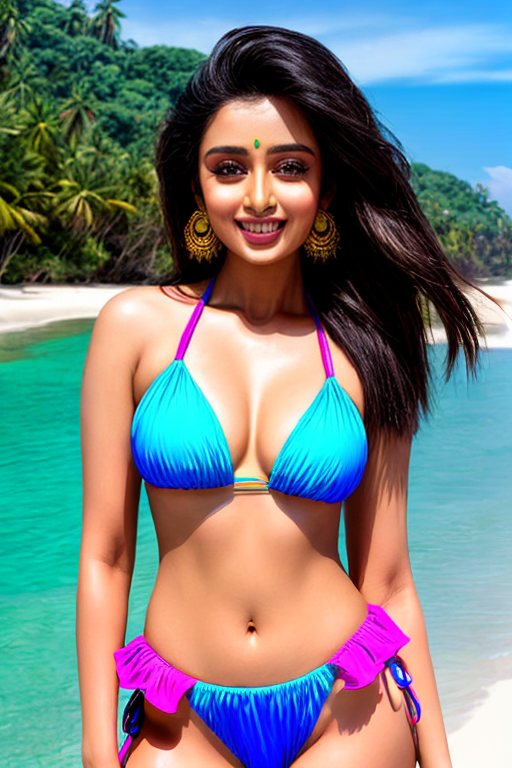
This is effective, but the real design opportunity lies in embedding the fusion into the garment's very structure.
Design Prompt:
How can the silhouette itself be a fusion?
- Could the draping of a sari inspire an asymmetrical monokini or a one-shoulder top?
- Could the neckline of a choli (sari blouse) be adapted into a unique bikini top?
- Could the intricate cutout patterns of Jaali latticework in Mughal architecture inspire the negative space in a monokini or the straps on a bikini back?
This approach moves beyond decoration to create a truly hybrid garment that is both modern and culturally resonant.
Activity: Define Your Design Opportunities
Now it's time to synthesize your findings. Based on the analysis of your catalogue and the ideas we've explored, identify three distinct and specific design opportunities.
For each one, write a short statement that includes:
- The Direction: A concise name for the concept (e.g., "Artisanal Fiber Swimwear").
- The Gap: A sentence explaining what gap this direction fills in the current Bollywood market (e.g., "Addresses the lack of sustainable and texturally diverse material options.").
- Key Elements: A few bullet points listing the core design features (e.g.,
Treated jute/bamboo fabric,Hand-woven details,Earthy color palette).
Document these three potential directions. They will be the launchpad for the final lesson in your capstone project.
Conclusion
In this lesson, you have transitioned from a cataloguer to a design strategist. By systematically analyzing your data, you've begun to map out the future of Bollywood bikini design.
Key Takeaways:
- You have learned to apply a framework of frequency and combination analysis to a design catalogue to identify market gaps.
- You have explored three major opportunity areas: material innovation, silhouette sophistication, and deeper cultural fusion.
- You have formulated a shortlist of specific, actionable design directions based on your research.
Preview of the Next Lesson:
In our next lesson, you will choose the most compelling opportunity from your list and develop it into a design brief for an original bikini concept. This is where your analysis culminates in a creative vision. You will define your target aesthetic, create a mood board, and produce the initial sketch for your unique design.