Introduction
Welcome to your next lesson. In our previous session, we established a clear understanding of structured bikini tops, distinguishing between the strapless bandeau, the supportive underwire, and the architectural one-shoulder style. We noted how these styles use internal construction—not just fabric tension—to create shape and form.
This lesson builds directly on that foundation. We will now explore how those structured (and unstructured) tops are integrated into a single garment to create some of the most visually dynamic styles in modern swimwear: the monokini and the cutout one-piece. The learning outcome for this session is to classify different monokini and cutout one-piece styles based on silhouette and placement of cutouts.
These styles are essentially hybrids, blending the coverage of a one-piece with the strategic exposure of a bikini. From a design perspective, they are a masterclass in the use of negative space—the areas of the body that are revealed—to contour, shape, and create visual interest. Your experience with lingerie design, where paneling and structure are used to sculpt the body, will provide a strong parallel for understanding how these garments work.
1. Defining the Modern Monokini and Cutout Style
Historically, the term "monokini" referred to a specific topless swimsuit designed in the 1960s. However, in contemporary fashion and particularly in Bollywood, its meaning has evolved.
Today, a monokini generally refers to a swimsuit that appears to be a two-piece from the back but is connected at the front, often by a narrow strip of fabric. This creates significant cutouts at the sides, back, and sometimes the midriff.
A cutout one-piece is a broader category that includes any one-piece swimsuit with sections of fabric strategically removed. While all modern monokinis are a type of cutout one-piece, not all cutout one-pieces have the specific "connected bikini" structure of a monokini.
For design purposes, the key principle uniting both is the deliberate use of negative space. The shape and placement of the cutouts are just as important as the fabric itself in defining the garment's silhouette and overall impact.
2. A Framework for Classification
To analyze these styles systematically, which will be useful for building your design repertoire, we can classify them along two primary axes:
- Overall Silhouette: How the garment is constructed and connects the upper and lower sections.
- Cutout Placement: Where the negative space is located on the body.
Classification by Silhouette
- The Classic Monokini: This is the most common form. It consists of a recognizable bikini top (like a halter, triangle, or bandeau) connected to a bottom piece by a panel of fabric over the stomach. The defining feature is the large, symmetrical cutouts at the waist.
- The Plunging One-Piece with Side Cutouts: This silhouette is characterized by a very deep neckline (a "plunge") and cutouts along the sides of the torso. It often features a high-cut leg to further elongate the body line.
- The Asymmetrical Cutout: This style plays with imbalance. It might feature a one-shoulder top connected to the bottom on one side, leaving the other side completely open, or have cutouts of different shapes and sizes on each side.
Classification by Cutout Placement
- Side/Waist Cutouts: The most frequent placement, designed to highlight the waist and create an hourglass illusion.
- Center/Sternum Cutouts: Often called "keyhole" cutouts, these are placed on the midline of the torso, typically just below or between the bust.
- Underbust Cutouts: A horizontal cutout that runs beneath the bust line, separating the bust section from the midriff panel.
- Multiple/Slashed Cutouts: A series of smaller, often diagonal or geometric cutouts, creating a "slashed" or "strappy" effect.
3. Case Studies from Bollywood
The 2023 film Pathaan served as a major showcase for contemporary monokini styles, with costume designer Shaleena Nathani creating several high-impact looks for Deepika Padukone. Let's analyze a few key examples.
Case Study 1: The Golden High-Leg Monokini
This look became one of the most talked-about styles from the film.

Let's classify this piece using our framework:
- Silhouette: This is a Plunging One-Piece with Side Cutouts. While it has a deep scoop neck rather than a sharp V, the principle is the same. The silhouette is defined by a central vertical element with large open spaces on either side.
- Cutout Placement: The design features massive side cutouts that extend from below the bust to the hip. The extremely high-cut leg and low-scoop back also act as significant "cutouts" that contribute to the minimalist, leg-lengthening silhouette.
This style is an excellent example of how a monokini can be used to create a bold, statuesque effect through a clean silhouette and striking fabric choice, with minimal need for extra embellishment.
To get more detail on this and another key look, please read the following brief excerpts.
5 Looks of Deepika Padukone from Pathaan's new track 'Besharam ...
The following article from Bollywood Hungama describes two key monokini looks from 'Pathaan'. Pay close attention to the descriptions of the construction and the named designers.
Please read the sections titled '1. Golden Swimsuit' and '2. Yellow cut-out monokini'. Note the specific design details mentioned for each, such as the neckline, cut, and hardware.
Case Study 2: The Yellow Halter Monokini
As described in the article you just read, the yellow monokini by designer Louisa Ballaou presents a different approach.
- Silhouette: This is a Classic Monokini. It's constructed from what is essentially a halter-neck bikini top connected to a bottom. The article notes it has "a self-tie fastening at the halter neck and back," reinforcing its two-piece origins.
- Cutout Placement: The primary cutouts are at the sides/waist. A key design detail here is the use of hardware—the "spring rings" or "golden hoop" mentioned in the resources—to create the connection point. This turns a structural element into a decorative focus.
This style demonstrates how hardware can be integral to a monokini's design, defining the shape of the negative space.
Case Study 3: The Multi-Style Cutout Monokini
Finally, let's look at another common variation that combines color, print, and strategic cutouts.
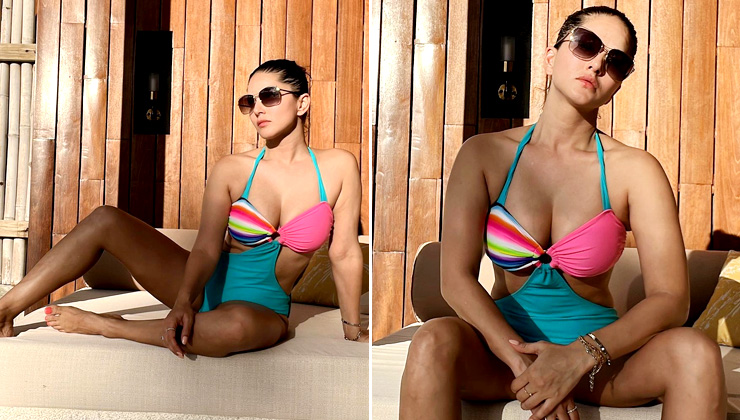
Let's classify this look:
- Silhouette: This is another example of a Classic Monokini, with a clear halter top connected to a solid bottom piece.
- Cutout Placement: The design features prominent side/waist cutouts. The central connecting panel is relatively wide, creating a different shape of negative space compared to the more revealing styles worn by Deepika Padukone.
- Design Details: Unlike the solid, metallic look of the Pathaan examples, this monokini uses color and print blocking (striped cup vs. solid cup) to add visual complexity. The structure is softened by the playful aesthetic.
Conclusion
In this lesson, we dissected the monokini and cutout one-piece, moving beyond a simple description to a structured classification system. This approach allows for a more rigorous analysis of these popular Bollywood styles, which is essential for your goal of building a design repertoire.
Key Takeaways:
- Modern monokinis and cutout one-pieces are defined by their use of negative space.
- They can be classified by their silhouette (Classic Monokini, Plunging, Asymmetrical) and the placement of their cutouts (side/waist, center, underbust).
- Bollywood styles often use these garments to create high-impact, fashion-forward statements, utilizing everything from metallic fabrics and hardware (as in Pathaan) to playful prints and colors.
Preview of the Next Lesson:
We touched upon asymmetrical silhouettes in this lesson. In our next session, we will dive deeper into this concept by analyzing the design principles of asymmetrical and hybrid bikini/swimsuit styles. We will explore how designers use one-shoulder tops, uneven hemlines, and other unbalanced elements to create unique and modern swimwear.