Hello! Welcome to the final lesson in our module on Clinical Trial Design and Critical Appraisal.
In our last lesson, you learned to critically appraise a systematic review, the highest level of evidence for answering a clinical question. We briefly introduced the GRADE framework as the final step in judging the overall certainty of the evidence presented in a review.
Today, we will dive deep into this powerful tool. This lesson is designed to help you master the learning outcome: Apply the GRADE framework to a body of evidence to assess its overall quality and strength of recommendation.
We'll move beyond simply understanding a rating of "high" or "low" certainty. By the end of this lesson, you will understand the systematic process of how that rating is determined and how it informs clinical recommendations. For your goal of bridging Ayurveda and modern science, this skill is paramount. It allows you to look at a body of evidence on an Ayurvedic therapy—whether it's a set of RCTs or observational studies—and transparently judge how much confidence we can truly have in the findings before making decisions for clinical practice or future research.
1. What is GRADE?
The GRADE (Grading of Recommendation, Assessment, Development and Evaluation) approach was developed to create a single, unified system for rating the quality of evidence and the strength of recommendations. Its key features are transparency and a systematic process. Major health organizations, including the World Health Organization (WHO), use GRADE to develop clinical practice guidelines.
To get a clear overview of the basic concepts, let's start with a short video.
This video, 'Introduction to GRADE' by Cochrane Austria, provides an excellent summary of the framework's purpose and its two most important components: Certainty of Evidence and Strength of Recommendation.
Please watch from 00:00 to 02:11 and then from 08:40 to 09:26. Focus on understanding: Why GRADE was created. The definition of 'Certainty of Evidence'. The definition of 'Strength of Recommendation'.
As the video explained, the GRADE process has two distinct but related parts:
- Assessing the Certainty of the Evidence: How confident are we in the estimate of an intervention's effect?
- Determining the Strength of the Recommendation: Based on the evidence and other factors, should we recommend for or against the intervention?
Let's break down each part.
2. Part 1: Assessing the Certainty of Evidence
Certainty of evidence is categorized into four levels: High, Moderate, Low, and Very Low.
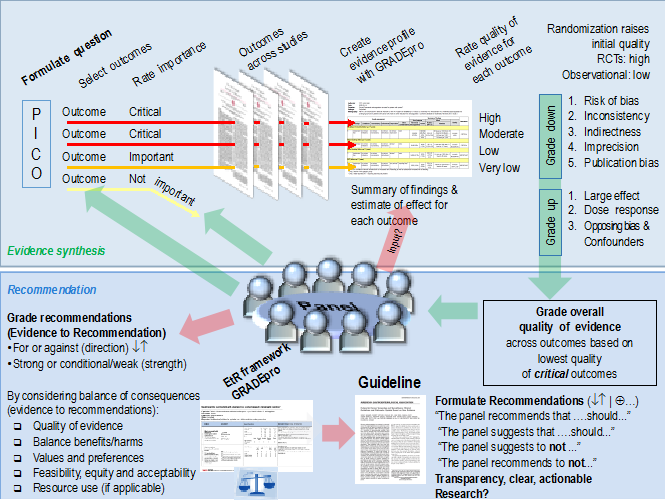
The process for determining this rating involves a clear starting point and a set of factors that can either lower or raise our confidence.
Step 1: The Starting Point
The initial certainty level is based on the study design of the evidence being evaluated:
- A body of evidence from Randomized Controlled Trials (RCTs) starts as High certainty.
- A body of evidence from Observational Studies starts as Low certainty.
This starting point is just a preliminary grade. We must then consider several factors that can change this initial rating.
Step 2: Factors that Downgrade Certainty
There are five key domains that can lower our confidence in the evidence. If a body of evidence has serious problems in one or more of these domains, we "downgrade" its certainty level (e.g., from High to Moderate, or Moderate to Low).
To understand these five factors in detail, please watch the following video. It provides clear explanations and visual examples for each domain.
Systematic Reviews and Meta-Analyses: Part 4 - Assessing Certainty of Evidence: The GRADE Approach
The video 'Systematic Reviews and Meta-Analyses: Part 4' gives a practical walkthrough of the five downgrading factors. It will help you visualize what to look for when assessing a body of evidence.
Please watch from 04:36 to 13:46. This segment covers the five reasons for downgrading evidence. As you watch, try to link each concept to what you've learned about critical appraisal in previous lessons.
Let's summarize those five critical downgrading factors, drawing from the video and other key resources.
GRADE Methods in traditional medicine - PMC
The following article, 'GRADE Methods in traditional medicine,' is highly relevant to your goals. For this section, we will focus on its excellent summary of the downgrading and upgrading factors.
Please read Section 4, 'Factors that downgrade or upgrade the evidence,' and pay close attention to Table 1. This table provides a concise map of the entire rating process.
Here is a breakdown of the five downgrading domains from the resources you just reviewed:
-
Risk of Bias: The studies have methodological flaws (e.g., no blinding, poor randomization). You learned how to assess this in our lesson on appraising RCTs. If most studies in a review have a high risk of bias, our confidence in the overall result decreases.
-
Inconsistency (or Heterogeneity): The results vary significantly from one study to another without a clear explanation. For example, if some studies show an Ayurvedic herb helps reduce pain, while others show it has no effect or even worsens it, the evidence is inconsistent.
-
Indirectness: The evidence doesn't directly answer your clinical question. This can happen in several ways:
- Population: The studies were done on young adults, but your patient is elderly.
- Intervention: The studies used a standardized extract, but in your practice, you use a whole-herb powder (churna).
- Comparison: The studies compared the herb to a placebo, but you want to know if it's better than the standard conventional treatment.
- Outcome: The studies measured a biomarker (e.g., C-reactive protein), but you are interested in a clinical outcome (e.g., patient-reported pain). This is using a "surrogate outcome."
-
Imprecision: The results are not precise, usually due to a small number of patients or events. This is reflected by a wide confidence interval (CI). For example, if a study reports that a treatment reduces symptoms by 15% (95% CI: 2% to 28%), the true effect could be very small (2%) or quite large (28%). This uncertainty reduces our confidence.
-
Publication Bias: As we discussed in the last lesson, studies with "positive" results are more likely to be published. If a systematic review is missing unpublished "negative" studies, its results will be overly optimistic. This is often suspected if a funnel plot is asymmetrical.

Step 3: Factors that Upgrade Certainty
For evidence from observational studies, which starts as "low" certainty, it's possible to upgrade the rating if certain conditions are met:
- Large Magnitude of Effect: The observed effect is very large and consistent. For example, if an observational study shows that a particular diet reduces the risk of a disease by 80-90%, it's less likely that this large effect is due to confounding alone.
- Dose-Response Gradient: There is evidence that a larger dose or longer duration of the intervention leads to a greater effect. For example, if studies show that taking 1 gram of an herb has a small effect, while 3 grams has a large effect, this increases our confidence.
- Effect of Plausible Confounding: If all likely confounding factors would have biased the results towards finding no effect, but the study still found an effect, this can increase our confidence.
Test your understanding!
A systematic review of five small RCTs examines the effect of Ashwagandha on stress levels, measured by a validated stress questionnaire. The RCTs start with High certainty. You find the following:
- All five studies were double-blinded and well-conducted (low risk of bias).
- The results are similar across all studies, with each showing a modest reduction in stress.
- However, when the results are pooled in a meta-analysis, the 95% confidence interval for the effect is very wide and almost crosses the "no effect" line.
How would you rate the final certainty of this evidence (High, Moderate, Low, or Very Low), and which GRADE domain is the primary reason for your rating?
Show answer
The final certainty of the evidence would likely be downgraded to Moderate or even Low.
The primary reason for downgrading is Imprecision. Even though the studies are of high quality and consistent, the fact that they are small leads to a wide confidence interval. This means we cannot be very confident about the true size of Ashwagandha's effect on stress. The true effect might be clinically meaningful, or it might be negligible.
3. Part 2: From Evidence to Recommendations
Assessing the certainty of evidence is only the first step. To make a clinical recommendation, we must consider other factors. GRADE uses the Evidence to Decision (EtD) framework to do this transparently.
A guideline panel making a recommendation will consider:
- The certainty of the evidence for benefits and harms.
- The balance between those desirable and undesirable effects.
- Patients' values and preferences. Do patients care more about the potential benefit or the potential side effects and cost?
- Resource use (costs).
- Equity, acceptability, and feasibility.
This is particularly relevant for Ayurvedic medicine. A treatment might have low-certainty evidence, but if it is also very safe, inexpensive, and aligns with a patient's cultural and personal values, a panel might still make a weak recommendation for its use.
4. Strength of Recommendation
After weighing all the EtD criteria, the panel makes a recommendation, which can be either Strong or Weak.
- Strong Recommendation: ("We recommend..."). Confidence is high that the desirable effects outweigh the undesirable ones. For most patients, this is the right course of action.
- Weak Recommendation: ("We suggest..."). There is uncertainty in the balance of effects, or the best choice depends heavily on the patient's situation, values, or preferences. This calls for shared decision-making between the practitioner and the patient.
It is crucial to understand that the strength of the recommendation is not the same as the certainty of the evidence. You can have high-certainty evidence of a very small benefit, leading to a weak recommendation because the benefit might not be worth the cost or side effects.
5. Applying GRADE to Traditional Medicine: An Example
The article "GRADE Methods in traditional medicine" provides a perfect example of how these concepts are applied to a non-pharmacological therapy.
GRADE Methods in traditional medicine - PMC
Let's return to the article on 'GRADE Methods in traditional medicine'. This time, we will analyze a practical example.
Please go to Section 6, 'Application of GRADE in guidelines of traditional and integrative medicine.' Study the question 'Should acupuncture versus usual care be used for knee OA?' and the accompanying 'Table 2. Evidence summary...'. Try to understand what each column represents before reading my explanation below.
Let's break down that table (Table 2 from the article):
- Outcomes: The panel chose three critical/important outcomes: Pain, Function, and Hematoma (an adverse event).
- Study Design: The evidence for all three comes from RCTs, so it starts as High certainty.
- Quality Assessment: For the Pain and Function outcomes, the evidence from 2 RCTs (with 520 patients) was not downgraded. The authors judged there were no serious issues with limitations (bias), inconsistency, indirectness, imprecision, or publication bias.
- Quality (Certainty): Therefore, the final certainty rating remains ⊕⊕⊕⊕ HIGH.
- Summary of Findings: We see the absolute effect. For pain, the effect size was a standardized mean difference (SMD) of -0.52. This is generally considered a moderate effect.
- Conclusion: Based on this table, a guideline panel would see high-certainty evidence that acupuncture provides a moderate improvement in pain and function with a slightly increased risk of minor hematoma. This would likely lead to a strong recommendation for using acupuncture for knee osteoarthritis.
This example shows the power of GRADE to transparently summarize a large amount of information into a clear assessment of confidence, which can then guide clinical decisions. The paper also highlights a key challenge you will face: for many traditional therapies, the evidence base is weak, meaning many outcomes will be rated as low or very low certainty. This doesn't mean the therapy is ineffective, but it does mean more high-quality research is needed.
Conclusion
You have now learned to apply the GRADE framework, one of the most important tools in modern evidence-based practice. This moves you from being a consumer of research to a sophisticated evaluator of it. You can now not only appraise a single study but also assess an entire body of evidence and understand the rationale behind clinical recommendations.
Key Takeaways:
- GRADE is a transparent framework for rating the certainty of evidence (High, Moderate, Low, Very Low) and the strength of recommendations (Strong, Weak).
- The certainty rating begins with the study design (RCTs start high, observational studies start low) and is then modified by five downgrading factors (risk of bias, inconsistency, indirectness, imprecision, publication bias) and three upgrading factors.
- Recommendations are based not only on evidence certainty but also on the balance of benefits/harms, patient values, and resource use, as outlined in the Evidence to Decision (EtD) framework.
- Applying GRADE to Ayurvedic research will be essential for identifying both promising therapies and areas where evidence is currently weak and more research is desperately needed.
Preview of the Next Lesson:
This lesson concludes Module 7. You have now journeyed from appraising single trials to synthesizing evidence and judging its overall quality. Our next lesson begins Module 8, "Translating Ayurvedic Concepts into Scientific Frameworks," where we will start by exploring how to correlate the concept of Agni with modern understandings of digestion and cellular metabolism. You will see how the research skills you've just acquired are essential for building these bridges.