Hello! Welcome back to our course on designing research for Ayurvedic interventions.
In our last lesson, we explored research designs like pragmatic trials and N-of-1 trials, which are well-suited for evaluating the complex, personalized nature of Ayurvedic medicine. We established that choosing the right design is the first crucial step in planning a scientifically sound study that respects Ayurvedic principles.
Today, we will take the next step and translate that conceptual choice into a concrete plan. Our goal is to draft the 'Methods' section of a research proposal, which is the detailed blueprint of your study. This section is arguably the most critical part of a proposal, as it explains exactly how you will conduct your research. We will break it down into its four essential components:
- Study Design
- Study Participants
- Intervention(s)
- Outcome Measures
By the end of this lesson, you will understand how to structure this section and what specific details to include, especially for an Ayurvedic study.
1. The Blueprint of Your Research: The Methods Section
The Methods section (sometimes called 'Methodology') of a research proposal has one primary purpose: to describe what you plan to do in such detail that another researcher could, in theory, replicate your study exactly. It’s the recipe for your research.
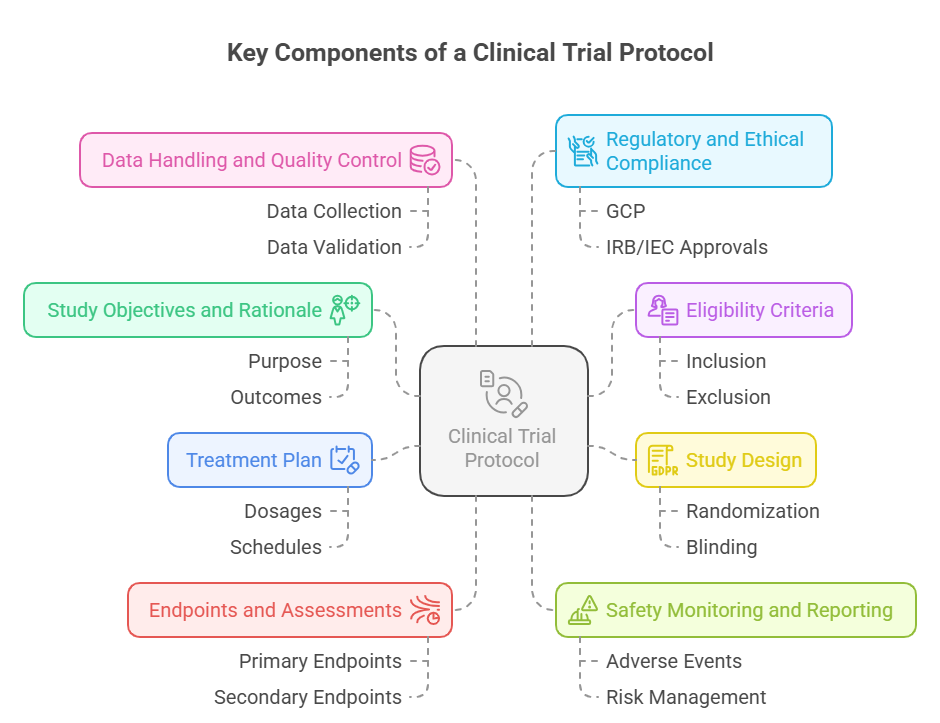
This mind map provides a great visual overview of where the components we are discussing today fit within a complete clinical trial protocol.
To start, let's watch a short video that provides a clear, step-by-step overview of how to approach writing a methodology section.
How to Write a Research Methodology in 4 Steps | Scribbr 🎓
This video from Scribbr provides an excellent general framework for writing a research methodology. It will help us understand the core purpose and structure before we dive into the specifics for Ayurveda.
Please watch the video from the beginning until 03:47. Pay attention to the four main steps it outlines: explaining your approach, describing data collection, describing analysis, and justifying your choices. We will focus on the first two steps today.
The video provides a solid foundation. Now, let's build upon it by focusing on the unique aspects of designing a study for an Ayurvedic intervention. For the rest of this lesson, let's imagine we are planning a hypothetical study: a pragmatic randomized controlled trial to evaluate a whole-system Ayurvedic approach for managing mild-to-moderate knee osteoarthritis, compared to standard care.
2. Component 1: Study Design and Setting
This is the first part of your Methods section. Here, you formally state the design you've chosen and describe the environment where the study will take place.
-
Study Design: You should concisely describe the architecture of your trial. This description usually includes several keywords. Based on our hypothetical study and what we learned previously, a good description would be: "This will be an open-label, parallel-group, randomized, controlled, pragmatic trial."
- Open-label: Both researchers and participants know which treatment is being administered (often necessary for complex Ayurvedic interventions where blinding is not feasible).
- Parallel-group: Each group receives a different treatment simultaneously.
- Randomized Controlled Trial (RCT): Participants are randomly assigned to a group, which is the cornerstone of reducing selection bias.
- Pragmatic: The trial aims to evaluate effectiveness in a real-world setting, as discussed in our last lesson.
-
Study Setting: You must specify where the research will be conducted. This is important for context and feasibility. For example: "The study will be conducted at the outpatient (OPD) and Panchakarma departments of a tertiary care Ayurvedic hospital."
To see how this is written in a real protocol, you can look at the "Study Design and Setting" section of the published protocol on osteoarthritis, "Efficacy of a Multimodal Ayurveda Regimen..." (Resource LINK).
3. Component 2: Study Participants
This section defines exactly who is eligible for your study. It's crucial for ensuring patient safety and the scientific validity of your results. This is done using inclusion criteria and exclusion criteria.
- Inclusion Criteria: The characteristics that a person must have to be included in the study.
- Exclusion Criteria: The characteristics that disqualify a person from participating, even if they meet the inclusion criteria.
For Ayurvedic research, it's vital to consider criteria from both modern and Ayurvedic perspectives.
Guidelines for AYUSH Clinical Studies in COVID-19
The Ministry of AYUSH has developed excellent guidelines that provide specific examples of eligibility criteria for Ayurvedic trials. Let's review the relevant section.
Please read the subsection titled 'Eligibility criteria' within section '5. Methods'. It starts on page 8. Pay close attention to how it suggests incorporating AYUSH-specific concepts, like excluding individuals of a specific Prakriti if the intervention is contraindicated for them.
As the guidelines highlight, your criteria should be specific and unambiguous. For our hypothetical osteoarthritis study, the criteria might look like this:
Inclusion Criteria:
- Male or female, age 40-70 years.
- Diagnosed with primary osteoarthritis of the knee based on American College of Rheumatology (ACR) criteria.
- Reports knee pain on most days of the past month.
- Provides written informed consent.
Exclusion Criteria:
- Patients with Ama dominant conditions, as the planned intervention may not be suitable. (Ayurvedic criteria)
- History of knee surgery or trauma. (Modern criteria)
- Diagnosis of rheumatoid arthritis. (Modern criteria)
- Pregnant or lactating women. (Safety criteria)
Test your understanding!
You are designing a study for an Ayurvedic intervention (*Medhya Rasayana*) aimed at improving memory in university students during exam periods. Draft one inclusion criterion and two exclusion criteria for this study.Show answer
- Inclusion Criterion (example): Currently enrolled, healthy university students aged 18-25 years, scheduled to take final examinations within the next month.
- Exclusion Criterion 1 (example): History of any diagnosed neurological or psychiatric condition (e.g., epilepsy, depression, anxiety disorder).
- Exclusion Criterion 2 (example): Regular use of any other memory-enhancing supplements or medications.
4. Component 3: The Interventions
This is where you provide a detailed description of the treatments the study groups will receive. For Ayurvedic research, this requires exceptional detail.
A. The Ayurvedic Intervention Group:
You must describe the "whole system" intervention. This includes all components of the treatment.
B. The Comparison/Control Group:
You must also describe what the control group receives. This could be a placebo, standard allopathic care, or a different Ayurvedic intervention.
Let's look at an extremely detailed example of how to document a complex Ayurvedic intervention.
Guidelines for AYUSH Clinical Studies in COVID-19
Annexure Four of the AYUSH guidelines provides a complete, illustrative protocol for a standalone Ayurveda intervention for COVID-19. It's a masterclass in how to detail a complex, multi-component treatment plan.
Please read section '4. Interventions' on pages 9-11 of the document. Notice how it's structured: it lists different medicines for 'Mild' and 'Moderate' stages, includes kriya (procedures), diet, and regimen. It also gives the classical text reference for each medicine. This level of detail is the standard to aim for.
As you saw, a comprehensive description of an Ayurvedic intervention should include:
- Medicines: Name (with classical reference), ingredients (if not a classical formula), dosage, frequency, anupana (vehicle), and duration.
- Procedures (Karmas): Name of the procedure (e.g., Janu Basti), materials used (e.g., specific oil), duration, and frequency.
- Diet (Pathya): Specific dietary recommendations and restrictions.
- Lifestyle (Vihara): Advice on rest, sleep, exercise, and other activities.
It is also crucial to state that the intervention will be personalized within the defined framework, if that is the case. For example: "The attending Vaidya will select from the listed medicines based on the patient's specific presentation of doshas and symptoms, in accordance with the principles of Ayurveda."
5. Component 4: Outcome Measures
This section defines what you will measure to assess the intervention's effects and answer your research question. As with participants, you should aim to capture both biomedical and Ayurvedic endpoints. This is central to your goal of bridging the two sciences.
It's standard practice to define:
- Primary Outcome: The single most important outcome that will determine the success of the trial. The sample size is usually calculated based on this outcome.
- Secondary Outcomes: Additional important outcomes that provide more information about the intervention's effects.
Guidelines for AYUSH Clinical Studies in COVID-19
The AYUSH guidelines also provide excellent guidance on selecting and defining outcome measures that are relevant to both Ayurvedic and modern contexts.
Please read the subsection titled 'Outcomes' within section '5. Methods', starting on page 12. Pay particular attention to the box on 'Different outcomes domain' and the specific section on 'Variables based on diagnostic and prognostic factors from AYUSH systems'.
For our hypothetical osteoarthritis study, the outcomes might be:
-
Primary Outcome:
- Change from baseline in the Western Ontario and McMaster Universities Osteoarthritis Index (WOMAC) score at 12 weeks. (A validated, modern questionnaire for pain and function).
-
Secondary Outcomes:
- Change in Ayurvedic symptom score for Sandhigata Vata (including pain - shula, stiffness - stambha, and crepitus - atopa).
- Change in inflammatory markers (e.g., hs-CRP) in blood tests.
- Amount of rescue pain medication used.
- Change in Quality of Life score (e.g., using the SF-36 questionnaire).
Finally, you must specify the schedule of assessments—a timeline showing when each outcome will be measured (e.g., at baseline, week 4, week 8, and week 12).
Putting It All Together: A Real-World Example
We have discussed the four main components in theory. Now, let's see how they look when assembled into a complete, professional Methods section.
Efficacy of a Multimodal Ayurveda Regimen in the ...
This published research protocol on an Ayurvedic regimen for osteoarthritis is a perfect example. It clearly lays out all the elements we have discussed. Reading it will help you synthesize your understanding.
Please read the entire 'Methods' section of this paper. As you read, identify the four components we've covered: 1) Study Design and Setting, 2) Study Participants (inclusion/exclusion), 3) Study Intervention (notice the detailed table), and 4) Outcome Measures (primary and secondary).
This protocol demonstrates the level of clarity, detail, and structure required to communicate your research plan effectively to ethics committees, funding agencies, and the broader scientific community.
Conclusion
You have now learned how to construct the Methods section of a research proposal for an Ayurvedic intervention. This section is the operational heart of your study, translating your research question into a series of clear, executable steps.
Key Takeaways:
- The Methods section must be detailed enough for another researcher to replicate your study.
- It is built around four key pillars: Study Design, Participants (inclusion/exclusion criteria), Interventions (for all groups), and Outcome Measures (primary and secondary).
- For Ayurvedic research, it is essential to be explicit about how Ayurvedic principles are incorporated, such as using Ayurvedic diagnostic criteria for exclusion or inclusion, providing a comprehensive description of the multi-component intervention (medicines, diet, procedures), and selecting both biomedical and Ayurvedic outcome measures.
Preview of the Next Lesson:
With the 'what' and 'how' of your study planned, the next logical steps are to detail how you will analyze the data you collect and to formalize the ethical protections for your participants. In our next lesson, we will focus on drafting the 'Data Analysis Plan' and 'Ethical Considerations' sections of your research proposal.