Introduction
Welcome to our next lesson. In our previous explorations, we've focused on sequential data structures like dynamic arrays (list) and strings. A common thread you might have noticed is that to find an arbitrary element, you often have to scan through the structure, an operation that takes O(n) time. Today, we'll introduce a data structure designed to shatter that limitation: the hash map.
This lesson will explain the fundamental purpose of a hash map: to provide remarkably efficient lookups. By the end, you will understand the core mechanism that allows hash maps to retrieve, insert, and delete data in what is, on average, constant time (O(1)). This concept is not just a theoretical curiosity; it's the engine behind Python's dict type and a cornerstone of efficient algorithm design, making it indispensable for your interview preparation.
The Problem with Sequential Lookups
Imagine you're building a system to manage millions of user profiles. A natural first step might be to store them in a list. If you need to find a user by their username, what's your strategy?
# A list of tuples: (username, name, email)
users = [
    ("j_doe", "John Doe", "j.doe@example.com"),
    ("a_smith", "Alice Smith", "a.smith@example.com"),
    # ... millions more users
]

def find_user(username_to_find, user_list):
    for username, name, email in user_list:
        if username == username_to_find:
            return (username, name, email)
    return None
As you know from our lessons on complexity, this find_user function has a time complexity of O(n). On average, you'd have to check half the list; in the worst case, the entire list. For millions of users, this is unacceptably slow.
The following video provides an excellent introduction to this exact problem and sets the stage for the solution that hash maps provide.
HashMaps & Dictionaries, Explained Simply
Watch the beginning of the video "HashMaps & Dictionaries, Explained Simply".
Please watch from the start up to the moment the speaker introduces hashmaps as the solution. This section perfectly frames the problem of inefficient lookups in arrays. Focus on why a simple array is not suitable when you need to find data using a non-numeric identifier like a username. Pay attention to the segment from the problem setup.
The Hash Map Solution: Direct Access via Keys
A hash map (known as a dictionary in Python) solves this problem by creating a direct mapping between a key (like a username) and a value (the user's profile data). Instead of searching, it calculates exactly where the data should be stored.
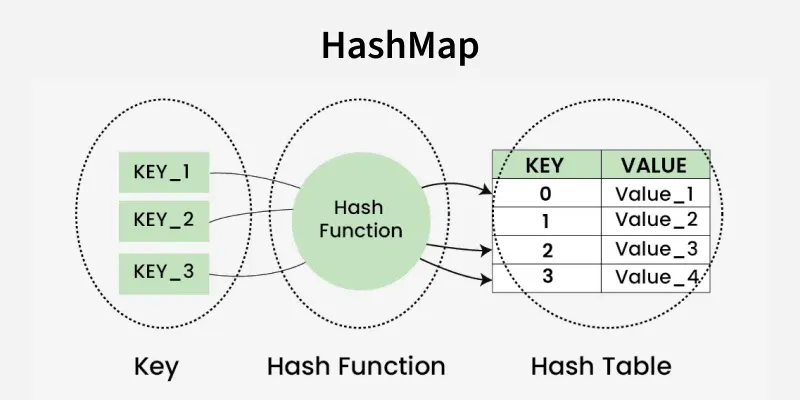
This diagram illustrates the core idea of a hash map. Keys are passed through a hash function, which generates an index to directly access a value in the underlying hash table.
The key-value pair is a powerful abstraction. You've certainly used it extensively in Python:
user_data = {
    "user_123": {"name": "Alice", "email": "alice@example.com"},
    "user_456": {"name": "Bob", "email": "bob@example.com"},
}

# Near-instantaneous lookup
print(user_data["user_456"])
But how does this "magical" direct access work?
The Core Mechanism: Hashing
The magic behind the hash map is a process called hashing. It consists of three main ideas:
- Underlying Array: At its heart, a hash map is just an array. This array is often called the hash table or a set of buckets.
- Hash Function: A special function, the hash function, takes a key of any (immutable) type and converts it into a large integer called a hash code or simply a hash. A good hash function is deterministic (the same key always produces the same hash) and aims to produce unique hashes for unique keys.
- Index Mapping: This large hash is then mapped to a valid index within the much smaller underlying array, typically using the modulo operator (
%). The formula isindex = hash(key) % array_size.
This calculated index is where the value is stored. When you want to retrieve the value, the hash map performs the exact same calculation, instantly knows the index, and retrieves the data directly. No searching is required.
The following video gives a wonderfully clear, step-by-step explanation of this entire process.
HashMaps & Dictionaries, Explained Simply
Continue watching "HashMaps & Dictionaries, Explained Simply".
This part of the video breaks down how a hash function turns a string key into an index. Please watch these two segments: First, watch the section that explains how a string is converted into a number, and the role of a hash function. It runs from turning a key into an index. Next, see how the modulo operator is used to map a very large hash value to a small, manageable array index. This crucial step is explained from using the modulo operator.
To solidify this, let's look at a concrete example. The image below shows how four input values are transformed by a simple hash function (H(x) = x % 10) into hash keys that correspond to indices in an array of size 10.

This flowchart and table show the hashing process for four integer inputs. Each input is processed by the modulo hash function to produce a hash key, which directly maps to an index in the storage array.
Why Hashing Enables O(1) Lookups
You can now see why hash maps are so efficient. The lookup operation does not involve iterating through the elements. It's a simple, fixed set of calculations:
- Compute the hash of the key:
hash(key). - Compute the index:
index = hash_value % array_size. - Access the array at that index:
array[index].
Each of these steps takes a constant amount of time. The speed of the lookup is therefore independent of the number of items, n, in the hash map. This gives us the coveted average time complexity of O(1) for insertions, deletions, and lookups.
To understand the theory behind this, please read the following article which cleanly summarizes the key mechanisms.
How Hash Tables Achieve O(1) Time Complexity
This article from Faangshui reinforces the core principles we've just discussed.
Read the introduction and the first major section, "Efficient Hash Functions." Focus on the text from this section. It summarizes the components of a hash table and the properties of a good hash function that enable O(1) performance.
A Quick Note on Collisions
You might be wondering: what happens if two different keys produce the same index after the modulo operation? This is called a collision, and it's an expected occurrence.
hash("Jeff") % 20000 -> 123hash("Bob") % 20000 -> 123
This is the reason we refer to the complexity as average O(1). A well-designed hash map has strategies to handle collisions efficiently, ensuring that performance doesn't degrade. While a deep dive into collision resolution strategies like chaining and open addressing is a topic for a future lesson, it's important to acknowledge their existence.
The video you've been watching explains one simple collision resolution strategy called linear probing.
HashMaps & Dictionaries, Explained Simply
Watch the final recommended segment from "HashMaps & Dictionaries, Explained Simply".
This part illustrates what happens during a collision and how it can be handled. Watch the section from demonstrating collisions. This will give you a complete, albeit high-level, picture of how a hash map works.
Hash Maps in the Real World
The principles we've discussed are not just theoretical. They are precisely how Python's powerful dict type is implemented. Every time you use a dictionary, you are leveraging the power of hashing. Given your background in data science and ML, you're constantly relying on this efficiency.
To tie this all together, please read about the practical applications of hashmaps.
Hashmaps in Python: Master Implementation and Use Cases
This article from roadmap.sh connects the concept of hashmaps directly to Python dictionaries and their real-world use cases.
Please read the first section, What is a hashmap in Python?, and then jump to the section "Practical applications of hashmaps." In that section, focus on the descriptions for these use cases. This will give you a strong sense of why this data structure is so prevalent in software engineering and data science.
The use cases, such as frequency counting, caching (memoization), and database indexing, are all areas where the O(1) lookup speed of a hash map provides a monumental performance advantage over linear data structures.
Conclusion
This lesson introduced the hash map, a fundamental data structure designed for one primary purpose: extremely fast data retrieval. By understanding its mechanics, you've unlocked a crucial piece of the puzzle for writing efficient code and acing technical interviews.
Key Takeaways:
- Purpose: Hash maps solve the
O(n)lookup problem of sequential data structures like arrays and lists. - Mechanism: They use a hash function to convert a key into an integer (hash code), and then the modulo operator to map that hash to an index in an underlying array.
- Efficiency: This direct computation allows for average
O(1)time complexity for lookups, insertions, and deletions, as the operation time is independent of the number of elements. - Python Implementation: The
dicttype in Python is a highly optimized hash map implementation. - Collisions: When two keys map to the same index, a collision occurs. Hash maps have built-in strategies to resolve this, which is why the time complexity is
O(1)on average.
In our next lesson, we will switch gears to an algorithmic pattern. We will explore the sliding window technique, a powerful method for efficiently solving problems involving contiguous subarrays or substrings.