Introduction
Welcome to the final lesson of our foundational module. In our last session, we mastered the sliding window technique, an efficient pattern for analyzing contiguous subarrays by maintaining a "window" and sliding it across an array. This was ideal for problems asking for the longest, shortest, or best property of a subarray.
Today, we'll tackle a related but distinct challenge: efficiently calculating the sum of elements within any given range [l, r] of an array. While you could use a sliding window of size r - l + 1, this becomes inefficient if you face many queries for different ranges. This lesson introduces the prefix sum technique, a powerful method that involves a one-time pre-computation to answer any subsequent range sum query in constant time. This concept of trading upfront computation for rapid query responses is a cornerstone of efficient algorithm design.
The Challenge of Repeated Range Sums
Imagine you are given a large array and need to answer thousands of queries, each asking for the sum of elements in a different sub-range. For example, in your work with financial data, you might be asked for the total return of a strategy between day 10 and day 50, then between day 20 and day 80, and so on.
The most straightforward approach is to loop through the array from the left to the right index for each query and add up the elements.
- Time Complexity of Naive Approach: For a single query on a range of length
k, this takesO(k)time. In the worst case, the range can span the entire array, making itO(n). If you haveQqueries, the total time complexity becomesO(Q * n), which is too slow for many applications.
This video introduces this exact problem, highlighting the inefficiency of the naive approach.
Prefix Sum Array and Range Sum Queries
Watch this video from the beginning to understand the problem setup and the redundancy involved in the naive, brute-force approach.
Pay attention to the initial problem description from the start and the simplification of the problem which discusses calculating sums from the beginning of the array from this point. This highlights where the repeated work occurs.
The Prefix Sum Solution: Pre-computation for O(1) Queries
The key insight to optimize this is that the sum of a range can be calculated from the cumulative sums from the start of thearray. This is the essence of the prefix sum technique.
We create a new array, let's call it prefix, where prefix[i] stores the sum of all elements in the original array arr from index 0 up to i-1.
The process involves two main steps:
- Pre-computation: Build the
prefixarray. This takesO(n)time as you only need to iterate through the original array once. - Querying: Use the
prefixarray to answer any range sum querysum(l, r)inO(1)time.
This diagram provides a perfect high-level overview of the entire technique.
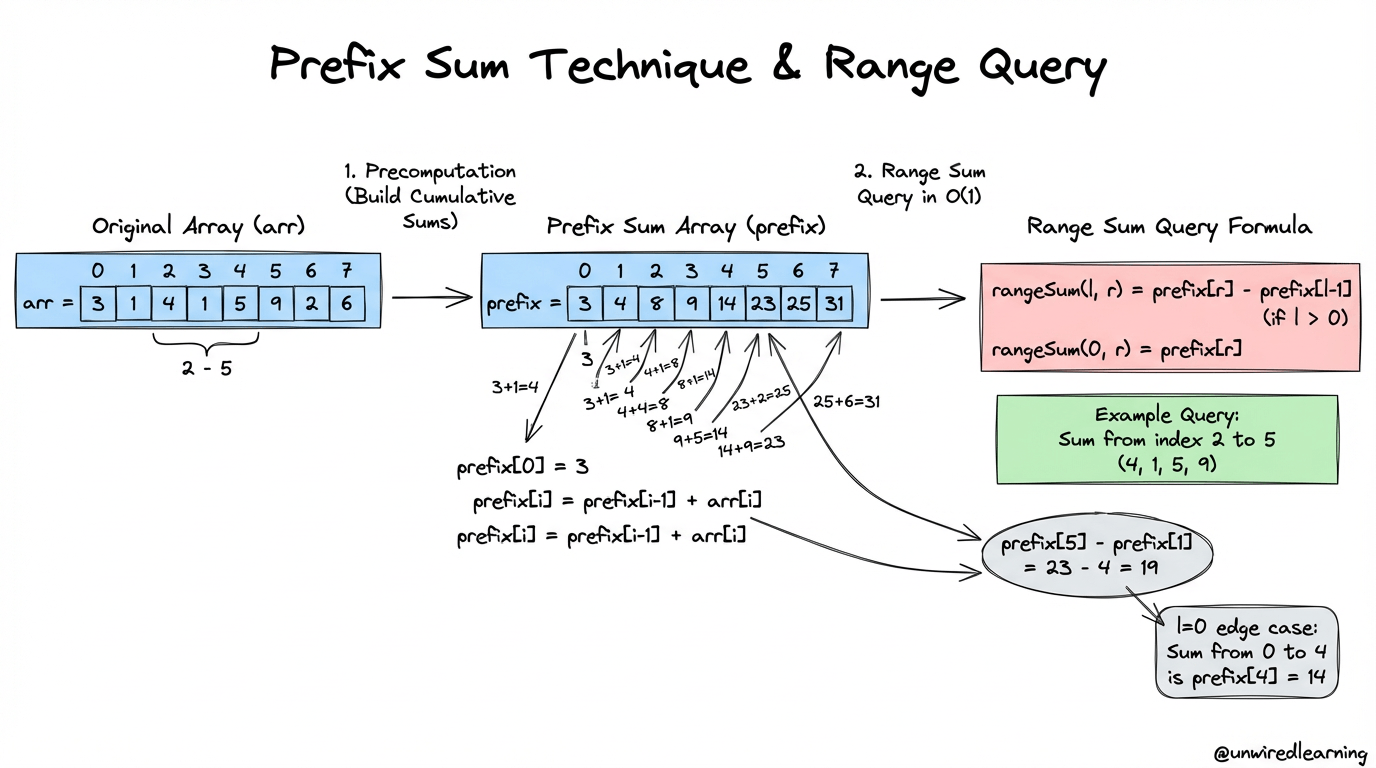
The formula to get the sum of elements from index l to r (inclusive) is:
This works because prefix[r+1] contains the sum from arr[0] to arr[r], and prefix[l] contains the sum from arr[0] to arr[l-1]. Subtracting the two leaves exactly the sum from arr[l] to arr[r].
For a deeper dive into this core logic, the following reading provides an excellent, detailed explanation.
303. Range Sum Query - Immutable - In-Depth Explanation
This resource from Algo.monster breaks down the intuition and implementation for the classic "Range Sum Query" problem. It clearly explains the time-space tradeoff and the indexing convention that makes the implementation clean.
Start by reading the Intuition section, which explains why pre-computation is useful and derives the core formula. Then, review the Solution Approach which formalizes the data structure. Finally, walk through the Example Walkthrough to solidify your understanding.
Implementation and Edge Cases
A common and elegant way to implement the prefix sum array is to make its size n+1 and initialize prefix[0] = 0. This small trick handles the edge case where the range starts at index 0 (l=0) without needing a separate if condition, as prefix[l] becomes prefix[0], which is 0.
Here is a Python implementation within a class, as is common in interview platforms like LeetCode.
from itertools import accumulate
from typing import List

class NumArray:
    def __init__(self, nums: List[int]):


        # The prefix sum array is of size n+1.
        # prefix_sums[i] stores the sum of the first i elements of nums.
        # initial=0 ensures prefix_sums[0] is 0.
        self.prefix_sums = list(accumulate(nums, initial=0))

    def sumRange(self, left: int, right: int) -> int:


        # The sum of elements from index left to right (inclusive) is
        # the sum up to 'right' minus the sum up to 'left-1'.
        # In our 1-based prefix_sums array, this translates to:
        # prefix_sums[right + 1] - prefix_sums[left]
        return self.prefix_sums[right + 1] - self.prefix_sums[left]


# Example Usage:
nums = [-2, 0, 3, -5, 2, -1]
num_array = NumArray(nums)
print(num_array.sumRange(0, 2))  # Output: 1  (-2 + 0 + 3)
print(num_array.sumRange(2, 5))  # Output: -1 (3 + -5 + 2 + -1)
print(num_array.sumRange(0, 5))  # Output: -3 (Sum of all elements)
Notice the use of itertools.accumulate. Given your proficiency in Python, you'll appreciate that this is a clean and efficient way to generate cumulative sums.
The following video walks through the implementation and clearly explains the initial=0 trick.
Prefix Sum Array and Range Sum Queries
This part of the video explains how to answer general range queries and the clever trick of padding the prefix sum array with a zero.
Watch from this point to see how the pre-computed array is used to answer general L to R queries. Then, pay close attention to the section from this timestamp, which covers the elegant solution for the l=0 edge case and analyzes the final time and space complexity.
Advanced Application: Subarray Sum Equals K
The prefix sum technique is not limited to simple range sum queries. It's a powerful building block for more complex problems. A classic example is LeetCode 560: "Subarray Sum Equals K," which asks for the count of all contiguous subarrays that sum to a target value k.
Here, we can combine prefix sums with a hash map (which you'll recall from an earlier lesson). The logic is as follows:
- Iterate through the array, calculating the
current_prefix_sum. - For a subarray ending at index
ito sum tok, we needcurrent_prefix_sum - previous_prefix_sum = k. - This means we are looking for a
previous_prefix_sumsuch thatprevious_prefix_sum = current_prefix_sum - k. - We can use a hash map to keep track of the frequencies of all prefix sums we have encountered so far. At each step, we check if
current_prefix_sum - kexists in our map. If it does, we add its stored frequency to our total count.
This image provides an excellent step-by-step walkthrough of this exact algorithm.

This combination of prefix sums and hash maps is a common and powerful pattern for solving a wide range of subarray problems that go beyond simple summation.
Conclusion
In this lesson, we've explored the prefix sum technique, a fundamental tool for efficiently handling array-based queries. By investing O(n) time for pre-computation, you gain the ability to answer any range sum query in O(1) time. This time-space tradeoff is a recurring theme in algorithm design.
Key Takeaways:
- Core Idea: Pre-compute cumulative sums to answer range sum queries in constant time.
- Implementation: An
O(n)pass to create aprefixarray. The formulasum(l, r) = prefix[r+1] - prefix[l]then runs inO(1). Using a prefix array of sizen+1with an initial0elegantly handles edge cases. - Complexity: The pre-computation is
O(n)time andO(n)space. Each subsequent query isO(1)time. This is highly efficient when the number of queries is large. - Applications: The technique is a building block for more complex problems, such as counting subarrays with a specific sum when combined with a hash map.
This lesson concludes our first module on foundational data structures and array/string patterns. You have now refreshed your understanding of complexity, lists, strings, hash maps, sliding windows, and prefix sums.
In our next module, we will shift our focus to Core Algorithms, starting with one of the most important and frequently tested algorithms: binary search.