Introduction
Welcome to your next lesson in the Geography module. In our previous discussion, we explored the diverse physical features of India, such as the mighty Himalayas, the fertile Northern Plains, and the ancient Peninsular Plateau. We touched upon how these features, particularly the mountains and rivers, are fundamental to the country's geography. Today, we will build directly on that knowledge to understand how these landforms orchestrate one of the most significant phenomena shaping life in India: the climate.
This lesson will address the learning outcome of identifying Indian climate patterns, the monsoon mechanism, and the distinct seasons. You will learn about the factors that control India's climate, demystify the mechanics of the monsoon, and walk through the annual cycle of seasons that defines the rhythm of life across the subcontinent. For your SSC CGL exam, this topic is crucial, as questions frequently appear on the monsoon, seasonal rainfall patterns, and associated terminology.
Factors That Shape India's Climate
To begin, it's important to distinguish between "weather" and "climate." Weather refers to the atmospheric conditions at a specific place and time (e.g., a sunny afternoon), while climate is the average weather pattern over a long period, typically 30 years or more. India's climate is broadly classified as a 'monsoon' type, but it exhibits immense regional variation.
Several factors, many of which you encountered in the last lesson, work together to produce India's unique climate.
Chapter 04 Climate | India Physical Environment | SATHEE
This chapter from the NCERT textbook "India Physical Environment" provides a clear and fundamental explanation of India's climate. It's an essential read to build a strong conceptual foundation.
Please read the section titled "FACTORS DETERMINING THE CLIMATE OF INDIA". As you read, focus on how each factor influences temperature and rainfall: Latitude: Notice how the Tropic of Cancer divides the country into tropical and sub-tropical zones. The Himalayan Mountains: Recall from our last lesson how these mountains act as a climatic divide, blocking cold winds from Central Asia and trapping monsoon winds. Distribution of Land and Water: Understand the concept of differential heating of land and sea, which is the primary driver of the monsoon. Distance from the Sea: This explains the difference between the moderate coastal climates (like Mumbai's) and extreme inland climates (like Delhi's). Altitude and Relief: Connect this to how the Western Ghats cause heavy rainfall on their western slopes but create a dry "rain-shadow" area to the east.
The Monsoon Mechanism: A Grand Reversal of Winds
The word "monsoon" comes from the Arabic word 'mausim', meaning 'season'. It refers to the seasonal reversal of wind direction, which is the defining characteristic of India's climate.
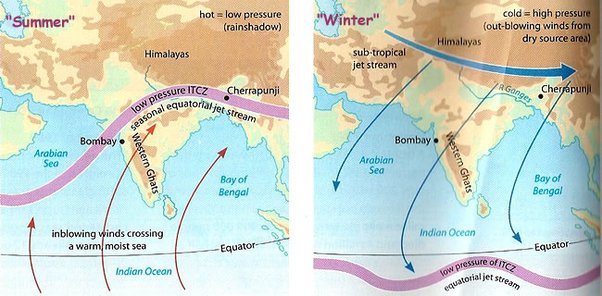
While the differential heating of land and sea is the classic explanation, the modern understanding of the monsoon is more nuanced and involves several other large-scale atmospheric phenomena.
To get a comprehensive and exam-focused overview of this mechanism, let's watch a segment from a lecture by Parmar Sir.
GEOGRAPHY FOR SSC EXAMS 2025 | MONSOON | FRB 2.0 BY PARMAR SIR
This video provides a concise explanation of the complex factors involved in the monsoon, which is perfect for your SSC preparation.
Watch the section from intense low pressure was formed. The instructor explains the key elements driving the monsoon's arrival: The creation of an intense low-pressure zone over the Indian subcontinent in summer. The formation of a high-pressure cell (Mascarene High) near Madagascar. The northward shift of the Inter-Tropical Convergence Zone (ITCZ), often called the "monsoon trough." The role of the intensely heated Tibetan Plateau. The influence of Easterly Jet Streams, which facilitate the monsoon's arrival.
The Rhythm of Seasons
The Indian Meteorological Department (IMD) recognizes four principal seasons. Let's explore the key features of each.
1. The Hot Weather Season (Summer: March to May)
As the sun moves northwards, the Indian landmass heats up, creating a strong low-pressure area. This season is characterized by intense heat and hot, dry winds in northern India called the 'Loo'.
Before the main monsoon arrives, various parts of the country experience pre-monsoon showers. These have local names and are very important to know for your exam:
- Mango Shower: Occurs in Kerala and coastal Karnataka, helping in the early ripening of mangoes.
- Blossom Shower: In Kerala and nearby coffee-growing areas, leading to the blossoming of coffee flowers.
- Nor'westers or Kal Baisakhi ('calamity of the month of Baisakh'): These are evening thunderstorms in West Bengal and Assam, crucial for jute and tea cultivation. In Assam, they are also known as Bardoisila.
2. The Southwest Monsoon Season (Rainy Season: June to September)
This is the main rainy season for most of India. The high-pressure winds from the southern Indian Ocean cross the equator, get deflected to the right due to the Coriolis force, and approach India as the Southwest Monsoon.
The arrival of the monsoon is a sudden and dramatic event, often called the "burst" of the monsoon.
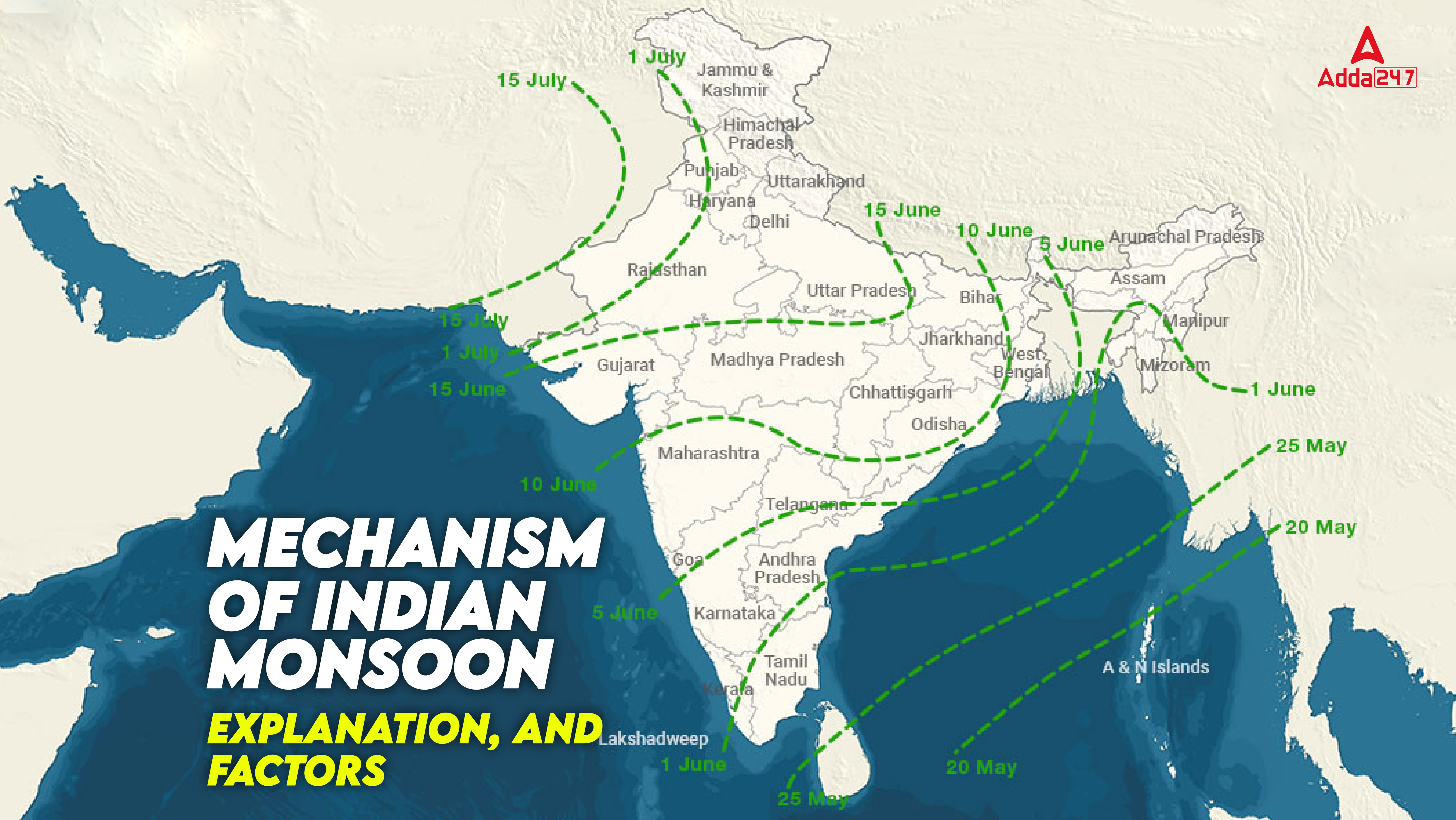
The Southwest Monsoon splits into two branches upon reaching the Indian peninsula:
- The Arabian Sea Branch: This branch strikes the Western Ghats, causing very heavy orographic rainfall on the windward (western) side and leaving the leeward (eastern) side, like the Deccan Plateau, in a rain-shadow area. One sub-branch moves up the Narmada-Tapi valley, while another moves parallel to the Aravallis, providing little rain to Rajasthan.
- The Bay of Bengal Branch: This branch brings heavy rain to Northeast India. The hills of Meghalaya (Garo, Khasi, Jaintia) trap these winds, making Mawsynram and Cherrapunji the wettest places on Earth. These winds then turn westwards, moving up the Gangetic plains, bringing rain to Bihar, UP, and Punjab, where they merge with the Arabian Sea branch. The Tamil Nadu coast remains largely dry during this season as it lies parallel to this branch and in the rain-shadow of the Arabian Sea branch.
3. The Retreating Monsoon Season (Autumn: October to November)
From September, as the sun moves south, the low-pressure trough over the northern plains weakens and is replaced by a high-pressure system. This marks the withdrawal or retreat of the monsoon.
The skies become clear, but the combination of high temperature and lingering moisture leads to oppressive, humid conditions known as 'October Heat'.
As the winds retreat, they blow from the northeast towards the Bay of Bengal. While crossing the bay, they pick up moisture and bring rain to the Coromandel Coast. This is why Tamil Nadu and southern Andhra Pradesh receive their main rainfall in winter. This is often called the North-East Monsoon.
4. The Cold Weather Season (Winter: December to February)
During this season, clear skies and low temperatures prevail over North India. A significant feature is the inflow of cyclonic disturbances from the Mediterranean Sea, known as Western Disturbances.
These disturbances are brought to India by the westerly jet stream and cause light but crucial winter rainfall over the northern plains (Punjab, Haryana, Delhi). This rain is highly beneficial for the winter or Rabi crops, especially wheat. In Rajasthan, this winter rain is locally known as 'Mawat'.
El Niño and its Impact
The Indian monsoon is also influenced by global phenomena. One of the most important is El Niño.
GEOGRAPHY FOR SSC EXAMS 2025 | MONSOON | FRB 2.0 BY PARMAR SIR
This short, animated segment clearly explains the complex El Niño and La Niña phenomena and their relevance to India.
Watch the section from you will know right now. The key takeaway is: Normal Conditions: Warm water piles up in the Western Pacific (near Australia), which helps the Indian monsoon. El Niño: This is a reversal where warm water moves to the Eastern Pacific (near South America). This abnormal warming disrupts the global weather pattern and is generally associated with a weaker, delayed, and deficient monsoon in India. La Niña: This is an intensification of the normal condition, with even cooler waters in the Eastern Pacific. It is generally favorable for the Indian monsoon, often leading to above-average rainfall.
Conclusion
In this lesson, we have delved into the dynamics of India's climate. You have learned about the crucial factors that control it, with the Himalayas and the peninsular landmass playing starring roles.
Here are the key takeaways:
- Controlling Factors: India's climate is governed by its latitude, the Himalayas, relief features, and its proximity to the sea.
- Monsoon Mechanism: The monsoon is a seasonal wind reversal driven by the differential heating of land and sea, the northward shift of the ITCZ, and the influence of jet streams.
- The Four Seasons:
- Summer: Characterized by heat, 'Loo', and pre-monsoon showers like Kal Baisakhi and Mango showers.
- Southwest Monsoon: The main rainy season, arriving as two branches (Arabian Sea and Bay of Bengal).
- Retreating Monsoon: Known for 'October Heat' and the North-East monsoon which brings rain to the Coromandel coast.
- Winter: Marked by Western Disturbances causing rain in North India, vital for Rabi crops.
- Global Influence: Phenomena like El Niño can significantly weaken the Indian monsoon.
A solid understanding of these patterns is essential not just for your exams but also for appreciating the intricate connection between geography and life in India.
In our next lesson, we will explore the soils, natural vegetation, and mineral resources of India, topics that are directly influenced by the climatic patterns and rainfall distribution we've discussed today.