Introduction
In our previous lesson, we concluded our journey through India's geography by examining its soils, vegetation, and mineral resources. Today, we pivot to a new and fundamental pillar of the General Awareness section for your SSC CGL exam: General Science. We will begin with Physics, a subject that explains the principles governing the world around us.
This lesson is designed to address the learning outcome: Apply fundamental concepts of units, motion, light, and sound to solve problems. We will cover a broad range of foundational topics, focusing on the core ideas, formulas, and types of questions frequently asked in your exam. We will explore how we measure physical quantities, analyze the motion of objects, understand the nature of light and reflection, and touch upon the basics of sound waves. Since you have an Arts background, we will build these concepts from the ground up, ensuring a clear and logical progression.
Part 1: The Language of Physics - Units and Quantities
Before we can describe motion, light, or sound, we need a common language to measure them. This is where physical quantities and their units come in. In physics, every measurement consists of a numerical value (its magnitude) and a unit.
For a concise overview of these foundational concepts, please read the first page of the provided PDF resource.
[PDF] Physics Notes & 50 Questions for SSC CGL Tier 2 Exam - Adda247
This document from Adda247 provides a quick, exam-focused summary of key physics concepts. We'll be using it throughout this lesson.
On the first page, please read the sections covering Physical Quantities, Units, and Rest and Motion. This will introduce you to fundamental vs. derived quantities and the basic idea of motion.
As you've just read, quantities are divided into two main types:
- Fundamental Quantities: These are the seven basic building blocks that are independent of each other: Mass (kg), Length (m), Time (s), Temperature (K), Electric Current (A), Luminous Intensity (cd), and Amount of Substance (mol).
- Derived Quantities: These are formed by combining fundamental quantities. For example, Speed is derived from Length (distance) and Time. Its unit is m/s.
Another crucial distinction is between scalar and vector quantities. This is a concept that often appears in SSC questions.
- Scalar Quantity: Has only magnitude (a numerical value). Examples: distance, speed, mass, time, work, energy. When you say you traveled 10 km, that's a scalar.
- Vector Quantity: Has both magnitude and direction. Examples: displacement, velocity, acceleration, force, momentum. When you say you traveled 10 km east, that's a vector.
This distinction is key to understanding the difference between distance and displacement, which we'll explore next.
Part 2: Describing Motion
Motion is all around us, from a moving car to a thrown ball. To analyze it for your exam, you need to be precise with the terms distance, displacement, speed, velocity, and acceleration.
The following video offers a very clear and relatable explanation of these concepts. The instructor uses the example of a student traveling to school, which is a great way to visualize the difference between the total path taken (distance) and the shortest path (displacement).
SSC Science | Physics | Motion Part-1 | Day-2 | A to Z Batch | All SSC Exams | Radhika ma'am
This video from 'SSC - Abhinay Maths' channel is excellent for building a strong conceptual foundation in motion, especially for those new to these physics concepts. The language is a mix of Hindi and English.
Please watch the following segments: Distance vs. Displacement: Watch this section for a detailed example distinguishing the total path from the shortest path. Scalar vs. Vector: The explanation continues from this timestamp, linking distance to scalar and displacement to vector quantities. Speed vs. Velocity: From here, the instructor defines speed (using distance) and velocity (using displacement). Acceleration: Watch from this part to understand acceleration as the rate of change of velocity, including positive, zero, and negative (retardation) acceleration with clear examples.
Key Formulas and Equations of Motion
Based on the video and your notes, here are the essential formulas you must know:
- Speed = Distance / Time (Scalar, Unit: m/s)
- Velocity = Displacement / Time (Vector, Unit: m/s)
- Acceleration () = (Final Velocity () - Initial Velocity ()) / Time () (Vector, Unit: m/s²)
When an object moves with uniform acceleration (constant change in velocity), its motion can be described by three key equations. These are extremely important for solving numerical problems in the SSC CGL exam.
Where:
- = final velocity
- = initial velocity
- = acceleration
- = time
- = displacement
A special case is motion under gravity (like a freely falling object). In this case, acceleration is replaced by the acceleration due to gravity, (approximately 9.8 m/s²).
Visualizing Motion with Graphs
Graphs are a powerful way to represent motion. The SSC often asks conceptual questions based on them.
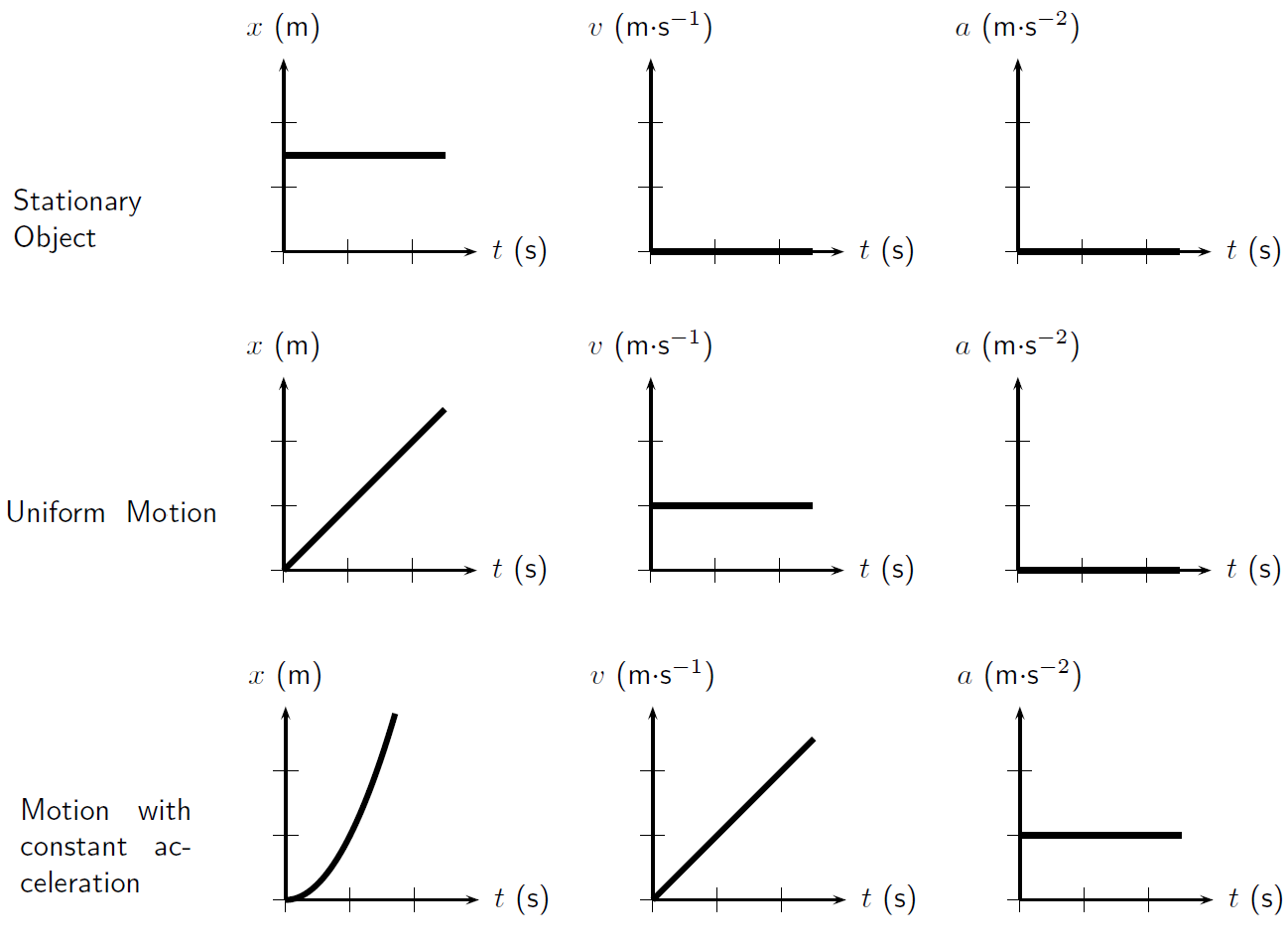
Let's break down these graphs:
- Stationary Object: Position is constant, so the x-t graph is a horizontal line. Velocity and acceleration are both zero.
- Uniform Motion: The object covers equal distances in equal times, so its velocity is constant. The v-t graph is a horizontal line. The x-t graph is a straight line with a constant slope. Acceleration is zero.
- Motion with Constant Acceleration: Velocity increases linearly with time, so the v-t graph is a sloped straight line. The x-t graph is a curve (a parabola), indicating that the object covers more distance in each successive time interval. The a-t graph is a horizontal line, as acceleration is constant.
Key takeaway for graphs:
- The slope of a position-time (x-t) graph gives velocity.
- The slope of a velocity-time (v-t) graph gives acceleration.
Part 3: The World of Sound
Sound is a form of energy that we perceive through hearing. For your exam, you should focus on its fundamental properties.
Sound is a mechanical wave, meaning it needs a medium (solid, liquid, or gas) to travel. It cannot travel through a vacuum. It is also a longitudinal wave, where particles of the medium vibrate parallel to the direction of wave propagation.
[PDF] Physics Notes & 50 Questions for SSC CGL Tier 2 Exam - Adda247
Let's return to our PDF resource for a concise summary of sound.
In the "OSCILLATIONS AND WAVES" section, find the part on Sound waves. Read about the types of sound waves (Infrasonic, Audible, Ultrasonic), and the properties of reflection, including the concept of an echo and the minimum distance required to hear it.
Here are the key points on sound:
- Speed of Sound: Sound travels fastest in solids, then liquids, and slowest in gases. For example, it's much faster in steel than in air.
- Audible Range: The human ear can typically hear frequencies between 20 Hz and 20,000 Hz (20 kHz).
- Infrasonic: Frequencies below 20 Hz.
- Ultrasonic: Frequencies above 20 kHz. Bats and dolphins use ultrasound for navigation.
- Echo: This is the repetition of sound caused by its reflection from a hard surface. To hear a distinct echo, the minimum distance between the source and the reflector should be about 17 meters.
Part 4: The Nature of Light
Light, like sound, is a form of energy, but its nature is quite different. It is an electromagnetic wave and a transverse wave, which means it does not require a medium to travel—it can pass through the vacuum of space. This is why sunlight reaches us.
Let's explore one of the most fundamental properties of light: reflection. The following video explains this phenomenon very clearly, including how images are formed in the mirrors we use every day.
SSC Science | Physics | Light | Day-7 | A to Z Batch | All SSC Exams | Radhika ma'am
This video, also from 'SSC - Abhinay Maths', provides an excellent visual explanation of light reflection and plane mirrors.
Please watch these two key segments: Laws of Reflection: From this timestamp, the instructor explains the incident ray, reflected ray, and the two laws of reflection, including the important relationship: angle of incidence = angle of reflection. Image Formation in a Plane Mirror: Watch from this section. It explains how virtual, erect images are formed and introduces the fascinating concept of lateral inversion with the practical example of a selfie camera.
Key Concepts of Light:
- Laws of Reflection:
- The angle of incidence () is equal to the angle of reflection ().
- The incident ray, the reflected ray, and the normal at the point of incidence all lie in the same plane.
- Image in a Plane Mirror: The image you see in a regular flat mirror is:
- Virtual: It cannot be projected onto a screen. It appears to be behind the mirror.
- Erect: It is upright, not upside down.
- Same Size as the object.
- Laterally Inverted: The left side of the object appears as the right side of the image, and vice versa. This is why the word "AMBULANCE" is written in reverse on the front of vehicles.
- Refraction: This is the bending of light when it passes from one medium to another (e.g., from air to water). This phenomenon is responsible for a pencil appearing bent in a glass of water.
- Mirrors and Lenses: You should know the common uses:
- Concave mirrors are used in car headlights and shaving mirrors (they can form magnified images).
- Convex mirrors are used as rear-view mirrors in vehicles because they provide a wider field of view.
- Convex lenses are used to correct farsightedness.
- Concave lenses are used to correct nearsightedness.
Part 5: Putting It All Together - Practice Problems
Now that we have covered the core concepts, it's time to apply them, just as you would in the SSC CGL exam. The best way to do this is by solving Multiple Choice Questions (MCQs).
[PDF] Physics Notes & 50 Questions for SSC CGL Tier 2 Exam - Adda247
This resource contains an excellent set of 50 practice questions with detailed solutions, which is perfect for testing your understanding.
Go to the "Questions" section starting on page 19. Try to solve the following questions on your own first, then check your answers with the solutions provided on pages 22-25. Focus on these specific questions to cover what we've learned: Motion: Q1, Q2, Q4, Q7, Q8, Q12, Q14, Q16, Q17, Q23, Q24 Sound: Q6, Q9, Q11, Q18, Q19, Q20 Light: Q45, Q46, Q47, Q49 Units/General: Q3, Q10, Q41
This exercise will give you a feel for the exam pattern and help you identify any areas where you need to review. Remember, the resource Physics Questions asked in SSC CGL Exams also provides great advice on common mistakes and preparation tips, which are worth reviewing.
Conclusion
In this lesson, we have laid the groundwork for the Physics section of your General Science preparation. We've moved from the abstract language of units to the tangible descriptions of motion, and explored the fascinating behaviors of sound and light.
Here are your key takeaways:
- Units & Quantities: Differentiate between scalar (magnitude only) and vector (magnitude + direction) quantities. Know the basic SI units.
- Motion: Understand the definitions and formulas for speed, velocity, and acceleration. Memorize the three equations of motion for constant acceleration, as they are essential for solving problems.
- Sound: Remember that sound is a mechanical, longitudinal wave that requires a medium and travels fastest in solids.
- Light: Know the laws of reflection (). Understand the characteristics of an image formed by a plane mirror: virtual, erect, same size, and laterally inverted. Be familiar with the common applications of mirrors and lenses.
Our next lesson will continue our exploration of General Science, shifting from Physics to Chemistry. We will start by examining another fundamental topic: Identify properties and uses of common acids, bases, salts, and important chemical compounds. This knowledge is crucial for answering direct, fact-based questions in the SSC CGL exam.