Introduction
Welcome to our final lesson in the "Geography, Science, and Environment" module. In our previous session, we explored significant scientific inventions and the remarkable achievements of ISRO, both of which are crucial for your General Awareness preparation.
Today, we'll shift our focus to the environment. This lesson is designed to help you describe basic environmental concepts: ecology, pollution, and conservation. These topics are fundamental to understanding the world around us and are frequently tested in the SSC CGL exam. We will begin by exploring the basics of ecology, then examine the different forms of pollution and their impacts, and conclude with an overview of conservation efforts, both in India and globally.
Part 1: Ecology – The Science of Interactions
Ecology is the study of how living organisms interact with each other and with their physical environment. These interactions form complex systems called ecosystems. For your exam, it's important to grasp the core components and dynamics of these systems.
Let's begin with a concise document created specifically for exams like the SSC CGL. It provides clear definitions of the foundational concepts.
environmental-science-pdf-for-ssc-and-railway-exam
This PDF from Exam Pundit provides a quick and targeted overview of basic environmental science concepts.
Please read the first part of the document, from the beginning up to the section on Environmental Issues. Focus on the definitions of Environment, Ecology, and Ecosystem. Also, pay close attention to the breakdown of an ecosystem's components: the Producers, Consumers, and Decomposers.
Trophic Levels and the Flow of Energy
One of the most important concepts in ecology is how energy flows through an ecosystem. This flow is often visualized as a pyramid, with different levels known as trophic levels.
- Producers (1st Trophic Level): These are organisms like plants that produce their own food, usually through photosynthesis. They form the base of the pyramid.
- Primary Consumers (2nd Trophic Level): These are herbivores that feed on producers.
- Secondary Consumers (3rd Trophic Level): These are carnivores or omnivores that feed on primary consumers.
- Tertiary Consumers (4th Trophic Level): These are predators at the top of the food chain that feed on secondary consumers.
The image below provides a clear example of a food chain pyramid.

A food chain shows a single path of energy flow, while a food web is a more realistic model showing multiple, interconnected food chains.
A key principle to remember is the 10% Rule: only about 10% of the energy from one trophic level is transferred to the next. The rest is lost, primarily as heat during metabolic processes. This is why the pyramid shape is so fitting—the amount of energy and biomass decreases as you move up the levels.
To solidify these concepts, let's watch a video specifically created for SSC CGL preparation. It explains these ideas in a very accessible way.
COMPLETE ENVIRONMENT FOR SSC CGL 2025 BY PARMAR SIR |
This video from 'PARMAR SSC' covers fundamental ecological concepts, including food chains, food webs, and ecological pyramids, which are essential for your exam.
Please watch the section from Food Chains to Ecological Pyramids. Pay close attention to: The different types of food chains (grazing and detritus). The definition of a food web as a network of food chains. The three types of ecological pyramids: Number, Biomass, and Energy. Note especially that the Pyramid of Energy is always upright.
Finally, let's look at two more critical concepts related to the food chain:
- Bioaccumulation: The gradual build-up of a substance, such as a pesticide or other chemical, in an organism.
- Biomagnification: The increasing concentration of these toxic substances in organisms at successively higher levels in a food chain. This is why top predators often have the highest levels of toxins.
The video you just watched also explains this clearly. You can review this specific part if you need a recap. The segment on Bioaccumulation and Biomagnification starts at
Part 2: Pollution – Threats to the Environment
Pollution refers to any undesirable change in the physical, chemical, or biological characteristics of air, land, or water. Understanding the types of pollution and their sources is a staple of the General Awareness section.
Let's return to the Exam Pundit PDF, which concisely covers the major environmental issues you need to know.
environmental-science-pdf-for-ssc-and-railway-exam
This section of the PDF details the main types of pollution and other significant environmental problems.
Please read the entire section titled ENVIRONMENTAL ISSUES, from this point onward. As you read, focus on: The definition of pollutants and the key environmental act in India, the Environment (Protection) Act, 1986. Air Pollution: Identify key pollutants like Carbon Monoxide (from incomplete burning) and Sulphur Dioxide (leading to Acid Rain). Note the role of CFCs in Ozone Layer Depletion. Water Pollution: Understand the concept of Eutrophication (nutrient enrichment) and BOD (Biochemical Oxygen Demand) as a measure of water pollution. Soil Pollution: Differentiate between biodegradable and non-biodegradable waste. Greenhouse Effect & Global Warming: Identify the main greenhouse gases (CO₂, Methane, Water Vapour) and understand that their increase leads to global warming.
Part 3: Conservation – Protecting Our Natural Heritage
Conservation is the protection and wise management of the environment and its resources. Questions in this area often focus on conservation methods, important laws, and major environmental movements.
Conservation Strategies
There are two primary strategies for conserving biodiversity:
-
In-situ Conservation: Conserving species within their natural habitats. This is generally the preferred method.
- Examples: National Parks, Wildlife Sanctuaries, Biosphere Reserves, and Sacred Groves (forests protected by local communities for religious reasons).
-
Ex-situ Conservation: Conserving species outside of their natural habitats. This is done when a species' natural habitat is lost or too threatened.
- Examples: Zoological Parks (Zoos), Botanical Gardens, Seed Banks, and Gene Banks.
Key Laws and Bodies in India
A few key legal and quasi-judicial bodies form the backbone of environmental protection in India. This infographic provides a quick summary of some important ones to remember.
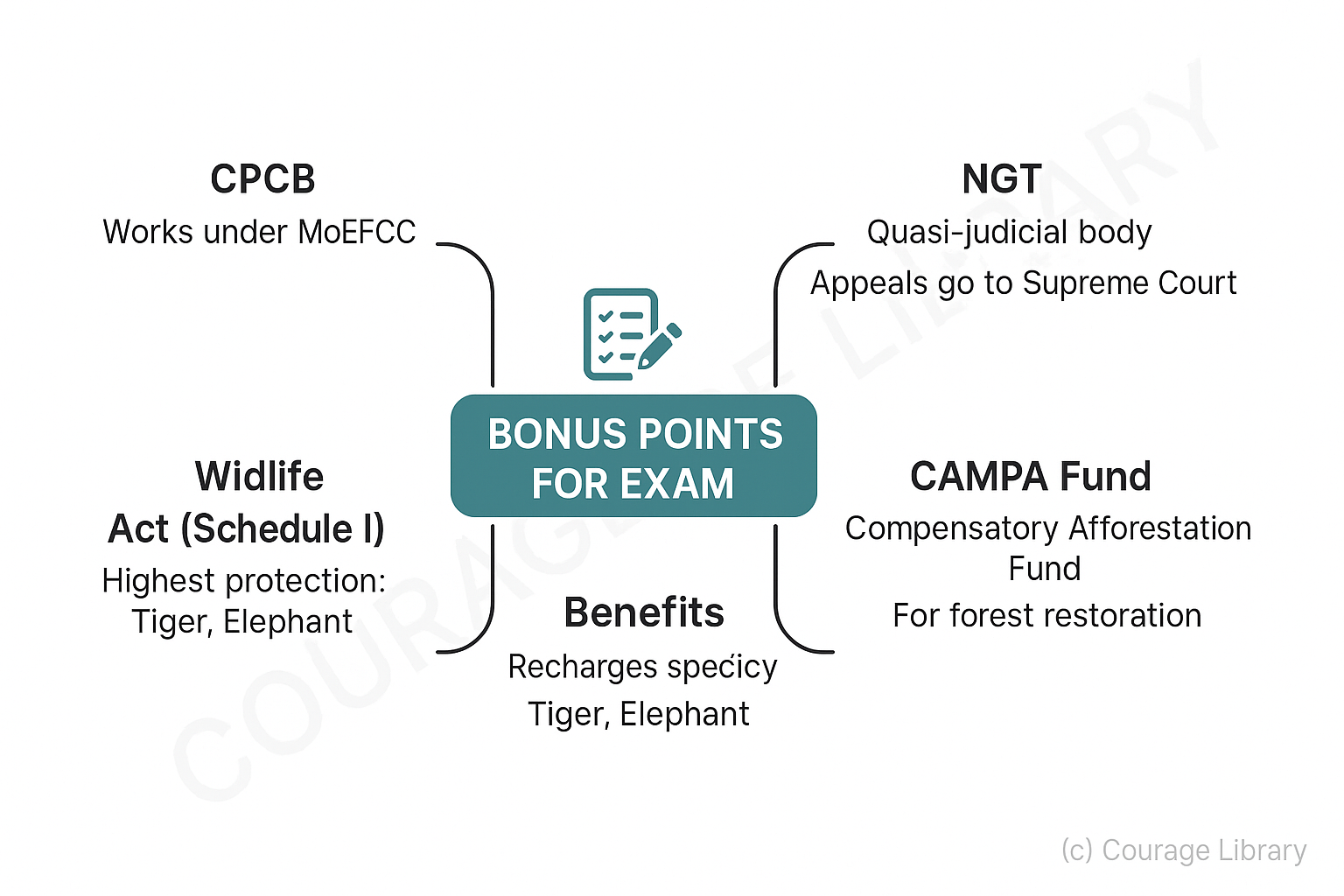
To expand on this:
- CPCB (Central Pollution Control Board): Works under the Ministry of Environment, Forest and Climate Change (MoEFCC) to prevent and control water and air pollution.
- NGT (National Green Tribunal): A specialized judicial body for handling environmental cases and providing speedy justice.
- Wildlife Protection Act, 1972: Provides a legal framework for protecting wild animals, plants, and their habitats. Animals in Schedule I, like the Tiger and Elephant, receive the highest level of protection.
- CAMPA Fund: The Compensatory Afforestation Fund is used to promote afforestation and regeneration activities to compensate for forest land diverted for non-forest uses.
Major Environmental Movements
Public movements have played a huge role in environmental conservation in India. Two of the most famous are:
- Chipko Movement (1973): A non-violent movement where villagers, primarily women, hugged trees to prevent them from being cut down in Uttarakhand.
- Narmada Bachao Andolan (1985): A social movement protesting the construction of large dams on the Narmada River, raising issues of displacement and environmental impact.
You can find more about these movements in the Drishti IAS PDF. Navigate to page 234 and look for the heading
International Conventions
Finally, a few international agreements are regularly asked about in exams. They set global goals for tackling environmental issues.
COMPLETE ENVIRONMENT FOR SSC CGL 2025 BY PARMAR SIR |
The 'PARMAR SSC' video provides an excellent, exam-focused summary of the most important environmental conventions.
Watch the segment from Environmental Conventions. As you watch, make a note of the main objective for each of the following: Minamata Convention: Mercury pollution. Montreal Protocol: Phasing out ozone-depleting substances (like CFCs). Basel Convention: Control of transboundary movement of hazardous wastes. Kyoto Protocol: Reducing greenhouse gas emissions. Stockholm Convention: Eliminating persistent organic pollutants (POPs). Paris Agreement: Limiting global warming to well below 2°C.
Conclusion
This lesson completes our journey through the "Geography, Science, and Environment" module. We've covered the essential environmental concepts of ecology, pollution, and conservation, all of which are high-priority topics for your General Awareness preparation.
Here are the key takeaways:
- Ecology: It is the study of interactions in an ecosystem. Energy flows from producers to consumers through food chains, with only about 10% of energy transferring between trophic levels.
- Pollution: The contamination of the environment by harmful substances. Key issues include acid rain from air pollution, eutrophication from water pollution, and global warming from the greenhouse effect.
- Conservation: Protecting biodiversity can be done via in-situ (in natural habitat) or ex-situ (outside natural habitat) methods. Important legal frameworks include the Wildlife Protection Act (1972) in India, and global efforts are guided by agreements like the Montreal and Kyoto Protocols.
In our next session, we will begin a new module, Foundations of Arithmetic. Our first lesson will focus on a core quantitative aptitude skill: solving percentage increase/decrease problems using the successive percentage method.