Welcome back. The previous lesson distinguished common muscle complaints from warning signs of serious muscle injury. This lesson makes a related distinction for the liver: an abnormal blood test is a finding to interpret, not a diagnosis of liver damage. You will learn what statin safety reports mean when they count “elevated liver enzymes,” what additional findings make liver injury more concerning, and why neither result alone establishes that a statin caused it.
A liver enzyme is a signal, not a measure of liver failure
A statin safety report may describe elevated ALT (alanine aminotransferase) or AST (aspartate aminotransferase). These are often called “liver function tests,” but that phrase can mislead. ALT and AST are chiefly markers that may signal cell injury; they do not directly measure whether the liver is still performing its essential jobs. AST can also come from skeletal muscle—an important detail given the muscle conditions discussed in the previous lesson.
Clinicians also consider bilirubin, a substance processed and excreted through the liver, and prothrombin time or INR, which can reflect production of clotting factors. Those results add different information. None is a stand-alone verdict: bilirubin and INR can be abnormal for reasons besides drug-induced liver injury, while an initially normal result does not rule injury out.
How to approach elevated liver enzymes?
Read this AASLD explanation to separate tests that suggest injury from tests that provide information about liver function.
In “What are liver enzymes?”, begin with the paragraph that categorizes injury and function markers. Read the explanation through the numbered discussion of bilirubin, stopping before “What are patterns of abnormal liver enzymes?” Focus on why ALT is more liver-specific than AST, why the height of an enzyme result does not by itself measure the extent of injury, and what bilirubin and clotting tests add.
Reports often express a result relative to the laboratory’s upper limit of normal (ULN). If a hypothetical laboratory sets ALT’s ULN at 40 units per liter, an ALT of 80 is twice that limit. This describes how far the result is from a reference range. It does not mean “twice as much liver damage,” nor does it establish the cause. A clinician needs the pattern over time, other test results, symptoms, medical history, and possible alternative explanations.
The distinction can be stated plainly:
| Reported finding | What it establishes—and what it does not |
|---|---|
| ALT or AST is elevated | A blood-test abnormality that may warrant assessment. It does not, alone, establish impaired liver function or statin-caused injury. |
| Enzymes are elevated alongside jaundice or a bilirubin rise | A more concerning combination requiring clinical evaluation. It still does not identify the cause on its own. |
| Clinically important liver injury is diagnosed | An assessment based on the fuller clinical picture, including investigation of other plausible causes—not simply a count of abnormal enzyme tests. |
Reading the harm reported in a statin study
Statins can be associated with asymptomatic, often transient enzyme elevations. Clinically important statin-related liver injury is uncommon, but “uncommon” is not “impossible.” A safety report should therefore specify which outcome it measured. The number of people whose ALT crossed a laboratory threshold is not interchangeable with the number who developed jaundice, clinically significant liver injury, or liver failure.
The AASLD summary puts the statin-specific findings alongside its monitoring advice:
When Medicine Turns Toxic: The Hepatotoxic Potential of Common Drugs | AASLD
Read the AASLD summary for statins to connect a typical enzyme-test finding with the more concerning combinations that affect clinical decisions.
In Table 1, locate the row labeled “Statins.” Read the statin row, including its monitoring column; the adjacent rows provide context for how the table compares different medicines. Notice that the entry distinguishes an isolated elevation from an elevation accompanied by symptoms or rising bilirubin. Treat its action threshold as information about clinician assessment, not an instruction to change treatment yourself.
Imagine a one-year trial reporting that 20 of 1,000 statin recipients and 10 of 1,000 placebo recipients crossed a specified ALT threshold, with no clinically important liver injuries observed in either group. The excess measured outcome would be 10 additional enzyme elevations per 1,000 over that year. Calling these “10 additional cases of serious liver damage” would change the outcome being counted. Equally, observing no serious cases would not prove that a very rare harm cannot occur.
Attributing a suspected injury to a statin is another step. Viral hepatitis, other medicines or supplements, biliary conditions, and other illnesses can produce abnormal tests. A case discovered during statin treatment deserves assessment, but its timing alone does not settle its cause.
A short clinical lecture illustrates why an initially suspected drug injury and an assessed drug injury are different counts:
Approach to drug induced liver injury and cell mediated hepatitis | UCLA Digestive Diseases
Watch the statin segment of “Approach to drug induced liver injury and cell mediated hepatitis” from UCLA Health for an example of reviewing suspected cases before attributing them to a medicine.
Watch the case review. Focus on the distinction between cases initially flagged as possibly statin-related and those judged statin-related after evaluation. These are selected liver-injury cases, not a denominator of everyone taking statins, so the figures cannot be used to calculate an individual user’s risk.
Thresholds prompt evaluation; they are not diagnoses
An older-style monitoring chart can make a blood-test cutoff look like a direct measure of danger. This chart, for example, separates results above and below three times the ULN and proposes scheduled repeat tests:
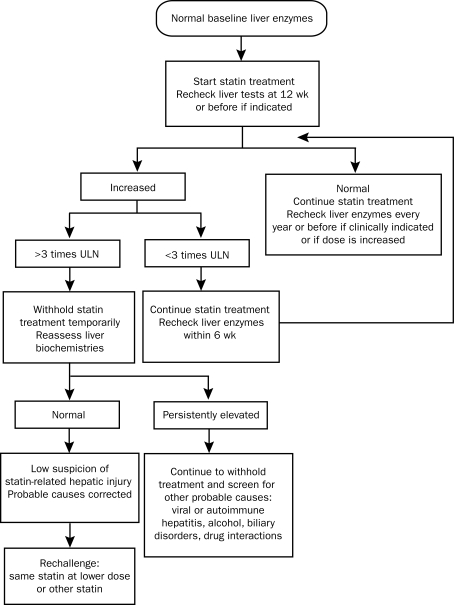
A threshold is useful because it tells a clinician when a result deserves closer attention. It does not turn every result above that line into liver failure, or every result below it into reassurance. The AASLD statin summary emphasizes the combination of markedly elevated ALT or AST with symptoms or rising bilirubin when discussing discontinuation. Clinicians may also repeat tests and investigate other causes according to the circumstances. Decisions about testing or treatment belong with them, rather than with a flowchart viewed in isolation.
Consider two illustrative reports. In the first, ALT rises modestly above a laboratory range, the person feels well, and bilirubin is normal. That is an abnormal result to interpret, not proof of clinically important injury; follow-up depends on the clinical context. In the second, ALT is substantially elevated and the person develops yellowing of the eyes and rising bilirubin. That combination is more concerning and needs prompt medical assessment, though it still does not prove that the statin is responsible.
New jaundice, marked illness, or other concerning symptoms should not be dismissed because serious statin-related liver injury is rare. Conversely, a mildly abnormal number without symptoms should not automatically be described as liver damage. Both errors replace clinical interpretation with a shortcut.
Key takeaways
When reading a statin safety report, keep its outcomes separate: elevated ALT or AST, symptoms and other abnormal results, and clinically important liver injury are not the same event. An enzyme elevation can be transient and symptom-free; symptoms, bilirubin changes, and the broader clinical picture can make a result more concerning. Neither an abnormal test nor its timing alone proves that a statin caused injury, and medication changes should be clinician-supervised.
The next lesson broadens this evidence-reading approach: even a well-conducted safety study may have limits when its findings are applied to an individual.