Hello! Welcome to your next lesson on Partnership Accounts.
In our previous lessons, we focused entirely on understanding and calculating goodwill. We wrapped up by mastering the Capitalization Methods. Now, we shift our focus to the procedural steps involved when a new partner joins the firm, a process known as the Admission of a Partner.
The admission of a new partner leads to the reconstitution of the firm and a new partnership agreement. One of the first and most critical adjustments is to determine the new profit-sharing arrangement. This lesson is dedicated to that specific task. You will learn to calculate the new profit sharing ratio and sacrificing ratio when a new partner is admitted. Understanding these calculations is fundamental, as they form the basis for several other accounting treatments, especially for goodwill.
Why Do We Need New Ratios?
When a new partner is admitted, they acquire a share in the firm's future profits. This share is given up, or "sacrificed," by the existing partners. This change necessitates the calculation of two important ratios:
- New Profit Sharing Ratio (NPSR): The ratio in which all partners (including the new one) will share future profits and losses.
- Sacrificing Ratio (SR): The ratio in which the old partners have agreed to sacrifice their share of profits in favour of the new partner. This ratio is particularly important for adjusting goodwill, as we will see in a future lesson.
The fundamental formula to keep in mind is:
Let's explore the different scenarios you will encounter when calculating these ratios.
Calculating the New Profit Sharing and Sacrificing Ratios
The method for calculating the NPSR and SR depends entirely on the information provided in the partnership agreement or the problem. We will cover the most common cases.
For a comprehensive overview with solved examples for each case, the following video will be our primary guide. We will break it down section by section.
[#1] Admission of a Partner [New Profit sharing Ratio & Sacrificing Ratio] with Solved Problem
This video by Kauser Wise is an excellent guide that systematically covers the various scenarios for calculating the New Profit Sharing Ratio and Sacrificing Ratio. Let's start with the basic definitions.
Watch the section from 04:17 to 05:28 to get a clear definition of the New Profit Sharing Ratio and the Sacrificing Ratio.
Now, let's dive into the practical calculations.
Case 1: New Partner's Share is Given, but Sacrifice is Not Mentioned
This is the most common and basic scenario. You are told the new partner's share, but the problem is silent about how the old partners contribute to this share.
The Logic:
In this case, we assume the old partners continue to share the remaining profit in their old profit-sharing ratio. Consequently, they also sacrifice their share in their old ratio.
The Steps:
- Assume the total share of the firm is 1.
- Calculate the remaining share:
Remaining Share = 1 - New Partner's Share. - Calculate the new share for each old partner:
Old Partner's New Share = Remaining Share × Old Partner's Old Share. - The new partner's share is already known. Ensure all shares have a common denominator to express the NPSR.
- Calculate the sacrificing ratio using the formula:
Sacrificing Share = Old Share - New Share.
Let's watch this in action.
[#1] Admission of a Partner [New Profit sharing Ratio & Sacrificing Ratio] with Solved Problem
The video will now demonstrate how to solve a problem for this first case. Pay close attention to how the remaining share is calculated and distributed.
Watch from 05:14 to 13:19. The instructor solves a problem where A and B are partners, and C is admitted for a 1/5th share. Notice that after calculating the NPSR, the sacrificing ratio is calculated and it turns out to be the same as the old ratio (5:2).
Key Takeaway: When the problem only gives the new partner's share, the old partners' sacrificing ratio is the same as their old profit-sharing ratio.
Case 2: New Partner Acquires Share in a Specific Manner from Old Partners
This scenario is more direct. The problem explicitly states how the new partner gets their share from the old partners. The keywords here are "acquires from," "takes from," or if the sacrifice is given "equally" or in a specific ratio.
The Logic:
The sacrificing share of each old partner is directly given or easily calculated. The new share is found by simply subtracting the sacrificed share from the old share.
The Steps:
- Identify the share sacrificed by each old partner from the problem statement.
- Calculate the new share for each old partner:
New Share = Old Share - Sacrificed Share. - The other old partners who are not sacrificing retain their original share.
- The new partner's share is the sum of the shares sacrificed by the old partners.
- The sacrificing ratio is simply the ratio of the shares sacrificed.
The video covers three variations of this scenario.
[#1] Admission of a Partner [New Profit sharing Ratio & Sacrificing Ratio] with Solved Problem
Let's see how to handle problems where the sacrifices are explicitly stated. We will look at unequal, equal, and entire sacrifice by one partner.
Watch the following three segments consecutively: Unequal Sacrifice (13:19 - 17:12): Here, C acquires 3/20th from A and 1/20th from B. The sacrificing ratio is directly stated as 3:1. Equal Sacrifice (17:12 - 20:38): Here, C acquires his 1/5th share equally. The sacrifice for each old partner is calculated as (1/5) * (1/2) = 1/10. Entire Sacrifice by one Partner (20:38 - 22:47): Here, C acquires his entire share from A. Only A's share changes.
Test your understanding!
X and Y are partners sharing profits in the ratio of 7:3. They admit Z for a 1/5th share, which he acquires from X and Y in the ratio of 2:1. Calculate the New Profit Sharing Ratio and the Sacrificing Ratio.
Show answer
1. Calculate the Sacrificed Shares:
- Z's share = 1/5. He acquires this from X and Y in the ratio 2:1.
- Share sacrificed by X =
- Share sacrificed by Y =
- The Sacrificing Ratio is 2:1.
2. Calculate the New Shares:
- X's New Share = Old Share - Sacrificed Share =
- Y's New Share = Old Share - Sacrificed Share =
- Z's New Share =
The New Profit Sharing Ratio of X, Y, and Z is 17:7:6.
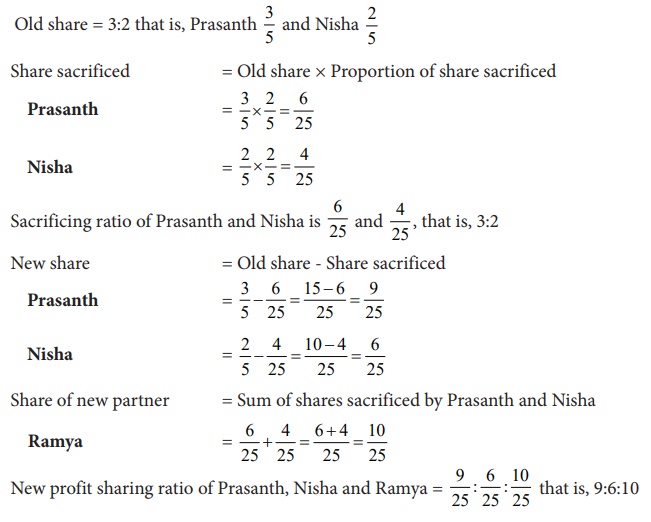
Case 3: Old Partners Surrender a Fraction 'OF' Their Share
Pay close attention to the wording here. "A surrenders 1/4 of his share" is different from "A surrenders 1/4 share from his share." The word "of" implies multiplication.
The Logic:
First, you must calculate the actual fraction being sacrificed by multiplying the surrender fraction with the old partner's share. Then, you subtract this amount to find the new share.
The Steps:
- Calculate the share sacrificed by each old partner:
Share Sacrificed = Old Partner's Share × Fraction Surrendered. - The ratio of these calculated sacrificed shares is the Sacrificing Ratio.
- Calculate the new share for each old partner:
New Share = Old Share - Share Sacrificed. - Calculate the new partner's share by summing the shares sacrificed by the old partners.
Let's see how this is handled.
[#1] Admission of a Partner [New Profit sharing Ratio & Sacrificing Ratio] with Solved Problem
This next segment demonstrates the 'of' case. Notice the initial multiplication step to determine the actual share being sacrificed.
Watch from 22:30 to 27:54. The problem states that C acquires '1/7th share from A' and '2/7th share from B', which the video interprets as 1/7th of A's share and 2/7th of B's share. Follow the calculation: A's sacrifice = (5/7) * (1/7) = 5/49 B's sacrifice = (2/7) * (2/7) = 4/49 This gives a sacrificing ratio of 5:4.
To reinforce this specific calculation, here is a clear visual summary.
Case 4: Both Old and New Ratios are Given
This is the most straightforward scenario for calculating the sacrificing ratio.
The Logic & Steps:
Simply apply the formula directly for each old partner:
A positive result means a sacrifice, while a negative result would mean a gain.
Watch the final segment of the video for a quick example.
[#1] Admission of a Partner [New Profit sharing Ratio & Sacrificing Ratio] with Solved Problem
Finally, let's look at the simple case where you are given both the old and new ratios and just need to find the sacrifice.
Watch from 27:40 to 30:37. The video shows how to calculate the sacrificing ratio by simply subtracting the new ratio from the old ratio for each of the old partners.
Conclusion
Excellent work! You have now covered the essential calculations required to readjust profit-sharing ratios upon the admission of a new partner. This is a foundational skill for this chapter.
Key Takeaways:
- New Profit Sharing Ratio (NPSR) is for sharing future profits among all partners.
- Sacrificing Ratio (SR) is the proportion in which old partners give up their profit share. It is calculated as
Old Ratio - New Ratio. - Case 1 (Implicit Sacrifice): If only the new partner's share is given, the SR is the same as the old partners' old ratio.
- Case 2 (Explicit Sacrifice "from"): If the sacrifice is specified (e.g., "from A," "equally"), the SR is given. Calculate NPSR by subtraction:
New Share = Old Share - Sacrificed Share. - Case 3 (Explicit Sacrifice "of"): If a partner surrenders a fraction 'of' their share, first multiply to find the amount sacrificed, then subtract to find the new share.
Preview of the Next Lesson:
Now that you can calculate the sacrificing ratio, you are ready to use it. In the next lesson, we will address the learning outcome: Account for goodwill on admission using the premium method (cash) and adjustment through capital accounts (non-cash). You will see how the sacrificing ratio is used to credit the old partners for the goodwill brought in by the new partner.