Hello! Let's get started on our next lesson.
In our last session, we learned how to prepare a Revaluation Account to ensure that gains or losses from changes in asset and liability values are fairly distributed among the old partners. Today, we'll address another crucial adjustment that follows the same principle of fairness.
This lesson focuses on how to adjust for accumulated profits, reserves, and losses on admission of a partner. Just like the profit or loss on revaluation, these items were accumulated over time by the old partners. It's essential to distribute them before the new partner officially joins to ensure they don't get an unearned share of past profits or bear the burden of past losses.
What are Accumulated Profits, Reserves, and Losses?
Over the years, a partnership might set aside a portion of its profits for future needs (reserves) or have undistributed profits or losses carried forward. These are 'accumulated' because they belong to past periods. When a new partner is admitted, these amounts must be settled among the partners who were present when they were generated—the old partners.
To begin, let's identify these items and where they typically appear in a Balance Sheet.
Treatment of reserves and Accumulated Profits. Admission of a Partner Part 5. TERM 1 | XII Accounts
The video 'Treatment of reserves and Accumulated Profits' by Sunil Panda provides a clear and concise list of the common items we need to adjust. It's a great starting point for identifying what to look for in a Balance Sheet.
Watch from 00:43 to 03:54. The instructor identifies seven key items—four on the liability side (accumulated profits) and three on the asset side (accumulated losses)—that must be distributed.
As the video explained, these items can be categorized as follows:
1. Accumulated Profits and Reserves (found on the Liabilities side):
- General Reserve / Reserve Fund
- Profit & Loss Account (Credit Balance)
- Workmen Compensation Reserve (WCR)
- Investment Fluctuation Reserve (IFR)
2. Accumulated Losses (found on the Assets side):
- Profit & Loss Account (Debit Balance)
- Advertisement Suspense Account (also called Deferred Revenue Expenditure)
- Goodwill (if it appears in the existing Balance Sheet, it is treated as an accumulated loss to be written off)
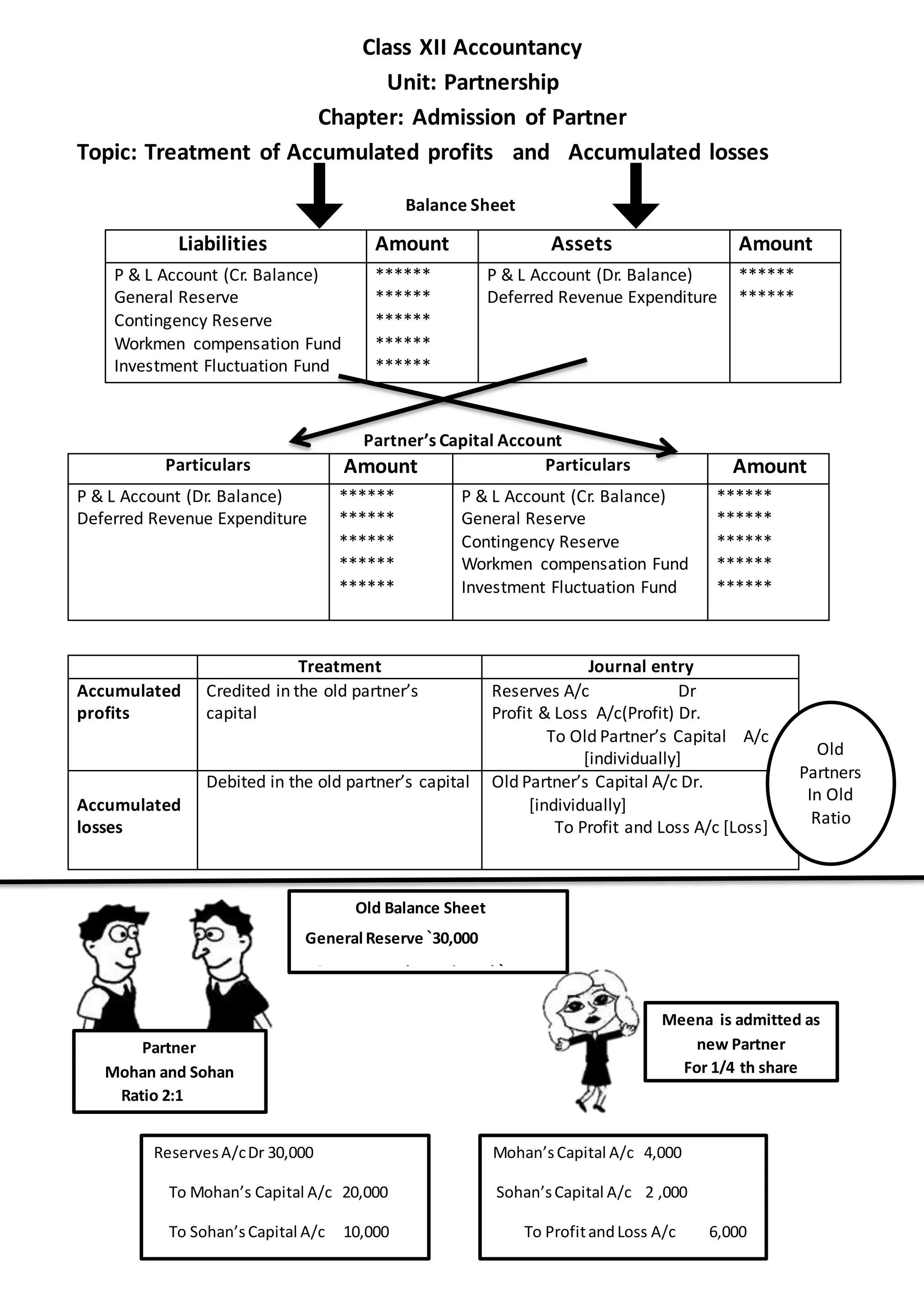
The Golden Rule: Distribute to Old Partners in Old Ratio
The logic for distributing these items is simple: they belong to the old partners. Therefore, they must be distributed only among the old partners in their old profit-sharing ratio. The new partner is not involved in this transaction at all.
To solidify this core principle, let's watch a short segment that explains why this distribution is so important.
Admission of a Partner | Part 5 | Treatment of Reserves | Class 12 | Accounts
This video, 'Admission of a Partner | Part 5 | Treatment of Reserves' by Rajat Arora, uses a simple story to illustrate the unfairness that would occur if reserves were not distributed before a new partner's admission. This will help you remember the 'why' behind the rule.
Watch from 03:43 to 07:26. Pay attention to the example of partners A and B with a ₹90,000 reserve and what happens when C joins. This clearly demonstrates why the reserve must be split between A and B before C's admission.
Accounting Treatment and Journal Entries
Now that we understand the 'what' and 'why', let's focus on the 'how'. The accounting treatment is straightforward and flows directly from your Grade 11 understanding of capital accounts.
1. For Distributing Accumulated Profits and Reserves
When you distribute profits or reserves, the partners' capital increases. An increase in capital is always credited. The reserve and profit accounts, which have credit balances, are closed by debiting them.
The journal entry is:General Reserve A/c Dr.Profit & Loss A/c (Cr. balance) Dr.Workmen Compensation Reserve A/c Dr.Investment Fluctuation Reserve A/c Dr.
To Old Partner A's Capital A/c
To Old Partner B's Capital A/c
(Being accumulated profits and reserves distributed among old partners in their old ratio)
2. For Distributing Accumulated Losses
When you distribute losses, the partners' capital decreases. A decrease in capital is always debited. The accumulated loss accounts, which have debit balances, are closed by crediting them.
The journal entry is:Old Partner A's Capital A/c Dr.Old Partner B's Capital A/c Dr.
To Profit & Loss A/c (Dr. balance)
To Advertisement Suspense A/c
(Being accumulated losses written off against old partners' capital accounts in their old ratio)
Let's watch a detailed explanation of these journal entries.
Treatment of reserves and Accumulated Profits. Admission of a Partner Part 5. TERM 1 | XII Accounts
Let's return to the Sunil Panda video. The instructor will now walk you through the journal entries for both profits and losses, which will reinforce what we just discussed.
Watch from 06:40 to 12:39. The video first explains why the distribution happens in the old ratio and then provides the exact journal entries for reserves (debiting the reserve, crediting partners) and for losses (debiting partners, crediting the loss account).
Test your understanding!
Anu and Binu are partners sharing profits in a 2:1 ratio. They admit Chinu as a new partner. On that date, their Balance Sheet shows:
- General Reserve: ₹90,000
- Profit & Loss A/c (Debit Balance): ₹30,000
What journal entries should be passed to adjust these balances?
Show answer
1. For General Reserve (Profit):
This increases the partners' capital. The entry will be:
General Reserve A/c Dr. ₹90,000
To Anu's Capital A/c ₹60,000 (90,000 × 2/3)
To Binu's Capital A/c ₹30,000 (90,000 × 1/3)
(Being General Reserve distributed in the old ratio of 2:1)
2. For P&L A/c (Loss):
This decreases the partners' capital. The entry will be:
Anu's Capital A/c Dr. ₹20,000 (30,000 × 2/3)Binu's Capital A/c Dr. ₹10,000 (30,000 × 1/3)
To Profit & Loss A/c ₹30,000
(Being accumulated loss distributed in the old ratio of 2:1)
A Note on Specific Reserves (WCR and IFR)
Workmen Compensation Reserve (WCR) and Investment Fluctuation Reserve (IFR) are created for specific purposes.
- WCR is for potential claims from employees.
- IFR is to cushion against a fall in the market value of investments.
If there is a claim against WCR or a fall in the value of investments against IFR, that amount is used first. Only the surplus (the remaining amount) of the reserve is considered a "free" reserve and distributed to the old partners. If the claim or loss is more than the reserve, the excess is debited to the Revaluation Account, as we learned in the previous lesson.
For a comprehensive overview of the entries and some solved examples, please refer to the following reading material.
CHAPTER 5 ADMISSION OF A NEW PARTNER
The study note 'CHAPTER 5 ADMISSION OF A NEW PARTNER' provides clear, summarized journal entries and includes solved illustrations that apply these concepts.
Please read the section titled 'Treatment of Reserves, Accumulated Profits and Losses'. Note the journal entries provided. Then, review 'Illustration 8' and its solution. This example is excellent as it shows the distribution of multiple reserves (Contingency, WCR, IFR), an accumulated profit (P&L A/c), and an accumulated loss (Advertisement Expenditure) all in one problem.
Conclusion
You have now learned the second major adjustment required during a partner's admission. Just like revaluation, adjusting for accumulated items ensures that the capital accounts of the old partners correctly reflect the value they have built up in the firm over time.
Key Takeaways:
- Accumulated profits, reserves, and losses belong exclusively to the old partners.
- These items must be distributed in the old profit-sharing ratio before the new partner's admission.
- Profits and Reserves (General Reserve, P&L Credit, etc.) increase partners' capital, so their capital accounts are credited.
- Losses (P&L Debit, Advertisement Suspense, etc.) decrease partners' capital, so their capital accounts are debited.
- After distribution, these items are removed from the firm's books and will not appear in the new Balance Sheet.
Preview of the Next Lesson:
So far, we have adjusted for goodwill, revaluation, and accumulated profits/losses. These steps give us the true closing capital balances of the old partners. In our next lesson, we will move to the next stage of partnership reconstitution: Adjusting the old partners' capitals based on the new partner's capital and the new profit-sharing ratio. This often involves partners bringing in or withdrawing cash to make their capital balances proportionate to their new roles in the firm.