Hello! Welcome to your next lesson in the module "Goodwill and Admission of a Partner."
In our last session, we explored the fundamental nature of goodwill, defining it as the intangible value of a firm's reputation and exploring the factors that contribute to it. We established what goodwill is and why it's important.
Today, we move from theory to practice. Our goal is to address the learning outcome: Calculate goodwill using the Average Profits and Super Profits methods. These are the two most common numerical methods you'll encounter. Mastering these calculations is essential because the value of goodwill directly impacts the financial adjustments made when a new partner joins a firm.
Let's get started with the first method.
1. The Average Profit Method
The logic behind this method is straightforward: a business's value is tied to its ability to earn profits. Therefore, we can estimate goodwill by looking at its average profits over the last few years.
The formula is:
- Average Profit is the average of the profits of the last few years.
- Number of Years' Purchase is the number of years for which the firm is expected to earn the same amount of profit after the change in ownership because of past efforts. This value will almost always be given to you in the problem.
Here is a simple illustration of the calculation:
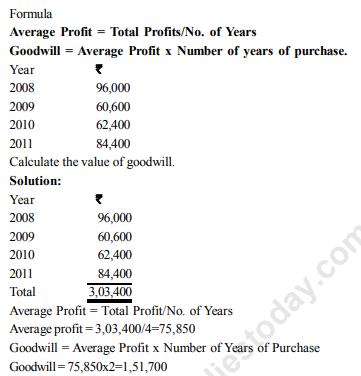
Adjusting Profits for Accurate Valuation
The most critical step in this method is ensuring the profits you use are the firm's normal operating profits. The profits reported in the Profit & Loss Account can often include unusual gains or losses that don't reflect the firm's true, repeatable earning capacity. To find the true average, we must adjust for these.
Goodwill | Average profit Method | Partnership | Chapter 2 | Class 12 | Part 1
To understand why these adjustments are so important, let's watch a section from a video by Rajat Arora. He does an excellent job of showing how abnormal items can distort the value of goodwill.
Watch from 13:10 to 18:20. Pay close attention to his examples of a lottery win (abnormal gain) and a loss by fire (abnormal loss). Notice how including these items gives a misleading value for goodwill, and why they must be removed to find the true business profit.
As you saw, to calculate the Adjusted Normal Profit for each year, we make the following adjustments to the given Net Profit:
- Add back any Abnormal Losses (e.g., loss by fire, theft, loss on sale of a fixed asset). These are one-time losses and are not expected to recur.
- Subtract any Abnormal Gains (e.g., profit on sale of a fixed asset, lottery income). These are one-time gains and are not part of regular business operations.
- Subtract any Income from Non-Trade Investments. This income is earned from outside the core business operations and should not be included when valuing the business's goodwill.
- Correct for Capital/Revenue Expenditure Errors. This is a very common type of adjustment.
For a detailed look at these adjustments, especially the tricky capital vs. revenue expenditure error, let's watch another video.
GOODWILL VALUATION | ONE SHOT | THEORY & NUMERICALS | Class 12 Accounts. Half Yearly & Boards 2025
This segment from Sunil Panda's one-shot lecture covers the key profit adjustments you'll need to make.
Watch from 11:27 to 15:46. Focus on his explanation of how to treat a capital expenditure wrongly debited as a revenue expense. Notice the two-part correction: (1) add back the amount of the asset that was wrongly expensed, and (2) subtract the depreciation that should have been charged on it.
Test your understanding!
A firm's profit for the year 2023 was ₹1,50,000. This profit was calculated after debiting a loss by fire of ₹40,000. What is the firm's adjusted normal profit for the year 2023?
Show answer
The adjusted normal profit is ₹1,90,000.
The loss by fire is an abnormal loss. It reduced the year's profit, but it does not reflect the normal earning capacity of the business. Therefore, we must add it back to the net profit.
Calculation: ₹1,50,000 (Net Profit) + ₹40,000 (Abnormal Loss) = ₹1,90,000.
2. The Super Profit Method
This method refines the concept of goodwill. It argues that goodwill should only be based on profits that are in excess of what is considered normal for the industry. This excess profit is called Super Profit. No business would pay extra for profits that they could have earned anyway by simply investing their capital elsewhere in the same industry.
The formula for goodwill under this method is:
To calculate this, we need to follow a few steps:
- Calculate Average Adjusted Profit: This is the same as we did in the Average Profit method.
- Calculate Normal Profit: This is the profit expected on the capital invested in the business.
- Calculate Super Profit: This is the excess of our average profit over the normal profit.
Key Terms:
- Capital Employed: The total funds invested in the business to run its operations. It's usually calculated as:
Total Assets (excluding goodwill and non-trade investments) - Outside Liabilities
- Normal Rate of Return (NRR): The rate of profit that an average firm in the same industry is expected to earn. This will be given in the problem.
If Super Profit is negative or zero, it means the firm is not earning any excess profits, and therefore, its goodwill is nil.
Now, let's see how this method is applied.
GOODWILL VALUATION | ONE SHOT | THEORY & NUMERICALS | Class 12 Accounts. Half Yearly & Boards 2025
Let's return to Sunil Panda's video. He will first explain the formulas for the Super Profit method and then walk through a numerical problem.
Watch from 29:40 to 35:25. First, focus on the definitions and formulas for Super Profit, Normal Profit, and Capital Employed (29:40 - 32:22). Then, follow his step-by-step calculation in the first example, where he calculates capital employed from assets and liabilities (32:22 onwards).
A Walkthrough Example
Let's apply these steps using a comprehensive example.
12 Accountancy: Goodwill: Nature and Valuation-Notes VL
This document from Margherita College contains clear, solved problems. Let's look at one for the Super Profit method to see all the steps in action.
Find and study Question 3 (Q3) in the document. Follow the solution step-by-step: See how they calculate 'Average Adjusted Profit' by deducting the partner's remuneration. Observe the calculation of 'Normal Profit' using the given Capital Employed and NRR. Note how 'Super Profit' is found by subtracting Normal Profit from Average Adjusted Profit. Finally, see how Goodwill is calculated by multiplying the Super Profit by the number of years' purchase.
Test your understanding!
A firm has a Capital Employed of ₹5,00,000. The Normal Rate of Return is 10%. The firm's average adjusted profit for the last three years is ₹75,000. Calculate the Super Profit.
Show answer
The Super Profit is ₹25,000.
-
Calculate Normal Profit:
Normal Profit = Capital Employed × NRR
Normal Profit = ₹5,00,000 × 10/100 = ₹50,000 -
Calculate Super Profit:
Super Profit = Average Profit - Normal Profit
Super Profit = ₹75,000 - ₹50,000 = ₹25,000
Conclusion
In this lesson, we transitioned from the theory of goodwill to its practical calculation. You have learned two essential methods for placing a monetary value on a firm's reputation.
Key Takeaways:
- Average Profit Method: Values goodwill based on the average historical profits. The key is to use adjusted normal profits by removing abnormal gains and losses.
- Formula:
Goodwill = Average Adjusted Profit × No. of Years' Purchase
- Formula:
- Super Profit Method: Values goodwill based only on profits earned above the industry norm. This is often considered a more refined approach.
- Formula:
Goodwill = Super Profit × No. of Years' Purchase - Where
Super Profit = Average Adjusted Profit - Normal Profit
- Formula:
Preview of the Next Lesson:
We've covered a lot of ground, but there's one more valuation technique to learn. In the next lesson, we will cover the Capitalization Method, which approaches valuation from a different angle. We'll learn how to calculate goodwill using both the Capitalization of Average Profits and the Capitalization of Super Profits. Once we complete that, you'll have a full set of tools for valuing goodwill in any scenario.