Hello! Welcome to your first lesson in the Grade 12 Accountancy course.
Given your tight schedule and clear goal to master the CBSE syllabus, we're jumping straight into the first core topic: Partnership Accounts. You mentioned you have a solid grasp of Grade 11 concepts like the final accounts for a sole proprietorship. That's a great foundation, as we'll be building directly on it.
In this lesson, we will focus on the first learning outcome for this module: to explain the characteristics and features of a partnership firm as per the Indian Partnership Act, 1932. This is the essential legal and theoretical bedrock you need before we can tackle the accounting calculations in our upcoming lessons.
Let's begin by understanding what a partnership is and why it exists.
From Sole Proprietor to Partnership
In Grade 11, you focused on businesses owned by a single individual—a sole proprietorship. While simple, this structure has limitations. A single person has limited capital, can only bear so much risk, and has a finite set of skills. To grow, a business often needs more resources. This is where a partnership becomes a logical next step.
To get a quick overview of this transition and the basic idea of a partnership, please watch the first part of the following video.
Fundamentals - Partnership | Chapter 1 | Accountancy Class 12 | Easiest way
This video by Rajat Arora provides a clear and simple introduction to why partnerships are formed and introduces the concept of a written agreement.
Please watch from 01:56 to 04:34. Focus on understanding the limitations of a sole proprietorship and how a partnership helps overcome them. Pay attention to the minimum and maximum number of partners mentioned and the introduction of the 'Partnership Deed'.
The Legal Definition and Essential Features
A partnership is not just an informal arrangement; it is a specific legal structure governed by the Indian Partnership Act, 1932.
Section 4 of this Act defines a partnership as:
"the relation between persons who have agreed to share the profits of a business carried on by all or any of them acting for all".
Let's break this definition down into its essential components. The NCERT textbook provides a clear, structured explanation of these features.
Chapter 01 Accounting for Partnership : Basic Concepts
The NCERT textbook, in its chapter on 'Accounting for Partnership : Basic Concepts', outlines the fundamental nature of a partnership as defined by the law.
Read the section titled '1.1 Nature of Partnership'. It starts right after the chapter introduction and ends just before '1.2 Partnership Deed'. This will cover the six key features of a partnership.
As you've just read, for a business to be legally considered a partnership, it must possess the following characteristics:
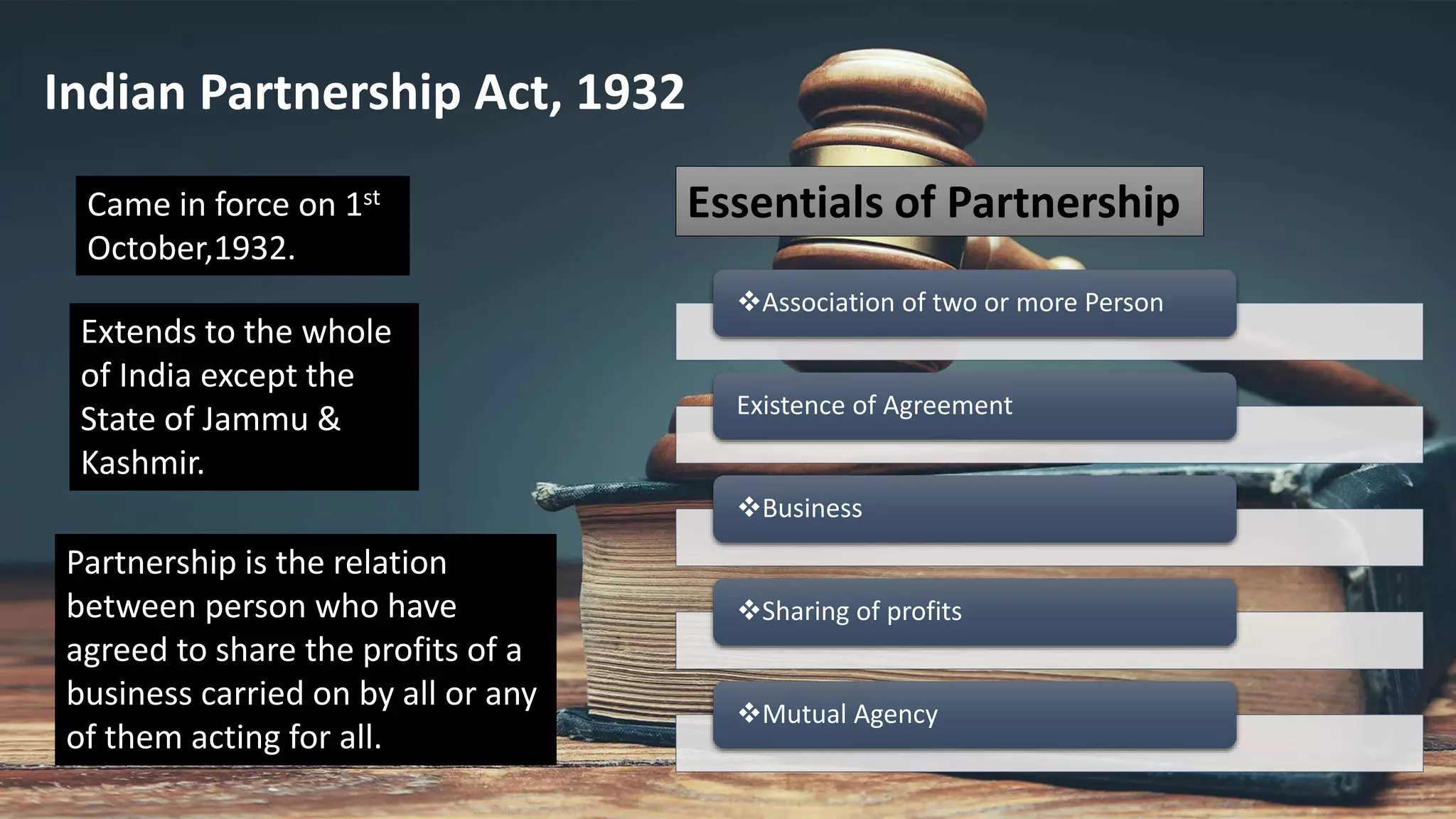
- Two or More Persons: A partnership requires a minimum of two people. The Companies Act, 2013, sets the maximum number of partners at 50.
- Agreement: A partnership is born from an agreement, which can be oral or written. This agreement forms the basis of the relationship. A written agreement is called a Partnership Deed.
- Business: The partners must come together to carry on a lawful business. Simply co-owning property does not make the owners partners. The intent must be to conduct a business.
- Sharing of Profit: The primary objective of the agreement must be to share the profits (and implicitly, the losses) of the business.
- Mutual Agency: This is a cornerstone of partnership. The phrase "carried on by all or any of them acting for all" means that each partner acts as both a principal (an owner) and an agent for all other partners. An act performed by one partner in the ordinary course of business binds the entire firm.
- Unlimited Liability: This is a crucial feature. Partners are jointly and severally liable for all the debts of the firm. If the firm's assets are insufficient to pay its liabilities, the partners' personal property can be used to settle the debts. This is a significant difference from a limited liability company.
The Importance of the Partnership Deed
The Partnership Deed is the formal written agreement that details the terms and conditions governing the partners. It is the constitution of the firm. While an oral agreement is valid, a written deed is highly recommended to avoid future disputes. It typically includes details like:
- Names and addresses of partners and the firm.
- Nature of the business.
- Capital contributed by each partner.
- Profit and loss sharing ratio.
- Interest on capital, loans, and drawings.
- Salaries or commissions payable to partners.
- Rights, duties, and liabilities of each partner.
What if There Is No Partnership Deed?
The Indian Partnership Act, 1932, is so fundamental because it provides a set of default rules that apply when the Partnership Deed is either non-existent or silent on a particular matter. Understanding these rules is critical for accounting.
Let's return to the video to see a clear explanation of these default provisions.
Fundamentals - Partnership | Chapter 1 | Accountancy Class 12 | Easiest way
This section of the video clearly lists the five key rules that apply in the absence of a partnership deed. These are directly derived from the Partnership Act, 1932.
Watch from 16:43 to 19:07. Focus on memorizing these five important rules, as they are frequently tested and applied in problems.
To summarize the rules that apply when the Partnership Deed is silent:
- Profit/Loss Sharing Ratio: Shared equally among all partners, regardless of their capital contribution.
- Interest on Capital: Not allowed. No partner is entitled to interest on their capital.
- Interest on Drawings: Not charged. The firm cannot charge interest on any money withdrawn by partners for personal use.
- Salary or Commission to a Partner: Not allowed. No partner is entitled to any salary or remuneration for managing the business.
- Interest on a Partner's Loan to the Firm: If a partner provides a loan to the firm (separate from their capital), they are entitled to interest at a rate of 6% per annum.
Test your understanding!
Amit and Binita are partners in a firm. They do not have a partnership deed. How will the following disputes be resolved?
- Amit contributed ₹5,00,000 as capital, while Binita contributed ₹3,00,000. Amit wants profits to be shared in the ratio of their capital contributions, but Binita wants an equal share.
- Binita spends more time managing the business and demands a salary of ₹10,000 per month. Amit disagrees.
- Amit has given a loan of ₹1,00,000 to the firm and demands interest at 10% per annum. Binita agrees to pay interest but only at 6% per annum.
Show answer
Here is how the disputes would be resolved according to the provisions of the Indian Partnership Act, 1932:
- Profit Sharing: Profits must be shared equally. Amit's claim is invalid. The profit-sharing ratio will be 1:1, regardless of the capital contributed.
- Salary: Binita is not entitled to any salary. In the absence of a deed, no remuneration is payable to any partner for participating in the business.
- Interest on Loan: Amit is entitled to interest on his loan, but only at the rate of 6% per annum, not 10%. Binita's stance is correct as per the Act.
Conclusion
In this lesson, we established the fundamental legal framework of a partnership.
Key Takeaways:
- A partnership is a business structure formed by an agreement between two or more persons (up to 50) to share profits from a business.
- The essential features are the agreement, the business motive, profit sharing, mutual agency, and unlimited liability.
- The relationship between partners is governed by the Partnership Deed (a written agreement).
- In the absence of a deed, the provisions of the Indian Partnership Act, 1932, apply. This means equal profit sharing, no interest on capital or drawings, no salaries, and 6% p.a. interest on a partner's loan.
Understanding these characteristics is crucial because they dictate how we will perform the accounting for the firm.
Preview of the Next Lesson:
In our next lesson, we will move from theory to practice. We will learn how to distribute the firm's profit among the partners. This involves preparing a new account that you haven't seen in sole proprietorships: the Profit and Loss Appropriation Account. We will see how it differs from the standard Profit and Loss Account and how it's used to apply the rules we learned today.