Hello! Welcome back.
In our last lesson, we mastered the technique of adjusting partners' capitals to align with a new profit-sharing ratio. This was the final individual adjustment we needed to learn for the admission of a partner. Today, we're going to put everything together.
Our goal is to prepare comprehensive Partners' Capital Accounts that incorporate all the adjustments we've covered: goodwill, revaluation, reserves, and capital changes. This is the central account where all the financial reshuffling during a partner's admission culminates. By the end of this lesson, you will have a systematic process to confidently tackle this crucial part of any comprehensive problem.
The Anatomy of a Partner's Capital Account
Think of the Partner's Capital Account as the master ledger for each partner. It tracks their initial investment and every subsequent change to their stake in the firm. When preparing it, we follow a standard format, recording all increases on the credit side and all decreases on the debit side.
Let's quickly review the items that typically appear on each side of a fluctuating capital account.
STUDY MATERIAL ACCOUNTANCY (055)
The 'STUDY MATERIAL ACCOUNTANCY (055)' provides a concise list of items that affect a partner's fluctuating capital account. This will serve as our checklist.
In this PDF, find Chapter 1, and look for 'PRACTICAL PROBLEMS'. Read the answers to Q3 and Q4. These questions list the items that appear on the credit and debit sides of a partner's fluctuating capital account.
Based on that review and our previous lessons, here is a summary of a Partner's Capital Account structure during admission:
Dr. Partners' Capital Accounts Cr.
| Particulars | Old Partner A (₹) | Old Partner B (₹) | New Partner C (₹) | Particulars | Old Partner A (₹) | Old Partner B (₹) | New Partner C (₹) |
|---|---|---|---|---|---|---|---|
| To Goodwill A/c (written off) | ✓ | ✓ | By Balance b/d | ✓ | ✓ | ||
| To P&L A/c (Dr. Bal) | ✓ | ✓ | By Cash/Bank A/c (Capital) | ✓ | |||
| To Advt. Suspense A/c | ✓ | ✓ | By General Reserve A/c | ✓ | ✓ | ||
| To Revaluation A/c (Loss) | ✓ | ✓ | By P&L A/c (Cr. Bal) | ✓ | ✓ | ||
| To Cash/Bank A/c (Withdrawal) | ✓ | ✓ | By Revaluation A/c (Profit) | ✓ | ✓ | ||
| To Balance c/d (Closing) | ✓ | ✓ | ✓ | By Premium for Goodwill A/c | ✓ | ✓ | |
| By Cash/Bank A/c (Deficit) | ✓ | ✓ |
A Systematic Approach to Preparing Capital Accounts
The key to accuracy is following a consistent order of operations. Here is a step-by-step process that will guide you through any comprehensive question:
- Opening Balances: Start by entering the opening capital balances of the old partners from the given Balance Sheet (
By Balance b/d). - Distribute Reserves & Losses:
- Credit Side: Distribute items from the liability side of the old Balance Sheet like General Reserve, Reserve Fund, and the credit balance of the P&L Account to the old partners in their old profit-sharing ratio.
- Debit Side: Write off items from the asset side like existing Goodwill, the debit balance of the P&L Account, and Deferred Revenue Expenditure (e.g., Advertisement Suspense) by debiting the old partners in their old ratio.
- Post Revaluation Profit/Loss: Transfer the net profit or loss from the Revaluation Account. A profit is credited (
By Revaluation A/c), and a loss is debited (To Revaluation A/c) to the old partners in their old ratio. - Record New Partner's Capital: Credit the new partner's column with the capital they bring in (
By Cash/Bank A/c). - Adjust for Goodwill: Credit the sacrificing partners' capital accounts with their share of the goodwill premium brought by the new partner (
By Premium for Goodwill A/c). If the new partner doesn't bring cash, you'll typically debit their Current Account instead (this will be reflected in the Balance Sheet, not the Capital Account). - Capital Adjustments (If Required): If the question asks for it, perform the capital adjustment calculation as learned in the previous lesson. The calculated 'required capital' becomes the closing balance (
To Balance c/d). The balancing figure on either the debit or credit side will be the cash brought in or withdrawn (To/By Cash/Bank A/c). - Find Closing Balances: If there are no capital adjustments (Step 6), simply balance the accounts. The balancing figure will be the closing capital (
To Balance c/d).
Putting it into Practice: A Worked Example
Let's watch a video where these steps are applied to solve a comprehensive question. This will help you see the flow of information from the question to the final accounts.
Admission of a Partner | 6 mark Comprehensive question | Part 7 | Class 12 | Accounts
In this video, 'Admission of a Partner | 6 mark Comprehensive question' by Rajat Arora, the instructor solves a typical board exam-style question. Pay close attention to the sequence of postings into the Partners' Capital Account.
Watch the segment from 03:04 to 12:46. The instructor will explain the sequence of preparing accounts and then proceed to solve the question, creating the Partners' Capital Account along the way. Observe how each adjustment finds its place in the account.
As you saw in the video, the process is very methodical. Let's trace the steps:
- First, the opening capitals were posted (
By Balance b/d). - Next, the adjustment for Workmen's Compensation Reserve was handled. Since the claim was more than the reserve, the excess was routed through the Revaluation Account, and no amount was distributed to partners.
- Then, the new partner's capital and goodwill premium were recorded (
By Bank A/candBy Premium for Goodwill A/c). - The premium for goodwill was distributed to the sacrificing partners.
- Finally, after completing the Revaluation Account, the revaluation loss was transferred to the old partners' capital accounts.
Visualizing the Complete Solution
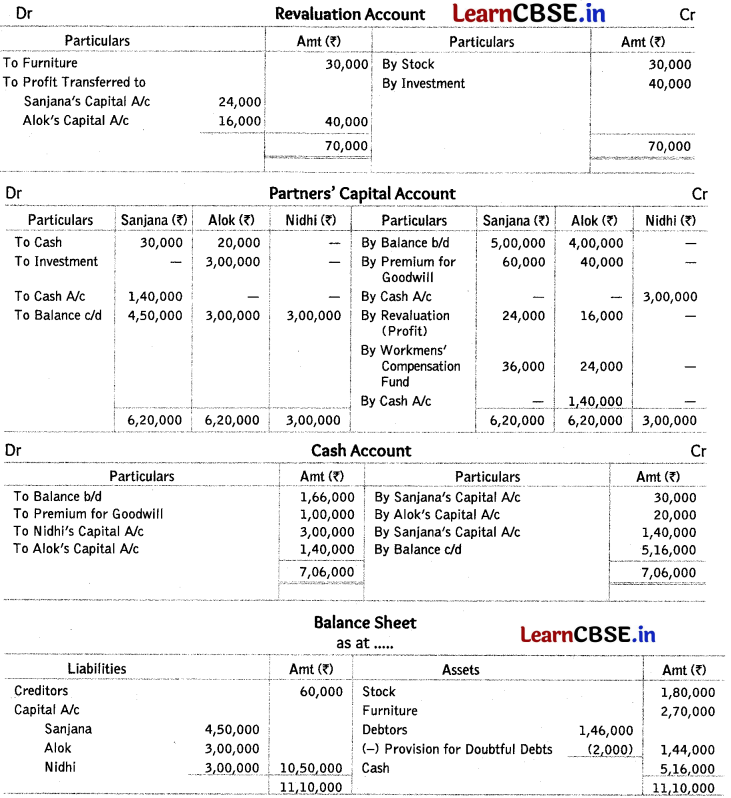
The Partners' Capital Account is just one piece of the puzzle. It takes input from the Revaluation Account and provides the final capital figures for the new Balance Sheet.
The image below shows a complete solution for an admission problem. Trace the flow of information: see how the revaluation profit is transferred to the capital accounts, and how the final capital balances are then shown on the liability side of the new Balance Sheet.
Tackling More Complex Adjustments
The previous example was a good start. Now, let's examine a problem with a few more layers, such as existing goodwill to be written off and a revaluation loss.
CHAPTER 5 ADMISSION OF A NEW PARTNER
This PDF document, 'CHAPTER 5 ADMISSION OF A NEW PARTNER', contains a variety of solved problems. We will look at Illustration 9, which is a great example of a capital account with multiple debit-side adjustments.
Find Illustration 9 in the document. You can skip the journal entries and Balance Sheet. Focus only on the preparation of the 'Partner's Capital Accounts'. Note how the following items are posted: Revaluation Loss (To Revaluation) Existing Goodwill written off (To goodwill A/c) Goodwill adjustment for the new partner (By Z's Current A/c) Investments taken over by partners (To Investment)
This illustration reinforces the principle that all losses, write-offs, and assets taken over by partners result in a debit to their respective capital accounts, reducing their stake in the firm.
Test your understanding!
The Balance Sheet of A and B, who share profits 3:2, shows: General Reserve ₹20,000 and a debit balance in P&L A/c of ₹10,000. Their capitals are A: ₹1,00,000 and B: ₹80,000.
C is admitted for a 1/4th share. On admission, the revaluation of assets resulted in a profit of ₹15,000. C brings ₹60,000 for capital and his share of goodwill premium, ₹10,000. The entire goodwill is credited to A, who alone sacrificed.
Prepare the Partners' Capital Accounts.
Show answer
Dr. Partners' Capital Accounts Cr.
| Particulars | A (₹) | B (₹) | C (₹) | Particulars | A (₹) | B (₹) | C (₹) |
|---|---|---|---|---|---|---|---|
| To P&L A/c (Loss) | 6,000 | 4,000 | By Balance b/d | 1,00,000 | 80,000 | ||
| To Balance c/d | 1,25,000 | 80,000 | 60,000 | By General Reserve A/c | 12,000 | 8,000 | |
| By Revaluation A/c (Profit) | 9,000 | 6,000 | |||||
| By Cash/Bank A/c (Capital) | 60,000 | ||||||
| By Premium for Goodwill | 10,000 | ||||||
| Total | 1,31,000 | 84,000 | 60,000 | Total | 1,31,000 | 84,000 | 60,000 |
Working Notes:
- General Reserve distribution (3:2): A = 12,000; B = 8,000.
- P&L Loss distribution (3:2): A = 6,000; B = 4,000.
- Revaluation Profit distribution (3:2): A = 9,000; B = 6,000.
Conclusion
Excellent work! Today, you've integrated all the pieces of the admission puzzle into a single, cohesive process. Preparing the Partners' Capital Account is no longer about remembering isolated rules, but about following a logical sequence of steps.
Key Takeaways:
- The Partner's Capital Account is the central ledger where all adjustments for reserves, revaluation, and goodwill are recorded.
- Following a systematic order is critical for accuracy:
- Opening Balances
- Reserves & Accumulated Losses
- Revaluation Profit/Loss
- New Partner's Capital & Goodwill
- Capital Adjustments (if any)
- Closing Balances
- Increases to a partner's capital (profits, reserves, premiums received) are credited. Decreases (losses, write-offs, withdrawals) are debited.
Preview of the Next Lesson:
Now that we know how to calculate the final, adjusted capital balances for all partners, we are ready for the final step. In our next lesson, you will learn to prepare the opening Balance Sheet of the reconstituted firm after a partner's admission. You will see how the new capital balances, revalued assets and liabilities, and changes in cash all come together to present the new financial position of the firm.