Hello! In our last lesson, we saw how Debenture Redemption Reserve (DRR) and Debenture Redemption Investment (DRI) are used when a company redeems its debentures. We recorded entries for encashing the DRI and transferring the DRR to the General Reserve.
Today, we'll dive deeper into the 'why' and 'how' behind these two crucial accounts. This lesson is all about understanding the specific legal rules and accounting procedures for Debenture Redemption Reserve (DRR) and Debenture Redemption Investment (DRI) as mandated by the Companies Act, 2013. Mastering these rules is essential, as they are a frequent source of adjustments in comprehensive debenture problems.
1. The 'Why': Protecting Debenture Holders
When a company issues debentures, it is taking on a significant long-term debt. To ensure the company is financially prepared to repay this debt and to protect the interests of the debenture holders (who are creditors), the law requires the company to take two specific measures:
- Set aside profits: Earmark a portion of profits that cannot be distributed as dividends. This is the Debenture Redemption Reserve (DRR).
- Invest cash: Set aside and invest actual cash in specified safe securities to ensure liquidity. This is the Debenture Redemption Investment (DRI).
Let's break down each of these components.
2. Debenture Redemption Reserve (DRR)
DRR is a restriction on the distribution of profits. By creating this reserve, a company is forced to retain a portion of its earnings specifically for the purpose of redeeming debentures. Think of it as a "book entry" that demonstrates financial prudence.
To get a clear conceptual understanding of DRR and the subsequent DRI, please watch the following video. The analogy of parents saving for a child's future is particularly helpful.
#1 Redemption of Debentures - Concept - DRR and DRI - By Saheb Academy - CA INTER
This video from Saheb Academy provides an excellent conceptual breakdown of both DRR and DRI, explaining their purpose and the logic behind their creation.
Please watch the video sections on DRR and DRI: Concept of DRR (13:35 - 20:12): Focus on what DRR is (a reserve from profits), its purpose (to ensure sufficient funds and show genuineness), and the journal entry for its creation. Concept of DRI (22:53 - 26:05): Understand why profits blocked in DRR shouldn't be kept idle and must be invested to ensure liquidity.
As explained in the video, DRR is about ensuring the company has a strong enough profit base, while DRI is about ensuring it has the ready cash.
Legal Requirements for DRR
Here are the key rules you need to know for your exams:
- Nature: It is an appropriation of profit, not a charge. It is created out of profits available for dividend distribution.
- Amount: At least 10% of the face value of outstanding debentures.
- Creation: It must be created before the redemption of debentures begins.
- Usage: The amount in DRR can only be used for redeeming debentures. After all debentures are redeemed, the balance is transferred to the General Reserve, making it a free reserve.
- Partly Convertible Debentures: DRR is created only on the non-convertible portion of the debentures, as the convertible part does not require a cash payout.
3. Debenture Redemption Investment (DRI)
DRI is the tangible counterpart to DRR. While DRR is a book reserve, DRI is a real asset—an investment made outside the business in specified liquid securities. Its purpose is to prevent a cash crunch when the time comes to pay the debenture holders.
Legal Requirements for DRI
- Nature: It is an investment and appears as an asset in the Balance Sheet.
- Amount: At least 15% of the nominal value of debentures maturing during the financial year (ending 31st March).
- Key Distinction: DRR is on total outstanding debentures, while DRI is only on the amount due for redemption in a particular year.
- Timing: The investment must be made on or before April 30th of the financial year in which the debentures are to be redeemed.
- Realization: The investment is encashed at the time of redemption to provide the necessary cash for payment.
4. Who Needs to Comply? The Exemption Rules
This is the most critical and often confusing part. Not all companies are required to create DRR and DRI. The rules vary based on the type and status (listed/unlisted) of the company.
The following video segment simplifies the complex legal table into a clear, easy-to-remember summary.
#1 Redemption of Debentures - Concept - DRR and DRI - By Saheb Academy - CA INTER
The rules for who needs to create DRR and DRI can be confusing. This segment of the video provides a simplified and clear summary, which is crucial for your exams.
Watch the video from 29:58 to 35:05. Focus on the summary table the instructor presents. Your goal is to identify which types of companies are exempt from DRR, from DRI, or from both.
Let's consolidate this into a simple table. This is a very important summary for solving problems.
| Company Type | DRR Required? | DRI Required? |
|---|---|---|
| All India Financial Institutions (AIFIs), Banking Companies | No | No |
| Other Financial Institutions | No | No |
| Listed Companies (other than the above) e.g., Listed Manufacturing Co., Listed NBFCs, Listed HFCs |
No | Yes (15%) |
| Unlisted Companies | ||
| - Unlisted NBFCs and HFCs | No | No |
| - Other Unlisted Companies (e.g., Unlisted Mfg Co.) | Yes (10%) | Yes (15%) |
Key Takeaway: For your exam problems, you will most likely deal with "Other Unlisted Companies" which must create both DRR and DRI, or "Listed Companies" which must create only DRI.
5. Accounting Treatment and Journal Entries
Now, let's put these rules into practice with the journal entries.
For DRR
-
For creating/transferring amount to DRR:
- Surplus, i.e., Balance in Statement of Profit and Loss A/c Dr.
- To Debenture Redemption Reserve A/c
(Being amount transferred to DRR)
-
For transferring DRR to General Reserve after redemption:
- Debenture Redemption Reserve A/c Dr.
- To General Reserve A/c
(Being DRR transferred to General Reserve on redemption of all debentures)
For DRI
-
For making the investment:
- Debenture Redemption Investment A/c Dr.
- To Bank A/c
(Being investment made as per legal requirements)
-
For encashing the investment at the time of redemption:
- Bank A/c Dr.
- To Debenture Redemption Investment A/c
(Being investment encashed for redemption)
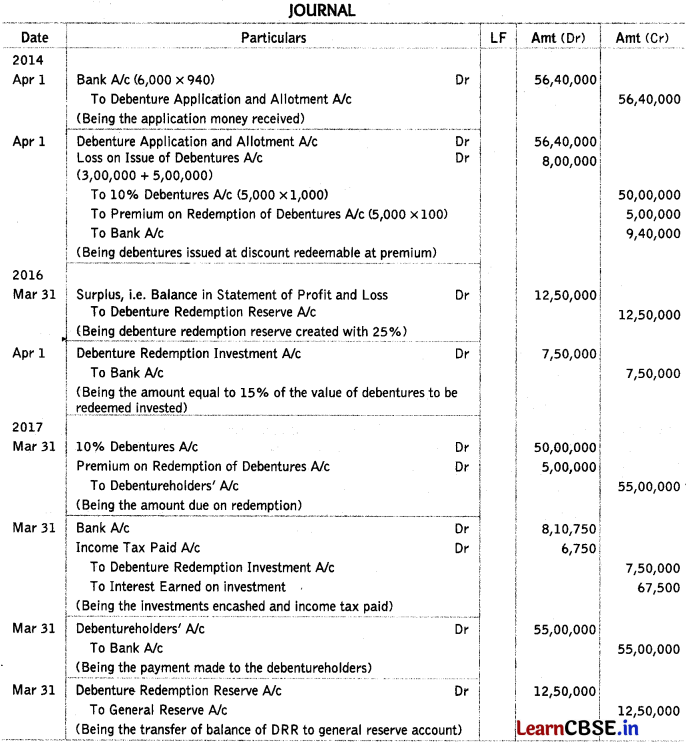
This image provides a great visual summary of these entries in the context of a full redemption problem.
Test your understanding!
An unlisted manufacturing company (not an NBFC or HFC) has ₹20,00,000, 9% Debentures outstanding on April 1, 2023. It needs to redeem ₹5,00,000 worth of these debentures on March 31, 2024.
Calculate the minimum amount of DRR and DRI the company must have/create, and by what dates.
Show answer
This is an "Other Unlisted Company," so it needs both DRR and DRI.
-
Debenture Redemption Reserve (DRR):
- Amount: 10% of outstanding debentures = 10% of ₹20,00,000 = ₹2,00,000.
- Timing: This amount must be in the DRR account before redemption begins on March 31, 2024.
-
Debenture Redemption Investment (DRI):
- Amount: 15% of debentures maturing during the year = 15% of ₹5,00,000 = ₹75,000.
- Timing: This investment must be made on or before April 30, 2023.
Practical Illustrations
To see how these rules apply in different scenarios, let's look at a few examples.
Joint Stock Company— Redemption of Debentures
This resource provides several solved illustrations that are perfect for understanding how the rules for DRR and DRI apply to different types of companies.
Please review the following illustrations. For each, focus on why DRR or DRI was created (or not created) based on the company type. Illustration 3 (or Illustration 8, which is similar): An unlisted (Non-NBFC) company. Notice it creates both DRR and DRI. Illustration 4: A listed company. Notice it does not create DRR, but it does create DRI. Illustration 5: A banking company. Notice it is exempt and creates neither DRR nor DRI.
These examples clearly demonstrate the practical application of the exemption table we discussed earlier.
Conclusion
You've done a fantastic job navigating some of the more technical legal requirements in company accounts! Understanding these rules is not just about memorization; it's about appreciating the framework designed to protect creditors.
Key Takeaways:
- DRR (Financial Prudence): A reserve created from profits. It's a book entry to restrict dividend payments. The requirement is 10% of outstanding debentures, applicable mainly to unlisted companies (non-financial).
- DRI (Liquidity): An actual investment of cash into specified securities. It's a tangible asset to ensure cash availability. The requirement is 15% of debentures maturing in the current year, applicable to most companies except banks, AIFIs, and unlisted financial companies.
- Timing is Crucial: DRR must be created before redemption starts. DRI must be invested by April 30th of the redemption year.
- Final Step: After all debentures are redeemed, DRR is transferred to the General Reserve.
Preview of the Next Lesson:
We have now covered the issue, interest, and redemption of debentures, including the creation of DRR and DRI accounts. The final piece of the puzzle is to see how all these items are correctly placed in the company's final accounts. In the next lesson, we will learn how to present Debentures and related items in the company's Balance Sheet as per the format of Schedule III.