Hello! Welcome back to our course on Company Accounts.
In our last lesson, we focused on the journal entries at the time of issuing debentures, taking into account different redemption terms like redeeming at a premium. We saw how the Prudence Concept requires us to anticipate and account for future losses today.
Today, we shift our focus from the one-time event of issue to the recurring obligation that a company has towards its debenture holders: paying interest. Since debentures are essentially a long-term loan, the company must compensate the lenders. This lesson will teach you how to account for interest on debentures, including the treatment of Tax Deducted at Source (TDS). This is a crucial and frequently tested topic for your Grade 12 CBSE exams.
1. The Fundamentals of Debenture Interest
Before we get into the journal entries, let's clarify three core principles about debenture interest.
- Basis of Calculation: Interest is always calculated on the face value (or nominal value) of the debentures. It doesn't matter if the debentures were issued at a discount or a premium; the interest rate applies to the original face value.
- Nature in Accounts: Interest on debentures is a charge against profit. This is a critical distinction. Unlike dividends on shares, which are an appropriation of profit (paid only if profits are available), interest is an expense that must be paid whether the company earns a profit or incurs a loss.
- Periodicity: Interest is paid periodically, as specified in the terms of issue. This is typically half-yearly (e.g., on September 30th and March 31st) or annually.
To get a formal definition and see the calculation formula, please review the following short text.
Interest on Debentures: Calculation, Journal Entries & TDS
This article from Vedantu provides a clear, concise overview of the fundamental principles of debenture interest.
Read the sections 'Meaning of Interest on Debentures' and 'Calculation and Formula for Interest on Debentures'. Pay close attention to the summary table at the beginning and the key principles: interest is a charge against profit and is always calculated on the face value.
2. Understanding Tax Deducted at Source (TDS)
The interest earned by debenture holders is considered income, and it is taxable under the Income Tax Act. It would be difficult for the government to track and collect tax from thousands of individual debenture holders.
To solve this, the law requires the company paying the interest to deduct the tax before making the payment to the debenture holder. This is called Tax Deducted at Source (TDS). The company then deposits this TDS amount directly with the government on behalf of the debenture holders.
Here's the flow:
- Company calculates the Gross Interest due.
- Company deducts TDS from the gross interest.
- The remaining Net Interest is paid to the debenture holders.
- The TDS amount is paid to the government.
From the company's perspective, the full gross interest is an expense. Let's watch a video that explains this concept clearly.
#7 Issue of Debentures - Interest on Debenture and TDS ( Tax Deducted at Source) - By Saheb Academy
This video from Saheb Academy explains the concept of TDS very clearly using a simple example.
Watch from 01:01 to 06:37. The video explains what TDS is, why the government requires it, and how it affects the amount of interest paid to debenture holders. Focus on understanding the flow of money: Gross Interest is split into Net Interest (for the holder) and TDS (for the government).
3. Journal Entries for Debenture Interest and TDS
Now, let's translate this process into accounting entries. The process involves four logical steps.
- Making Interest Due: We recognize the total interest expense and create liabilities for the amounts payable to debenture holders and the government.
- Paying Debenture Holders: We settle the liability to the debenture holders.
- Paying TDS to Government: We settle the tax liability.
- Transferring Interest Expense: At the end of the accounting year, we close the interest expense account by transferring it to the Statement of Profit and Loss.
The following video segment walks through these exact entries.
#7 Issue of Debentures - Interest on Debenture and TDS ( Tax Deducted at Source) - By Saheb Academy
With the concept of TDS clear, let's see how to record these transactions. The same video continues by detailing the necessary journal entries.
Continue watching from 07:53 to 10:59. The video breaks down the process into four key entries: making interest due, paying the holders, paying the TDS, and transferring the expense to the P&L statement. Follow along and note the logic for each debit and credit.
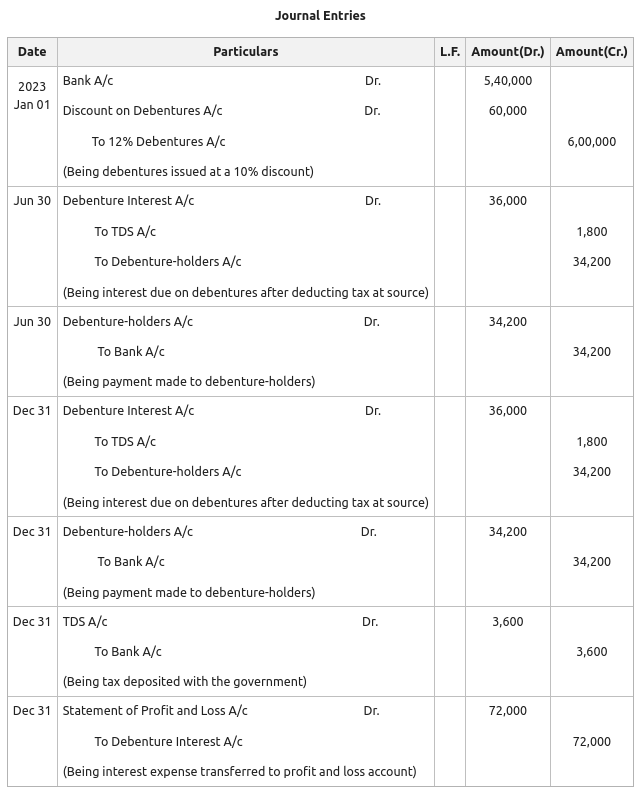
Here is a summary of the journal entries for your reference:
1. For making interest due:
Interest on Debentures A/c      Dr.   [Gross Interest]
    To Debenture Holders' A/c           [Net Interest]
    To TDS Payable A/c                  [TDS Amount]
(Being interest due and TDS deducted)
2. For payment of interest to debenture holders:
Debenture Holders' A/c         Dr.   [Net Interest]
    To Bank A/c
(Being interest paid to debenture holders)
3. For payment of TDS to the government:
TDS Payable A/c                Dr.   [TDS Amount]
    To Bank A/c
(Being TDS deposited with the government)
4. For transferring interest to the Statement of Profit and Loss (at year-end):
Statement of Profit and Loss   Dr.   [Total Annual Gross Interest]
    To Interest on Debentures A/c
(Being debenture interest transferred)
The image below provides a great visual summary of this process for half-yearly interest payments.
Test your understanding!
A company has ₹5,00,000, 10% Debentures. Gross interest for the year is ₹50,000 and the TDS rate is 10%. What is the journal entry for making the interest due?
Show answer
- Gross Interest: ₹50,000
- TDS Amount: 10% of ₹50,000 = ₹5,000
- Net Interest to Holders: ₹50,000 - ₹5,000 = ₹45,000
The journal entry would be:
| Particulars | Debit (₹) | Credit (₹) |
|---|---|---|
| Interest on Debentures A/c Dr. | 50,000 | |
| To Debenture Holders' A/c | 45,000 | |
| To TDS Payable A/c | 5,000 |
4. Comprehensive Example: Half-Yearly Interest
In exams, you will most commonly encounter questions where interest is paid half-yearly. The logic remains the same; you just repeat the "due" and "payment" entries for each half-year. Remember that the final transfer to the Statement of P&L happens only once at the end of the year and includes the total interest for the entire year.
Let's watch a quick solved problem to see this in action.
Interest on Debentures. Issue of debentures class 12th Accounts Part- 6 | Most important questions.
Let's apply everything we've learned to a typical exam-style problem involving half-yearly interest payments. This video from Sunil Panda solves a comprehensive question from start to finish.
Watch the example from 11:03 to 14:55. Notice how the same set of entries is repeated for each half-year (on Sept 30th and March 31st), and how the total annual interest (₹50,000) is transferred to the Statement of P&L at the year-end.
Conclusion
Excellent work today! You have now learned how to account for one of the most important ongoing costs associated with debentures.
Key Takeaways:
- Debenture interest is a charge against profit calculated on the face value.
- Tax Deducted at Source (TDS) is a mechanism where the company deducts tax from the interest payment and remits it to the government.
- The accounting process involves four main entries: recognizing the interest due (Dr. Interest, Cr. Holders, Cr. TDS Payable), paying the holders (Dr. Holders, Cr. Bank), paying the tax (Dr. TDS Payable, Cr. Bank), and finally, transferring the total annual interest expense to the Statement of Profit and Loss.
Preview of the Next Lesson:
Having covered the issue and interest payments, we will next address the final stage in a debenture's lifecycle: redemption. In our next lesson, you will learn to record the journal entries for the redemption of debentures, focusing on the methods of lump-sum payment and purchasing debentures in the open market for cancellation.