Hello! Let's continue our journey through the Cash Flow Statement.
In our last lesson, we mastered the crucial first step: calculating Net Profit before Tax and Extraordinary Items (NPBT). This figure is the starting point for determining cash flow from operating activities using the indirect method.
Today, we'll build directly on that foundation. Our goal is to take the NPBT figure and adjust it for non-cash and non-operating items. This is the second major step in preparing the operating activities section. By the end of this lesson, you will be able to adjust NPBT to arrive at a figure called 'Operating Profit before Working Capital Changes'.
1. The 'Why': From Accrual Profit to Operating Cash Profit
The NPBT you calculated is based on the accrual concept of accounting. It includes several expenses and incomes that don't actually involve a movement of cash in the current period (non-cash items) or that relate to investing or financing activities, not core operations (non-operating items).
To get closer to the actual cash generated from operations, we must reverse the effect of these items. The logic is simple:
- Expenses/Losses to be ADDED back: Items like depreciation, loss on sale of an asset, or interest paid on a loan were subtracted to arrive at net profit. Since they are not operating cash outflows, we add them back.
- Incomes/Gains to be DEDUCTED: Items like profit on the sale of an asset or dividend income received were added to arrive at net profit. Since they are not operating cash inflows (they are investing inflows), we must deduct them.
Let's watch a video that introduces this concept and lists the most common items you'll encounter.
[#1] Cash Flow Statement Format [Indirect Method] [AS PER AS - 3] Operating | Investing | Financing
This video from Kauser Wise clearly explains the logic behind adjusting for non-cash and non-operating items. It provides excellent examples for both items that are added back and those that are deducted.
Watch the segment from 03:34 to 06:46. Pay close attention to the distinction between non-cash items (like depreciation) and non-operating items (like profit/loss on sale of assets or interest income/expense).
2. The Format for Adjustment
After calculating NPBT, the next section in your Cash Flow Statement will look like this. This format organizes the additions and deductions systematically.
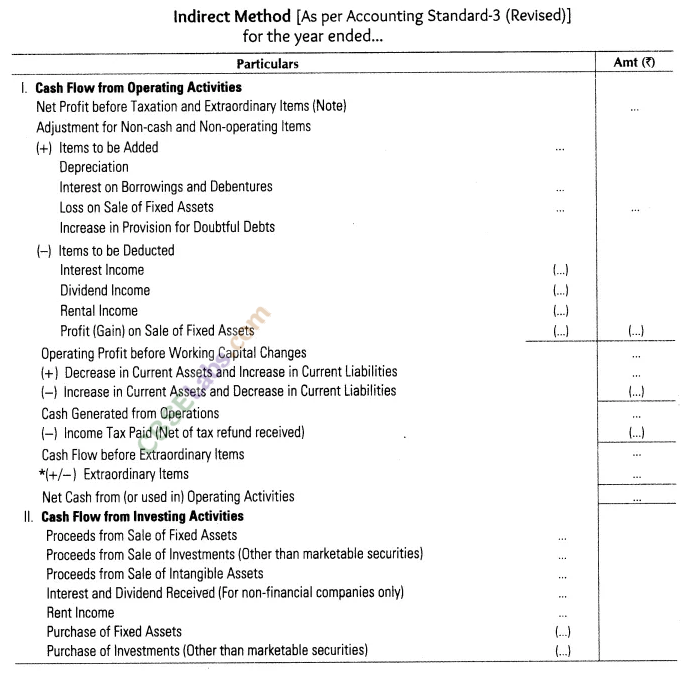
As you can see, the process involves two main groups of adjustments to NPBT:
- Add: Non-cash and Non-operating Expenses/Losses (e.g., Depreciation, Goodwill amortised, Interest on borrowings, Loss on sale of fixed assets).
- Less: Non-operating Incomes/Gains (e.g., Interest income, Dividend income, Profit on sale of fixed assets).
The result of these adjustments is the Operating Profit before Working Capital Changes.
3. Handling Complex Adjustments
In exam problems, figures like 'depreciation for the year' or 'loss on sale of asset' are often not given directly. You need to calculate them by preparing ledger accounts, just as we did for Provision for Taxation in the last lesson. Let's explore how to handle the most common ones.
The following video is a masterclass in handling the detailed adjustments required for the Cash Flow Statement. We'll break it down to focus on the key non-cash and non-operating items.
Cash flow statement | Accountancy | Class 12 | Part 2 | All basics
In this video, Rajat Arora provides an in-depth guide to the key adjustments. We will watch specific sections that explain how to find the figures for depreciation, profit/loss on sale of assets, interest on debentures, and goodwill amortization.
Please watch the following segments carefully, as they cover crucial calculation techniques: Asset Adjustments (21:18 - 31:06): This is the most important part. Focus on how to prepare a Fixed Asset Account and Accumulated Depreciation Account to find the balancing figures for Depreciation, Purchase, Sale, and Profit/Loss. Understand where each of these items is reported in the final Cash Flow Statement. Interest on Debentures (15:52 - 21:18): Pay attention to how interest is calculated when debentures are issued or redeemed during the year. This is a common non-operating expense. Goodwill (31:06 - 31:48): Understand why a decrease in goodwill is treated as 'Goodwill Written Off' and added back as a non-cash expense.
Summary of Key Ledger Account Logic:
Fixed Asset Account (when no Accumulated Depreciation A/c is given)
- Debit side: Opening Balance, Profit on Sale, Purchase (balancing figure).
- Credit side: Depreciation, Bank (Sale Proceeds), Loss on Sale, Closing Balance.
Fixed Asset Account & Accumulated Depreciation Account
- Accumulated Depreciation A/c:
- Debit: To Fixed Asset A/c (depreciation on the asset sold).
- Credit: Opening Balance, By Depreciation (P&L charge for the year - often the balancing figure).
- Fixed Asset A/c (at cost):
- Debit: Opening Balance (at cost), Purchase (balancing figure).
- Credit: Bank (Sale Proceeds), Accumulated Depreciation (on asset sold), Loss on Sale, Closing Balance (at cost).
The Depreciation and Loss on Sale figures you calculate are added back in the operating activities section. The Profit on Sale is deducted.
Test your understanding!
A company provides the following information:
- Net Profit before Tax and Extraordinary Items: ₹5,00,000
- Depreciation charged during the year: ₹80,000
- Profit on sale of an old machine: ₹20,000
- Interest paid on a long-term loan: ₹40,000
- Interest received on investments: ₹15,000
- Goodwill written off: ₹10,000
Calculate the Operating Profit before Working Capital Changes.
Show answer
| Particulars | Amount (₹) | Amount (₹) |
|---|---|---|
| Net Profit before Tax and Extraordinary Items | 5,00,000 | |
| Add: Non-cash & Non-operating expenses | ||
| Depreciation | 80,000 | |
| Interest on long-term loan | 40,000 | |
| Goodwill written off | 10,000 | 1,30,000 |
| Less: Non-operating incomes | ||
| Profit on sale of machine | (20,000) | |
| Interest received on investments | (15,000) | (35,000) |
| Operating Profit before Working Capital Changes | 5,95,000 |
4. A Complete Example
Let's tie it all together with a comprehensive example from a reference document. This will show you how the calculation of NPBT (from our last lesson) flows directly into the adjustments we learned today.
This PDF document provides a clear, worked-out problem. Illustration 1 shows the full sequence from calculating NPBT to adjusting for non-cash and non-operating items.
Please review 'Illustration 1'. First, see how they calculate 'Net Profit before Tax and Extra-ordinary item' (₹2,74,000). Then, carefully study the next section, 'Adjustment for non-cash and non-operating items', to see how depreciation, preliminary expenses written off, loss on sale, and profit on sale are used to arrive at 'Operating Profit before working capital changes' (₹2,99,000).
Conclusion
Excellent work today! You have now completed the second major block of the operating activities section. By adjusting for non-cash and non-operating items, you have successfully converted an accrual-based profit figure into a much more accurate measure of cash-generating ability from core business operations.
Key Takeaways:
- To find Operating Profit before Working Capital Changes, we adjust NPBT.
- Add back non-cash and non-operating expenses/losses like Depreciation, Amortization (Goodwill written off), Interest Paid, and Loss on Sale of Assets.
- Deduct non-operating incomes/gains like Interest Received, Dividend Received, and Profit on Sale of Assets.
- Complex problems often require you to prepare Fixed Asset and Accumulated Depreciation accounts to find the necessary adjustment figures.
Preview of the Next Lesson:
We are just one step away from finishing the operating activities section. In our next lesson, we will take the 'Operating Profit before Working Capital Changes' and make the final set of adjustments for changes in current assets and current liabilities (like debtors, creditors, and inventory) to arrive at the final 'Cash Flow from Operating Activities'.