Hello! Welcome to the next step in our journey through the dissolution of a partnership firm.
In the previous lesson, we finalized the Realisation Account by calculating the profit or loss from the winding-up process and distributing it among the partners. This was a crucial calculation, and today, we're going to put that result to use.
This lesson directly addresses the learning outcome: to prepare Partners' Capital Accounts to ascertain the final settlement (payment or receipt). We will construct the capital accounts from start to finish, incorporating all the adjustments that occur during dissolution. By the end, you'll be able to determine the exact amount of cash each partner either receives from the firm or must contribute to it.
1. The Role of the Partner's Capital Account in Dissolution
Think of the Partner's Capital Account as the final scorecard for each partner. It starts with their capital balance on the date of dissolution and is then adjusted for every item that affects their stake in the firm. Its ultimate purpose is to calculate the final cash settlement.
The key steps involved are:
- Recording opening balances.
- Distributing accumulated profits, reserves, and losses.
- Posting the profit or loss from the Realisation Account.
- Adjusting for any assets taken over by the partner or liabilities paid by them.
- Balancing the account to find the final amount to be paid to the partner or received from them.
2. Structuring the Partner's Capital Account
Let's begin by understanding the structure and the items that go into the capital account.
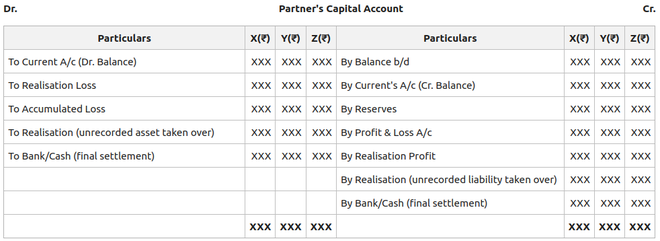
To get a clear, step-by-step breakdown of how to build this account, please read the following text.
Dissolution of Firm: Partner's Capital Account
The following article from GeeksforGeeks provides an excellent, structured guide on the accounting treatment for preparing Partners' Capital Accounts. It lists each step logically, which aligns well with your preferred learning style.
Please read the section 'Accounting Treatment' from Step 1 to Step 5. Focus on the journal entries and the logic for why each item is debited or credited. This covers everything from opening balances to adjustments for assets and liabilities taken over by partners.
To summarize the key adjustments from the reading:
Items that CREDIT (Increase) a Partner's Capital:
- Opening credit balance of the Capital Account.
- Share of General Reserve and accumulated profits (like Profit & Loss A/c credit balance).
- Share of Profit on Realisation.
- Any liability of the firm taken over by the partner (since the firm now owes this money to the partner).
- Any remuneration given to the partner or realisation expenses paid by the partner on behalf of the firm.
Items that DEBIT (Decrease) a Partner's Capital:
- Opening debit balance of the Capital Account (if any).
- Share of accumulated losses (like Profit & Loss A/c debit balance).
- Share of Loss on Realisation.
- Any asset of the firm taken over by the partner (as they are 'buying' it from the firm with their capital).
- Drawings made by the partner.
3. Ascertaining the Final Settlement
Once all the above adjustments are posted, the final step is to balance each partner's capital account. The balancing figure will be the cash settlement.
-
If the Credit Side > Debit Side: The partner has a credit balance. This means the firm owes money to the partner. The closing entry will be a payment from the firm's bank account to the partner.
- Journal Entry:
Partner's Capital A/c Dr.
    To Bank/Cash A/c
(Being final amount paid to the partner on settlement)
- Journal Entry:
-
If the Debit Side > Credit Side: The partner has a debit balance. This means the partner owes money to the firm. The closing entry will be cash brought in by the partner to the firm's bank account.
- Journal Entry:
Bank/Cash A/c Dr.
    To Partner's Capital A/c
(Being final amount received from the partner on settlement)
- Journal Entry:
This process ensures that each partner's account is settled and closed. The Dissolution of Partnership Firm PDF from your previous lesson confirms these settlement entries in point 17.
4. A Comprehensive Demonstration
Let's see this entire process in action. We'll watch a segment from the detailed problem we saw a glimpse of in the last lesson.
Dissolution Of Partnership | Class 12th Accountancy One Shot🎯Vishwaas Batch
This video provides a complete walkthrough of a dissolution problem. We will focus on the part where the Partners' Capital Accounts are prepared and settled.
Please watch from 01:13:58 to 01:18:18. Observe how the instructor prepares the capital accounts for partners A and B. Pay attention to how the following items are posted: Opening balances (By Balance b/d). Distribution of the Profit & Loss A/c (debit balance) and General Reserve. Posting of the Realisation Loss. Adjustments for the investment taken over by A and the liability (Mrs. A's Loan) paid by A. The final balancing figure (To Bank) which represents the cash paid to each partner.
This practical example ties everything together, showing how the capital account acts as the central ledger for all partner-related adjustments before the final payout.
Test your understanding!
The Capital Account of a partner, Priya, shows a credit balance of ₹50,000 on the date of dissolution. Her share of the General Reserve is ₹10,000, and her share of the loss on realization is ₹15,000. She also took over an unrecorded asset from the firm valued at ₹5,000.
Prepare Priya's Capital Account and determine the final amount she will receive or have to pay.
Show answer
Priya's Capital Account
| Particulars | Amount (₹) | Particulars | Amount (₹) |
|---|---|---|---|
| To Realisation A/c (Loss) | 15,000 | By Balance b/d | 50,000 |
| To Realisation A/c (Asset taken) | 5,000 | By General Reserve A/c | 10,000 |
| To Bank A/c (Final Payment) | 40,000 | ||
| Total | 60,000 | Total | 60,000 |
Calculation:
- Total Credits = ₹50,000 + ₹10,000 = ₹60,000
- Total Debits (before settlement) = ₹15,000 + ₹5,000 = ₹20,000
- Final Settlement (Payment to Priya) = ₹60,000 - ₹20,000 = ₹40,000
Priya will receive ₹40,000 from the firm.
Conclusion
Excellent work! You can now prepare a Partner's Capital Account, which is the final step before closing the firm's books entirely.
Key Takeaways:
- The Partner's Capital Account consolidates all transactions affecting a partner's final claim, including opening capital, reserves, realization profit/loss, and any assets or liabilities taken over.
- A credit balance at the end signifies a final payment to the partner.
- A debit balance signifies a final cash contribution from the partner.
- The journal entry for settlement involves either debiting the Capital Account and crediting Bank (for payment) or debiting Bank and crediting the Capital Account (for receipt).
Preview of the Next Lesson:
In our final lesson for this module, you will "Prepare a final Bank/Cash Account to verify the closure of the firm's books." The final settlement amounts you calculated today will be the key figures we use. The Bank/Cash Account acts as the ultimate check; if it balances perfectly to zero, it confirms that all assets have been realized and all claims have been settled correctly.