Welcome to the fifth lesson in your prompt engineering course. Last time, we focused on guiding an AI's style and structure by "showing" it examples with few-shot prompting. You learned how to ensure the AI's output matches your desired tone—a crucial skill for consistent HR communications.
Today, we shift from managing the style of a response to managing the complexity of a task. Many important HR functions, like creating a full recruitment strategy or developing a company-wide policy, are too large to be handled by a single prompt. In this lesson, you will learn how to break down these complex, multi-step projects into a sequence of smaller, manageable prompts. This technique, often called prompt chaining, is essential for producing accurate and detailed results for your most ambitious work.
From a Single Command to a Strategic Conversation
When faced with a large project, you wouldn't typically try to do everything at once. You'd break it down into logical steps. Prompting an AI for complex tasks works the same way. Instead of writing one enormous prompt with dozens of instructions, it is far more effective to guide the AI through a series of focused prompts, where the output of one step becomes the context for the next.
This is the core idea of prompt chaining.

This method works because it keeps the AI focused. Large language models can get "confused" or lose track of details when given too many instructions at once. By breaking the task down, you ensure the AI has a clean, relevant context for each step, which dramatically improves the quality and accuracy of the final result.
The following video provides a great overview of prompt chaining in action. It uses the example of an author marketing a novel, but the principle of breaking a large goal (marketing plan) into smaller steps (summaries, taglines, promotional plan) is directly applicable to HR.
Google's 9 Hour AI Prompt Engineering Course In 20 Minutes
This clip from Tina Huang's channel offers a clear and concise explanation of prompt chaining.
Watch the segment from prompt chaining to see how a complex creative task is broken down into a series of interconnected prompts. Notice how each prompt builds upon the last.
A core principle that makes prompt chaining effective is keeping one conversation focused on one major task. This prevents the AI from getting sidetracked by unrelated information from previous queries.
AI Prompting Mastery Guide for HR Teams
The "AI Prompting Mastery Guide for HR Teams" from Workleap explains why dedicating a single chat thread to a single task is so important.
Please read the section One Chat, One Task. As you read, consider how this practice supports the step-by-step nature of prompt chaining by preserving the context throughout your workflow.
Decomposing a Task: Prompt Chaining in HR
Let's apply this to a common HR scenario. Imagine you need to stand up a complete recruitment process for a brand-new role in your organization. This is a perfect candidate for prompt chaining.
Instead of a single, massive prompt, you would first deconstruct the task into its logical components:
- Draft a compelling and inclusive job description.
- Define the key competencies for the role.
- Design a multi-stage interview process.
- Generate behavioral interview questions for each competency.
- Draft an outreach message for passive candidates on LinkedIn.
You would then tackle each of these in sequence, within the same chat, using the output of the previous step to inform the next.
Prompt 1: Job Description
Act as an expert HR copywriter. Draft a comprehensive and inclusive job description for a new 'Senior HR Business Partner' role at a 500-person tech company. The role reports to the Head of HR and will support the Engineering and Product departments. Focus on attracting candidates who are strategic, data-driven, and have experience with high-growth environments. The tone should be professional yet engaging.
Once the AI generates the job description, you use it as the foundation for your next prompt.
Prompt 2: Interview Process & Questions
Based on the job description we just created, design a 4-stage interview process. For each stage, specify the goal and the interviewers involved. Then, identify the 5 most critical behavioral competencies from the job description and generate two STAR-based interview questions for each competency.
This video from Recruiter Preston provides a live demonstration of this exact workflow: creating interview stages and then generating specific questions based on a job description.
How to ACTUALLY use CHATGPT for Recruiting?! Real Examples!
Watch how a recruiter uses ChatGPT to first define the stages of an interview and then generate questions, iterating as he goes.
First, watch the segment on creating interview stages. Notice how he gives an initial prompt and then refines it when the AI doesn't perfectly follow his instructions. Then, see how he continues the chain by asking for interview questions based on the role.
This chained approach ensures that your interview process and questions are perfectly aligned with the job description you've created, leading to a much more coherent and effective hiring process.
A Note on "Chain-of-Thought"
You may also hear the term Chain-of-Thought (CoT) prompting. It's important to understand the difference:
- Prompt Chaining is a workflow where you, the user, break a task into multiple sequential prompts.
- Chain-of-Thought (CoT) is a technique where you ask the AI to "think step-by-step" within a single prompt to improve its reasoning on complex problems.
They are complementary. You can use a CoT prompt as one of the links in your prompt chain. For example, when analyzing survey data, you might chain prompts for cleaning the data, then summarizing it, and finally use a CoT prompt to ask the AI to generate action items.
AI Prompting Mastery Guide for HR Teams
This section from the Workleap guide clarifies the CoT technique and provides a great HR example.
Read the section on Chain-of-Thought. Pay attention to the HR example for analyzing employee survey data. This is a perfect example of a prompt that could be one step in a larger analysis chain.
Your Turn: Create a Performance Improvement Plan (PIP)
Now it's time to practice. Your task is to use prompt chaining to develop a comprehensive Performance Improvement Plan (PIP). This is a sensitive, multi-step process that is ideal for a sequential approach.
Scenario:
An employee, Jane Smith, who is a Marketing Coordinator, is underperforming. Her key issues are missing deadlines for campaign reports and a lack of proactivity in team meetings.
Your Task:
In your AI tool (like ChatGPT or Gemini), create a three-prompt chain to handle this situation.
-
Prompt 1: Create the PIP Template. Your first prompt should ask the AI to generate a blank, structured PIP template. This ensures you have a consistent framework.
- Hint: Ask for sections like "Employee Information," "Performance Gaps," "Measurable Improvement Goals," "Support and Resources," "Check-in Schedule," and "Consequences."
-
Prompt 2: Populate the PIP for Jane Smith. Your second prompt will be a follow-up in the same chat. Ask the AI to fill out the template it just created using the specific details for Jane Smith.
- Hint: Refer back to the template ("Using the template we just created...") and provide the context about Jane's role and performance issues. Instruct the AI to propose specific, measurable goals (e.g., "Submit all campaign reports by the agreed-upon deadline 100% of the time for the next 60 days").
-
Prompt 3: Draft the Manager's Opening Script. Your final prompt in the chain should ask the AI to create a script for Jane's manager to use when initiating the PIP conversation.
- Hint: Specify the tone ("supportive, constructive, and firm") and the goal (to frame the PIP as a tool for success, not a punishment).
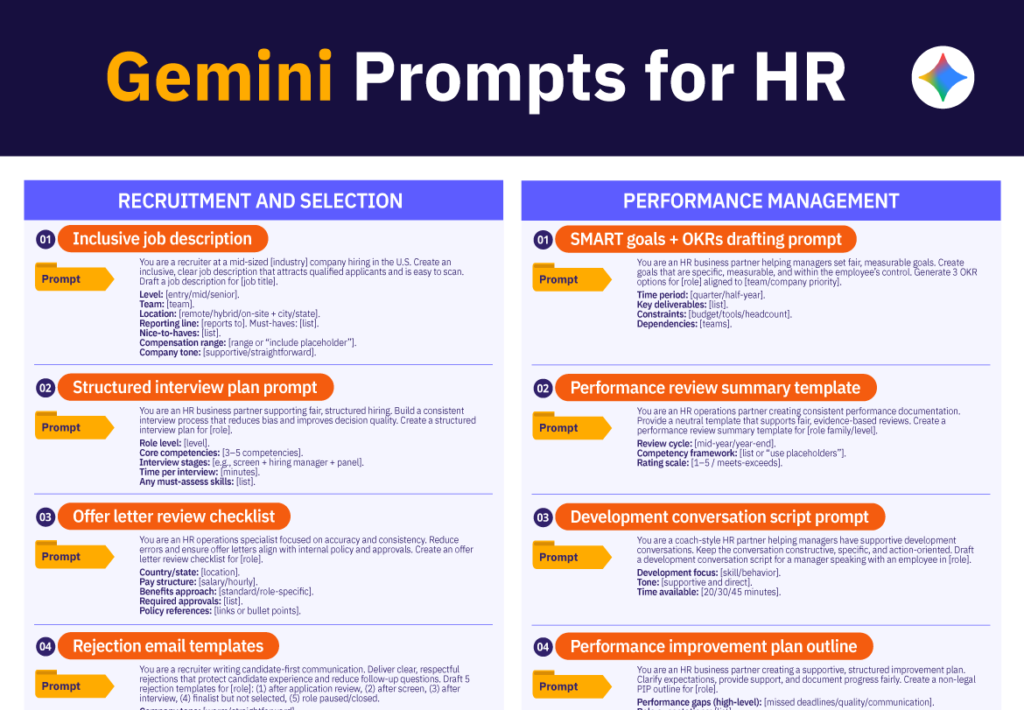
Take about 15-20 minutes to work through this chain. The goal is to see how each step logically flows into the next, resulting in a complete and coherent set of documents. You can find examples of prompts for PIPs and other performance management tasks in the provided image of "Gemini Prompts for HR."
Conclusion
You have now learned how to tackle large, complex HR projects by breaking them down into a logical sequence of prompts. This prompt chaining method is one of the most powerful and practical techniques in prompt engineering, allowing you to move from simple Q&A to using AI as a strategic partner in your work.
Key Takeaways:
- Deconstruct Complex Tasks: Before prompting, break down large HR projects into smaller, logical steps.
- Chain Your Prompts: Use a sequence of prompts within a single chat, where each prompt builds on the output of the previous one.
- Maintain Clean Context: Dedicate one chat conversation to one major task to avoid confusing the AI and improve accuracy.
- Combine Techniques: You can use other techniques, like Chain-of-Thought, as individual steps within your larger prompt chain.
In our previous lessons, you mastered the building blocks of a great prompt. Today, you learned how to assemble those blocks to construct sophisticated workflows. In our next module, we will put all of this together and apply it to specific HR functions, starting with the cornerstone of talent acquisition. You will learn to apply core and advanced techniques to generate a comprehensive, role-specific job description that attracts top talent.