Hello! Welcome to the first lesson of our course on moving your story forward.
From our conversation, I know your main challenge is keeping the narrative moving and avoiding those moments where you feel stuck or start rambling. This course is designed to give you a set of practical tools to build momentum and ensure every part of your story has a purpose.
Today, we're starting with the most fundamental building block: the scene. We'll focus on how to construct a single, powerful scene that acts as an engine for your plot. By the end of this lesson, you'll be able to structure a scene with a clear character goal, an obstacle that gets in their way, and a resulting change that forces the story into its next phase. This single technique is a powerful antidote to "running out of ideas."
The Core Idea: Action and Reaction
At its heart, a story is a chain of cause and effect. One event causes another, which in turn causes the next. This creates the forward momentum you're looking for. The most effective way to build this chain is to think of your story in two alternating parts: Action and Reaction.
- An Action scene is one where your character actively tries to achieve a goal.
- A Reaction scene is one where your character deals with the consequences of that action.
Author K.M. Weiland describes this as a row of dominoes—once you set it up correctly and push the first one, the rest fall in a natural, compelling sequence.
To get a feel for this fundamental rhythm, let's watch a short segment from one of her videos.
Scene Structure and Transitions in Big Scenes
Watch this clip from K.M. Weiland's video, "Scene Structure and Transitions in Big Scenes".
Pay close attention to the concepts of scene and sequel being about action and reaction. Notice her "dominoes" analogy from this timestamp—it's a powerful way to visualize how scenes should connect.
Today, we are going to focus exclusively on the first half of this structure: the Action scene.
The Three Pillars of an Action Scene
An effective action scene is built on three simple, powerful pillars. Different writers use slightly different terms, but the core components are always the same.
- Goal: Your character wants something specific and immediate.
- Conflict/Obstacle: Something or someone stands in their way.
- Outcome/Disaster: The character fails to achieve the goal, or achieves it in a way that creates a new, bigger problem.
The key here is that the outcome is almost never a clean success. A "disaster" doesn't have to be a building exploding; it can be as small as a missed opportunity or a difficult conversation gone wrong. This failure is what creates the problem that the next scene will have to address.
Let's watch another short video that lays out this three-part structure very clearly.
Mastering Scene Structure (Fiction Writing Advice)
Watch this segment from "Mastering Scene Structure" by writer Brandon McNulty.
Focus on his breakdown of the "goal-oriented scene" from this section. He calls the three parts Goal, Conflict, and Disaster. This is the fundamental template we'll be working with.
From Theory to Practice: Building Your Scene
Now that we have the basic template—Goal, Obstacle, Outcome—let's look at how to apply it effectively and avoid common pitfalls that can make a scene feel flat or disconnected.
The following article from the blog Writers Helping Writers provides an excellent, practical breakdown of each component and highlights common issues writers face. This will help you diagnose problems in your own writing later.
Scene Mastery: Navigating Common Goal-Driven ...
This article breaks down the action scene into three parts: Goal, Turning Point (the obstacle), and Change (the outcome). As you read, think about how this structure provides a clear path forward for a character, preventing the "rambling" you mentioned.
Please read the following sections: Start at the heading "Here's how goal-driven scenes work" and read the brief definitions of Goal, Turning point, and Change. Continue through the section "1: Establish the Scene Goal". Pay attention to the issue of making the goal emotionally engaging. Read "2: Interrupt With a Turning Point". Note the important distinction that the turning point must be directly related to the scene goal. Finally, read "3: Demonstrate Change". The key idea here is that the outcome should not be a resolution; it should propel the story forward.
To summarize the key takeaways from that article:
- Goal: The character's objective must be clear to the reader and matter to the character.
- Obstacle (Turning Point): The obstacle must directly interfere with the pursuit of the goal. A random, unrelated problem doesn't create narrative tension.
- Outcome (Change): The scene must end with the character in a different state than they started—usually worse off. This creates the question: "What will they do now?"
Exercise: Putting It All Together
Let's apply this with a short, practical exercise. First, let's see it in action in a familiar example.
1. Analysis
Remember the video by Brandon McNulty? Let's revisit his breakdown of the opening of Raiders of the Lost Ark. As you watch, actively identify the three pillars we've discussed.
Mastering Scene Structure (Fiction Writing Advice)
Watch the analysis of the opening scene of Raiders of the Lost Ark.
Focus on the first part of his example, the goal-oriented scene from the beginning. What is Indiana Jones's specific Goal? What are some of the Obstacles he faces? What is the final Outcome or "disaster" of the scene?
You can see how this structure creates a thrilling, high-stakes sequence where the failure at the end (losing the idol to his rival) directly sets up his motivation for the next part of the story.
2. Your Turn (Approx. 15 minutes)
Now, let's try it yourself. Use the following prompt to build the skeleton of a scene. Don't worry about writing beautiful prose; the focus is on the structure.
Prompt: A character, Alex, realizes they left a highly confidential file on their desk at work. It's late at night, and the automated security system will lock the building in 15 minutes.
Your Task:
- Goal: In one sentence, state Alex's specific, immediate goal. (e.g., "Alex needs to get past the night guard, retrieve the file from their third-floor office, and get out before the lockdown.")
- Obstacle: Brainstorm three different potential obstacles that could directly prevent Alex from achieving this goal.
- Outcome: Choose one of your obstacles. Write a short paragraph (3-5 sentences) describing how the scene ends. Remember, the outcome should be a "disaster" or a complication, not a success. It should leave Alex with a new problem to solve.
Take about 15 minutes to work through this.
Key Takeaways and Next Steps
Well done. The structure we've worked on today—Goal, Obstacle, and Outcome—is the engine of a compelling plot.
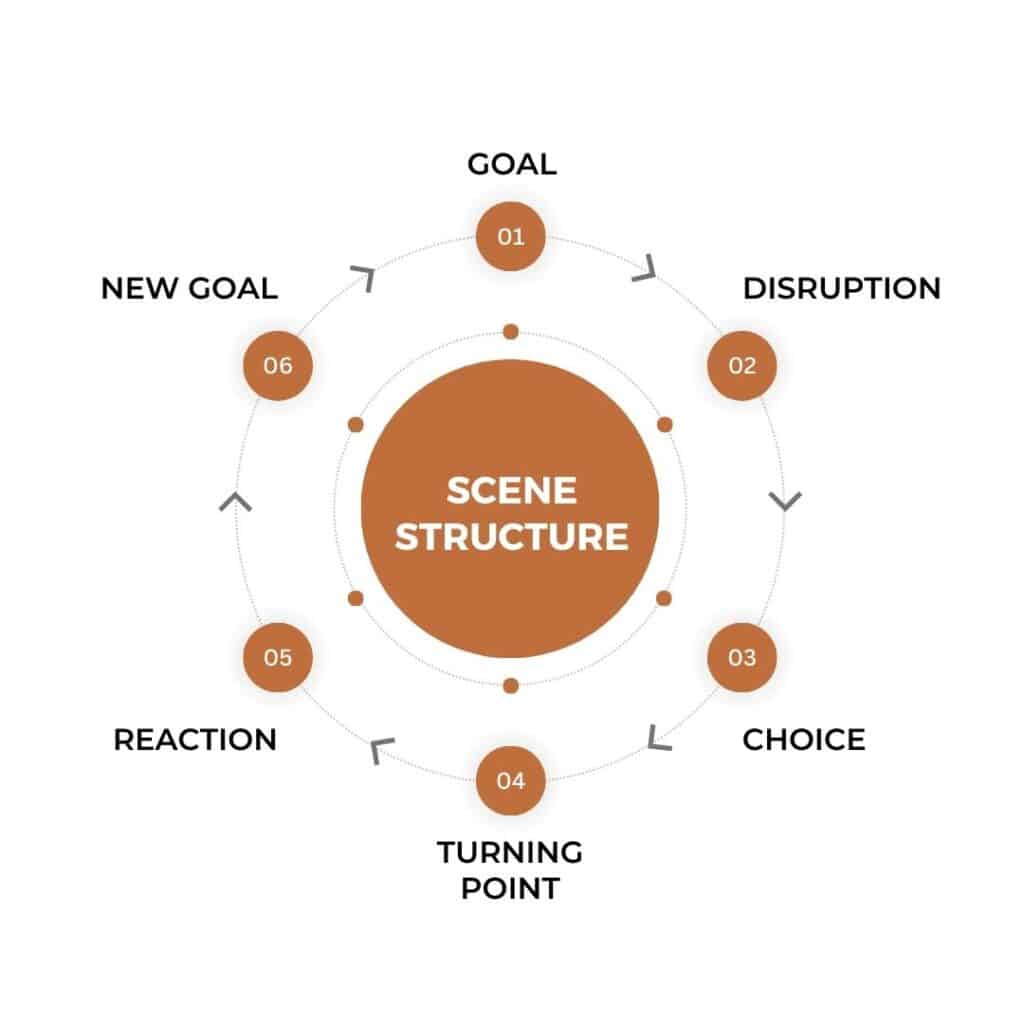
When you feel your story is stalling, you can almost always trace the problem back to a scene that is missing one of these three core components.
In our next lesson, we'll focus on the second half of this cycle: the Reaction. We'll explore what a character does after the "disaster" and how their emotional response and decision-making process create the goal for the very next scene. This will equip you to diagnose exactly why a scene might feel static and how to fix it.