Welcome to the first lesson of your course! I'm excited to get started with you on this journey into filmmaking. Your goal to create short films and YouTube content is a fantastic one, and this course is designed to give you the building blocks to do just that, blending theory with the practical skills you'll need.
This first module, "Foundations of Visual Storytelling," is all about the blueprint. Before you ever press record, the most important work happens: creating the story. In this lesson, we will focus on how to structure a short narrative film with a clear beginning, middle, and end. This is the bedrock of compelling storytelling, whether you're making a two-minute short or a feature film.
The Core of Every Story: Beginning, Middle, End
Every story you've ever loved, from a short YouTube video to an epic film, shares a fundamental structure. It has a start, a middle, and a finish. It seems simple, but understanding the job of each part is key to holding your audience's attention.

Let's break down these three essential parts:
-
The Beginning (The Setup): This is where you introduce your audience to the world of your story. You answer the essential questions:
- Who are the characters, especially the protagonist?
- Where and when does the story take place?
- What is their normal life like before the main events of the story begin?
-
The Middle (The Confrontation): This section introduces a problem or conflict that disrupts the character's normal life. The character attempts to solve this problem but faces a series of obstacles. This is where the tension builds and the stakes are raised.
- What is the central problem or goal?
- What obstacles stand in the character's way?
-
The End (The Resolution): Here, the story's conflict reaches its peak in a final showdown, known as the climax. The problem is resolved, and we see the aftermath.
- How is the problem ultimately solved?
- How have the characters changed as a result of their journey?
To get a more formal definition of these parts as they apply to short films, have a look at the following resource.
Short Film Story Outline Structure
This article from Open Screenplay, 'Short Film Story Outline Structure,' provides a concise breakdown of the three acts specifically for short-form content.
Please read the sections '3 Act Story Structure vs. Custom Story Structure for Short Films' and '3 Act Story Structure for Short Films'. These sections will reinforce the function of the beginning, middle, and end.
A Deeper Dive: The Three-Act Structure
The "Beginning, Middle, End" model can be expanded into a more detailed and powerful framework known as the Three-Act Structure. This is the most common structure used in Western storytelling, and you can find it in everything from Hollywood blockbusters to the narrative quests in many video games.
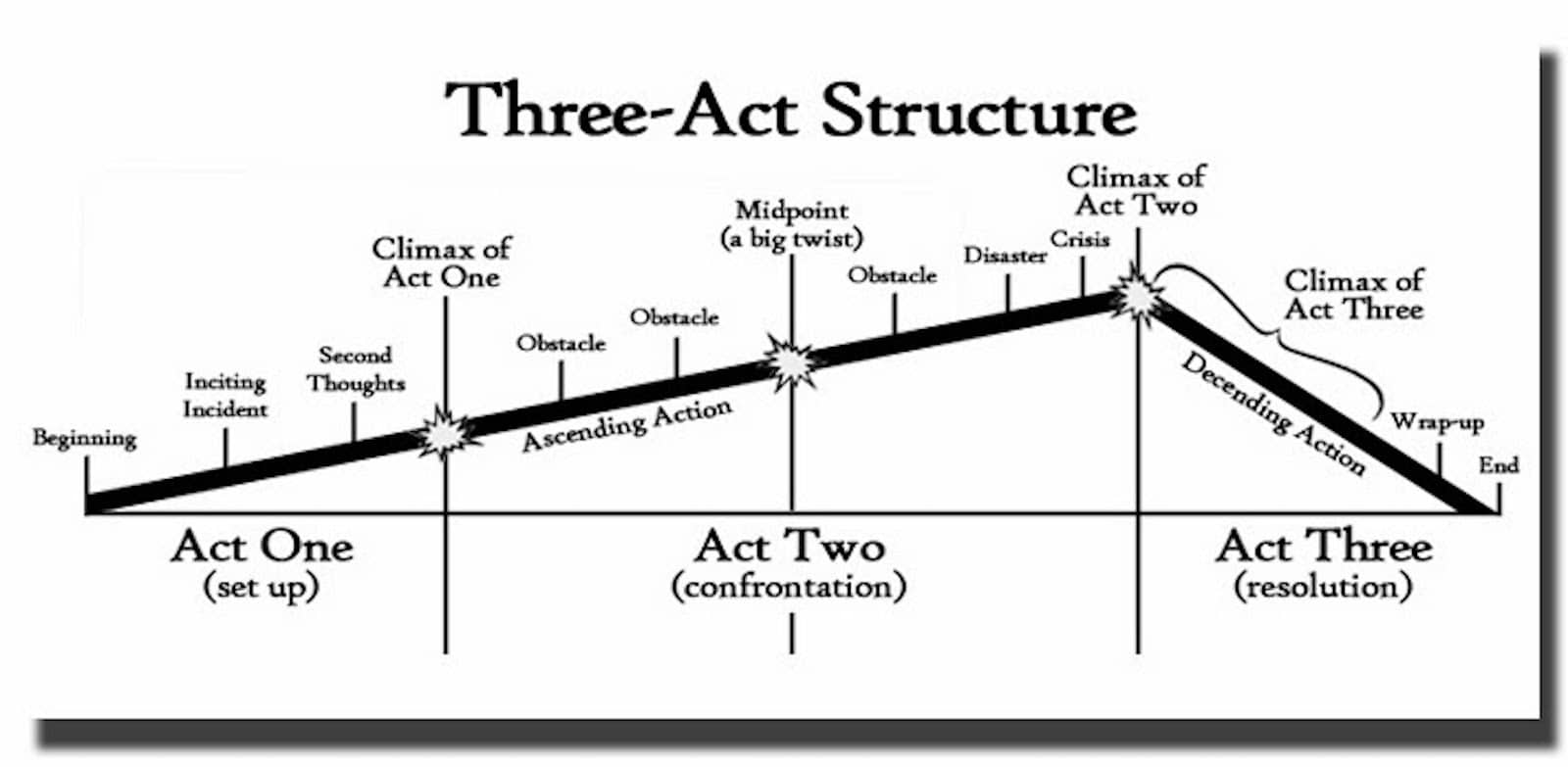
This structure is not a rigid formula but a flexible guide for building dramatic tension and creating a satisfying emotional journey for the audience. To explore it in detail, we'll watch a fantastic video essay from StudioBinder that uses Jurassic Park as a case study.
Three Act Structure Explained — The Secret to Telling a Great Story
The video 'Three Act Structure Explained' breaks down this classic framework into eight key 'beats' or plot points. We'll go through it in three parts, corresponding to each act.
You don't need to watch the entire 26-minute video at once. Follow the steps below to break it down by act. Focus on understanding the purpose of each plot point.
Act 1: The Setup (First ~25% of your story)
Act 1 establishes the world and ends with the hero committed to a journey.
- Watch: The sections of the video covering the Hook, the Inciting Event, and the First Plot Point (timestamp 00:03:24 to 00:11:09).
- Key Concepts:
- Hook: Grabs the audience's attention and makes them ask questions.
- Inciting Incident: The event that kicks off the story and introduces the main conflict. The character is presented with a choice or a call to adventure.
- First Plot Point (The Point of No Return): The character fully commits to the conflict. They cross a threshold, and there's no going back to their "normal world."
Act 2: The Confrontation (Middle ~50% of your story)
Act 2 is the longest act, where the character faces rising obstacles and undergoes significant change.
- Watch: The sections of the video on the First Pinch Point, the Midpoint, and the Second Pinch Point (timestamp 00:11:09 to 00:20:28).
- Key Concepts:
- Rising Action & Pinch Points: A series of events where the protagonist tries to achieve their goal, but obstacles (and the antagonistic force) get in their way, raising the stakes.
- Midpoint: A major turning point halfway through the story. Often, a new revelation changes the character's understanding of the conflict, shifting them from a reactive to a proactive state.
- Second Pinch Point: Reminds the audience of the antagonist's power and what's at stake, setting up the low point to come.
Act 3: The Resolution (Final ~25% of your story)
Act 3 brings the conflict to a head and shows the aftermath.
- Watch: The final sections of the video covering the Third Plot Point, the Climax, and the Resolution (timestamp 00:20:28 to 00:26:20).
- Key Concepts:
- Third Plot Point (The Low Point): The character faces what seems like a defeat or their darkest moment. It often follows a "false victory." From here, they must rally for one final push.
- Climax: The final confrontation between the protagonist and the antagonistic force. The central conflict is resolved once and for all.
- Resolution: We see the aftermath of the climax. Loose ends are tied up, and we see the character in their "new normal," demonstrating how they have changed.
Test your understanding!
Think about one of your favorite films. Can you identify its Inciting Incident, Midpoint, and Climax? How do these moments change the direction of the story?
Show answer
There's no single right answer here, as it depends on the film you choose! But let's take Star Wars: A New Hope as an example:
- Inciting Incident: Luke discovers Princess Leia's holographic message inside R2-D2. This is the "call to adventure" that pulls him out of his ordinary life on the farm.
- Midpoint: The Millennium Falcon is pulled into the Death Star. This is a huge turning point. Luke and his allies are no longer just fleeing the Empire; they are now in the heart of enemy territory and must shift from reacting to proactively finding a way to escape and rescue the princess.
- Climax: Luke, guided by the Force, fires the proton torpedoes that destroy the Death Star. This is the final confrontation that resolves the main plot goal of the film.
Adapting Structure for Short Films
While the three-act structure is a powerful tool, trying to fit all eight of those beats into a 5-minute film can feel overwhelming. For short films and YouTube videos, economical storytelling is crucial. Every second counts.
This next resource is a masterclass in how to think about story specifically for short-form content. It debunks common myths and introduces a more flexible, character-focused model.
In 'How to Write a Short Film,' filmmaker Tyler Mowery explains why story is still king in short films and provides a fantastic case study using a more fluid structural tool: Dan Harmon's Story Circle.
First, watch the section 'debunking myths' (00:00:40 - 02:01). Then, watch the sections explaining how to build a story from a character's beliefs (03:14 - 07:22) and how the Story Circle works (07:22 - 13:29). Focus on how the structure serves the character's internal journey.
The key takeaways from this video are:
- Start with Character: A great short film often revolves around a character with a deep desire who holds a conflicting belief that prevents them from achieving it. The story becomes about them overcoming that internal obstacle.
- The Story Circle: This 8-step model is less about plot mechanics and more about a character's transformation:
- A character is in a zone of comfort.
- But they want something.
- They enter an unfamiliar situation to get it.
- They adapt to it.
- They get what they wanted.
- But pay a heavy price for it.
- They return to their familiar situation...
- Having changed.
This model is fantastic for short films because it centers the entire narrative on a clear, relatable transformation.
Practical Exercise: Outline Your First Story
Now it's your turn to put this into practice. This is not about writing a full script, but about training your brain to think structurally.
-
Choose a simple concept. It could be anything:
- A barista is too shy to talk to a regular customer they like.
- Someone finds a wallet and debates whether to return it or keep the cash.
- A character is trying to bake a perfect cake for a special occasion, but everything keeps going wrong.
- Feel free to use your own idea!
-
Outline the story using the simple Beginning, Middle, End structure. Write one or two sentences for each part.
- Beginning: Who is your character and what is their world?
- Middle: What problem do they face and what obstacles get in their way?
- End: How do they finally resolve the problem, and how are they different?
-
Identify the Key Turning Points. Looking at your outline, can you pinpoint where the major shifts would happen in a three-act structure?
- What is the Inciting Incident that kicks off the story?
- What could be a Midpoint twist that changes your character's plan?
- What is the Climax where they face their biggest challenge?
Take about 10-15 minutes on this. The goal is to create a solid blueprint that could one day become a short film.
Key Takeaways and Next Steps
Congratulations on completing your first lesson! You've taken the most critical step in learning to be a filmmaker: understanding the architecture of story.
Here are the main points we covered:
- All narrative stories are built on a foundation of a Beginning, Middle, and End.
- The Three-Act Structure provides a detailed map for creating tension and character transformation, using key plot points like the Inciting Incident, Midpoint, and Climax.
- For short films, economical storytelling is essential. Focusing on a single, clear character transformation using a model like the Story Circle can be incredibly effective.
In our next lesson, we'll build directly on this foundation. We'll explore how to translate a script or story idea into a visual shot list. This is where we start moving from the page to the screen, thinking like a director and deciding how to visually tell the story you've just structured.