Hello! Welcome to the first lesson in our new module, "Sound for Film: On-Set Audio Recording."
In our previous module, "Painting with Light," you learned how to shape the visual mood of a scene. We finished by exploring low-key lighting to create drama and suspense. Now, we turn our attention to the other half of the cinematic experience: sound. Great audio is just as crucial as great visuals for immersing an audience in your story. Poor audio can instantly take a viewer out of the experience, no matter how beautiful the images are.
This lesson addresses the first fundamental step in capturing good audio. By the end of our time today, you will be able to identify different microphone types (e.g., shotgun, lavalier) and their use cases. Just as you've learned to choose a lighting style to serve the story, you'll now learn to choose the right microphone for the job, whether you're shooting a short film or creating content for your YouTube channel.
The Language of Microphones
Before we look at specific microphone models, we need to understand two fundamental concepts that define how any microphone works: its transducer type and its polar pattern.
- Transducer Type (How it Hears): This refers to the internal mechanism that converts sound waves into an electrical signal. The two most common types in filmmaking are Dynamic and Condenser.
- Polar Pattern (Where it Hears): This describes the microphone's sensitivity to sound from different directions.
To get a clear overview of these core ideas, let's watch a section of the following video. It breaks down these technical topics in a very practical way.
Watch BEFORE Buying a Microphone for Filmmaking in 2025 | Buyers Guide
The video 'Watch BEFORE Buying a Microphone for Filmmaking' from the channel Content Creators provides an excellent introduction to the key technical aspects of microphones.
Please watch from 01:24 to 07:24. First part (01:24 - 04:42): Focus on the differences between Dynamic and Condenser microphones. Note their durability, sensitivity, and power needs (the concept of 'phantom power'). Second part (04:42 - 07:24): Pay close attention to the different polar patterns described, especially Cardioid, Supercardioid, and Omnidirectional. Try to visualize the shape of their pickup areas.
To summarize the key points from the video:
- Condenser Mics are generally more sensitive and capture a more detailed, natural sound. They require power (either a battery or "phantom power" from a recorder/camera) and are the most common type for on-set film work.
- Dynamic Mics are more rugged and less sensitive, making them excellent at rejecting background noise. They are ideal for loud sound sources or for podcasting/voiceover work where the speaker is very close to the mic.
The polar pattern is what truly determines a microphone's primary use. Here is a visual guide to the patterns discussed in the video.
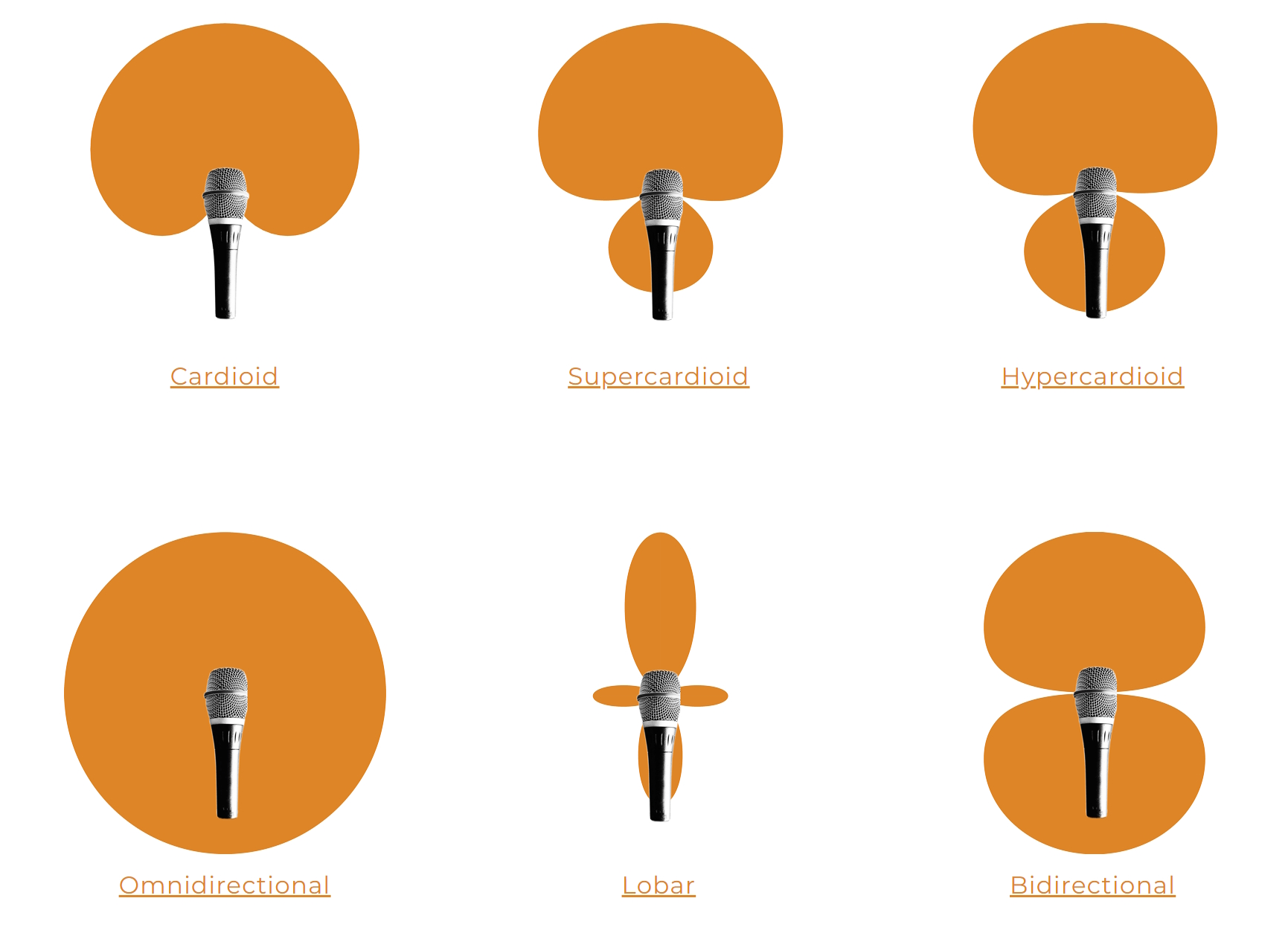
Now, let's see how these principles apply to the two most essential microphones in a filmmaker's toolkit.
The Filmmaker's Toolkit: Shotgun and Lavalier Mics
For capturing dialogue in short films and most YouTube-style content, you will primarily rely on two types of microphones: the Shotgun mic and the Lavalier mic.

1. Shotgun Microphones
A shotgun microphone is a type of condenser microphone with a highly directional polar pattern (typically Supercardioid or Lobar). Its long, tube-like body is designed to reject sound from the sides and rear, allowing it to "focus" on whatever it's pointed at.
Primary Use Case:
The main job of a shotgun mic on a film set is to capture clean dialogue from a distance, just outside the camera's frame. It is almost always mounted on a boom pole and operated by a crew member who positions it above or below the actors.
Let's see this type of microphone in its natural habitat.
Watch BEFORE Buying a Microphone for Filmmaking in 2025 | Buyers Guide
Let's return to the 'Watch BEFORE Buying a Microphone' video to learn about the more advanced shotgun mics used in professional productions.
Watch the segment from 14:14 to 15:31. Notice how these mics are used on professional sets, often requiring external power (phantom power) and XLR cables, and how versatile they are when used with a boom pole.
Pros:
- Captures more natural-sounding audio because it's not attached to the subject.
- Excellent for recording scenes with multiple actors, as the boom can move to follow the dialogue.
- Stays out of the shot.
Cons:
- Requires a boom operator or a stand to be positioned correctly.
- In rooms with lots of echo (reverb), the side-rejection can cause unnatural sound artifacts.
2. Lavalier (Lav) Microphones
A lavalier mic (or "lav") is a small condenser microphone designed to be clipped directly onto a person's clothing. Most lavs are Omnidirectional, meaning they pick up sound equally from all directions. This makes placement easier, as it doesn't need to be pointed precisely at the mouth.
Primary Use Case:
Lavs are the go-to solution when a boom is impractical. This includes interviews, wide shots where a boom operator can't get close enough, and noisy environments where the mic needs to be as close to the sound source as possible. They can be wired or, more commonly, part of a wireless system.
The same video has a great section on lavs.
Watch BEFORE Buying a Microphone for Filmmaking in 2025 | Buyers Guide
Now let's examine the lavalier microphone, your tool for getting great audio when close proximity is everything.
Watch the segment from 09:54 to 12:56. The key takeaway here is how lav mics solve the problem of distance. Also, pay attention to the discussion of wired vs. wireless options and the different connector types (TRS vs. TRRS).
Pros:
- Maintains a consistent audio level even if the subject moves around.
- Can be hidden on an actor's clothing.
- Essential for wide shots or difficult recording locations (like inside a car).
Cons:
- Can pick up the sound of clothing rustling.
- The sound perspective is "on the chest," which can sound less natural than a boomed mic.
Other Useful Mics for Content Creators
While shotguns and lavs are the workhorses for narrative film, your goal of creating YouTube content introduces two other relevant categories.
- On-Camera Shotgun Mics: These are smaller, less powerful shotgun mics designed to mount directly on top of your camera. They are a significant upgrade from your camera's built-in microphone and are great for vlogging or "run-and-gun" shooting where you need better audio without a complex setup. The video you watched mentions these from 08:10 - 09:54.
- Desktop/Podcast Mics: These are typically dynamic or condenser mics designed for stationary use, like recording voiceovers or filming a talking-head video at a desk. They provide excellent quality when you can be very close to them. The video covers these from 15:31 - 17:58.
Putting It into Practice: Choosing the Right Mic
The most important skill is knowing when to use each microphone. The choice almost always comes down to the specifics of the scene you are shooting.
To solidify your understanding, let's refer to a quick summary article and then a practical guide with recommendations.
What Mic Should I Use? 5 Types of Microphones for Video ...
The article 'What Mic Should I Use?' from Boxcast provides a concise summary of the microphones we've discussed and their ideal applications.
Please read the sections on 'Dynamic Podcast Mics,' 'Lavalier Mics,' and 'Shotgun Mics.' This will reinforce the core use cases we've covered.
Now, let's see how these choices play out in different filming scenarios.
Watch BEFORE Buying a Microphone for Filmmaking in 2025 | Buyers Guide
Finally, let's watch the concluding section of the 'Watch BEFORE Buying a Microphone' video, where the creator gives specific recommendations for different types of content.
Watch from 18:07 to 20:53. Listen to the recommendations for freelance videographers, vloggers, and talking-head YouTubers. Think about how these scenarios relate to the short films and YouTube videos you want to create.
Test your understanding!
You are planning a scene for a short film. Two characters are having an important conversation while walking through a busy city park. You can see their full bodies in the shot as they walk away from the camera.
Which microphone type would be the best primary choice for this scenario, and why? What would be a major challenge of using the other main type?
Show answer
The best primary choice would be lavalier microphones, one for each actor, likely connected to a wireless system. Because the shot is wide and the actors are moving, it would be impossible to keep a shotgun mic close enough to them without it being in the frame. Lavs ensure a close, consistent sound source regardless of their distance from the camera.
The major challenge of using a shotgun mic on a boom pole would be maintaining proximity. As the actors walk away, the audio quality would degrade rapidly. Furthermore, the shotgun's directional nature would pick up a lot of the ambient park noise, potentially making the dialogue hard to hear.
Conclusion
You've now taken your first step into the world of production sound. Understanding the tools available is the foundation upon which all good audio is built. While the world of microphones is vast, focusing on the main types for film and video will serve you in almost every situation you'll encounter.
Key Takeaways:
- Microphones are defined by their transducer type (condenser vs. dynamic) and their polar pattern (directional focus).
- Shotgun mics are highly directional and are the standard for capturing dialogue from a distance on a boom pole, keeping the mic out of the shot.
- Lavalier mics are small, wearable mics that excel in situations where a boom is impractical, such as wide shots, interviews, or when a subject is moving a lot.
- The best microphone choice is always dictated by the needs of the shot: camera placement, subject movement, and the recording environment.
Next Lesson Preview:
Knowing what mic to use is only half the battle. Knowing where to put it is the other, equally important half. In our next lesson, we will focus on positioning microphones for optimal dialogue recording while staying out of frame. We'll explore the art of booming and the techniques for hiding lavalier mics to get the cleanest sound possible.