Hello! Welcome to your fourth lesson.
Introduction
In our last lesson, you mastered the crucial skill of drawing free-body diagrams (FBDs). We saw how an FBD gives us a clear, visual map of all the forces acting on an object. This is a qualitative description—it shows us the direction of forces and their relative strengths.
Today, we will add the mathematics. We'll take the diagrams you learned to draw and apply Newton's Second Law of Motion. This powerful law provides the exact mathematical relationship between the forces on an object (the "why" of motion change) and the acceleration it experiences (the "how" of motion change).
By the end of this lesson, you will be able to apply Newton's Second Law to your free-body diagrams to solve one-dimensional problems for an unknown force, mass, or acceleration. This is one of the most fundamental quantitative skills in all of physics.
Newton's Second Law: The Core Equation
Newton's Second Law is famously summarized by a simple but profound equation:
Let's break this down.
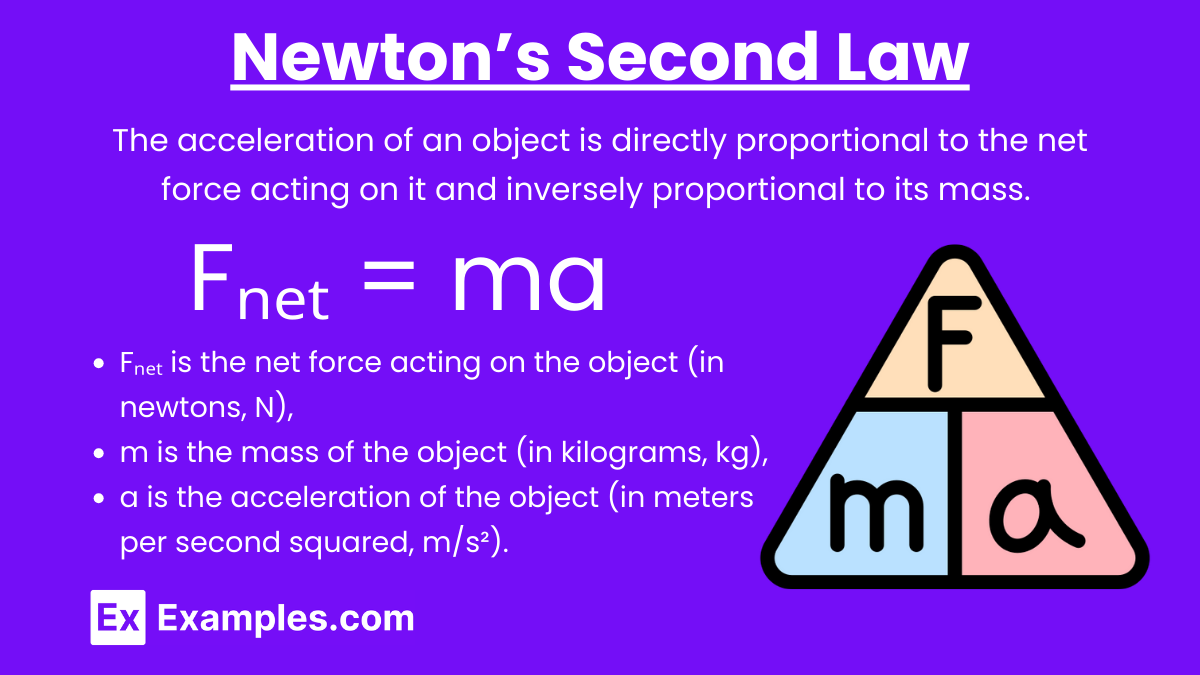
- represents the net force (often written as ). The Greek letter sigma () means "sum of". The net force is the vector sum of all the individual forces acting on the object—the same forces you've been drawing in your FBDs.
- is the mass of the object in kilograms (kg). Mass is a measure of an object's inertia, or its resistance to being accelerated.
- is the acceleration of the object in meters per second squared (m/s²). It is a vector, meaning it has both magnitude and direction.
Critically, the law states that the acceleration an object experiences is:
- Directly proportional to the net force applied. If you double the net force, you double the acceleration.
- Inversely proportional to the object's mass. For the same net force, an object with twice the mass will experience half the acceleration.
The standard unit of force is the Newton (N). From the equation, you can see that . It's the force required to accelerate a 1 kg mass at a rate of 1 m/s². Always ensure your units are in kg, m, and s before calculating.
A Strategy for Solving Problems
Applying Newton's Second Law isn't just about plugging numbers into an equation. It's a systematic process that connects a physical scenario to a mathematical solution. Here is a reliable strategy to follow for 1D problems:
- Draw a Free-Body Diagram (FBD): This is always your first step. Isolate the object of interest and draw and label all the forces acting on it. You practiced this in the last lesson.
- Choose a Coordinate System: For 1D motion, this is simple. Decide which direction is positive. For horizontal motion, "right" is typically positive. For vertical motion, "up" is often positive.
- Write the Net Force Equation: Write down Newton's Second Law, . Then, look at your FBD and sum the forces, applying positive or negative signs based on the direction you chose in step 2.
- For example, if a force points right (+ direction) and a force points left (- direction), your net force equation becomes: .
- Solve for the Unknown: Use algebra to solve the equation for the quantity you need to find (force, mass, or acceleration).
- Check Your Answer: Does the result make sense? For example, if you find a negative acceleration, does that match the direction of the net force? Are the units correct?
A Complete Worked Example
Let's see this strategy applied to a real-world scenario. The following video demonstrates a complete problem where the goal is to find the force of friction on a moving cart. This example is excellent because it combines what you learned about kinematics in Lesson 2 with our new tool, Newton's Second Law.
Introductory Newton's 2nd Law Example Problem and Demonstration
This video from Flipping Physics walks through an entire problem, from identifying the knowns and drawing the FBD to solving for an unknown force.
Please watch the video from 2:32 to 8:15. I've broken it down to match our problem-solving strategy: Givens & FBD (2:32 - 4:16): Notice the careful conversion of units to kg and m. Pay attention to how the FBD is drawn, identifying all four forces. Net Force Equation (4:16 - 5:34): See how they apply \Sigma F_x = ma_x to the horizontal forces from the FBD to get an equation for the force of friction. Using Kinematics (5:34 - 7:04): They realize acceleration (a) is unknown. Watch how they use a kinematic equation from our second lesson to calculate it from displacement and time. Final Solution (7:04 - 8:15): Finally, they substitute the calculated acceleration back into the net force equation to find the force of friction.
This example perfectly illustrates how different physics concepts connect. We used kinematics to describe the motion () and dynamics () to explain the cause of that motion.
Time to Practice
Now it's your turn. The best way to understand this is to do it yourself.
Quick Drills
Let's start with a few quick problems to get comfortable with the main equation.

Try solving problems 1, 2, and 4 from the worksheet image above.
- Question 1: What net force is required to accelerate a 5 kg object at 4 m/s²?
- Question 2: What is the acceleration of a 10 kg object if a net force of 30 N is applied?
- Question 4: A net force of 25 N causes an object to accelerate at 10 m/s². What is the mass of the object?
Click here to see the solutions.
A More Complete Problem
Now, let's tackle a problem that requires the full strategy, including finding the net force first.
Problem: A 10 kg box starts from rest. A 200 N force is applied pushing it to the left, and a 50 N force is applied pushing it to the right. How fast will the box be moving after 3 seconds? (Assume the forces are constant and there is no friction).
Try to solve this using our step-by-step strategy before checking the solution.
- FBD: Draw the box with the two horizontal forces.
- Coordinates: Let's choose the right direction as positive.
- Net Force Equation: Sum the forces.
- Solve: Find the acceleration, then use a kinematic equation to find the final velocity.
Click here for the step-by-step solution.
- FBD: Your diagram should show a 200 N arrow pointing left and a 50 N arrow pointing right. (There are also vertical forces of weight and normal force, but they cancel out and don't affect the horizontal motion).
- Coordinates: Right is positive (+), left is negative (-).
- Net Force: . The net force is 150 N to the left.
- Find Acceleration: The acceleration is 15 m/s² to the left.
- Find Final Velocity (Kinematics): We know initial velocity , acceleration , and time . The final velocity is 45 m/s to the left.
Conclusion
You've made a huge leap today, moving from just describing forces to using them in calculations. This is the heart of dynamics.
Key Takeaways:
- Newton's Second Law, , is the mathematical link between the net force on an object and its acceleration.
- Solving problems with this law is a systematic process: draw the FBD, choose a coordinate system, write the net force equation, and solve.
- Many physics problems require you to combine dynamics () with kinematics (the equations of motion) to find your answer.
Connection to Robotics and Programming:
This principle is fundamental to robotics. If you want a robot arm to accelerate and move to a specific point, you need to calculate the required net force. Your program then commands the motors to generate that precise amount of torque (a rotational force) to achieve the desired acceleration, all governed by .
Preview of the Next Lesson:
So far, we've only considered forces that line up perfectly along a single axis (left-right or up-down). But what happens when you pull a sled with a rope angled upwards? That force is part horizontal and part vertical. In our next lesson, we will learn how to resolve force vectors into components. This will unlock our ability to analyze and solve much more complex and realistic two-dimensional problems.