Introduction
Hello! In our last lesson, we explored the concept of power, which is the rate at which work is done or energy is transferred. We saw how crucial this is for understanding real-world systems, from a simple lift to the performance of a robotic motor.
So far, we've focused on how forces change an object's energy through work. Now, we're going to shift our perspective and explore a different, equally fundamental, aspect of motion. We'll examine how forces acting over a period of time affect an object. This leads us to the concepts of momentum and impulse.
Today's lesson will address the first learning outcome in our new module. We will:
- Define linear momentum as a measure of an object's "mass in motion."
- Define impulse as the effect of a force applied over a time interval.
- Connect these two concepts through the powerful impulse-momentum theorem to analyze impacts and collisions.
This framework is essential for understanding everything from car crashes to the way a robotic gripper might handle a delicate object.
1. What is Linear Momentum?
You've probably heard the term "momentum" used in sports, where a team that's "on a roll" is said to have momentum. In physics, the concept is more precise: it's a measure of how much motion an object has, taking into account both its mass and its velocity. We call it "linear" momentum to distinguish it from the rotational equivalent, which we'll see later.
The key idea is that an object with a lot of momentum is hard to stop. To get a feel for this, let's watch a short video that defines it clearly.
This video from The Efficient Engineer provides an excellent introduction to linear momentum, defining it and explaining its vector nature.
Please watch from 0:25 to 1:40. Focus on the definition of momentum, its units, and why it's considered a vector quantity.
As the video explained, linear momentum, represented by the symbol , is the product of an object's mass () and its velocity ():
A few key points to remember:
- Vector Quantity: Because velocity is a vector (with magnitude and direction), momentum is also a vector. It points in the same direction as the object's velocity.
- Units: The SI unit for momentum is kilogram-meters per second (kg·m/s).
- Intuition: A heavy truck moving slowly can have the same momentum as a light car moving very fast. Both would be difficult to stop.
Calculating Momentum
Since momentum is a vector, its direction matters. In one-dimensional problems, we use positive and negative signs to indicate direction (e.g., right is positive, left is negative).
Let's try a quick calculation:
- A 10 kg block moves east (to the right) at 5 m/s. Its momentum is .
- A 20 kg block moves west (to the left) at 3 m/s. Its momentum is .
2. Impulse and the Impulse-Momentum Theorem
So, how do you change an object's momentum? You have to apply a force. But for how long? Intuitively, both the size of the force and the duration it's applied for should matter. This combined effect is called impulse.
Let's start from Newton's Second Law, which you know as . Newton originally formulated his second law in a slightly different, more general way.
Momentum and Impulse Connection
This article from The Physics Classroom gives a clear, step-by-step derivation of the connection between force, time, and change in momentum.
Read the section titled 'Impulse'. It starts by recalling Newton's second law and shows how a simple rearrangement leads to a new, powerful equation. Focus on understanding the derivation of F • t = m • Δv.
As the reading shows, by starting with and substituting , we get:
Multiplying both sides by gives us the central equation of this lesson:
Let's break down this equation:
- The term on the right, , represents the change in the object's momentum, .
- The term on the left, , is defined as the impulse (). Its units are Newton-seconds (N·s).
This gives us the Impulse-Momentum Theorem:
In words: The impulse applied to an object is equal to the change in that object's momentum.
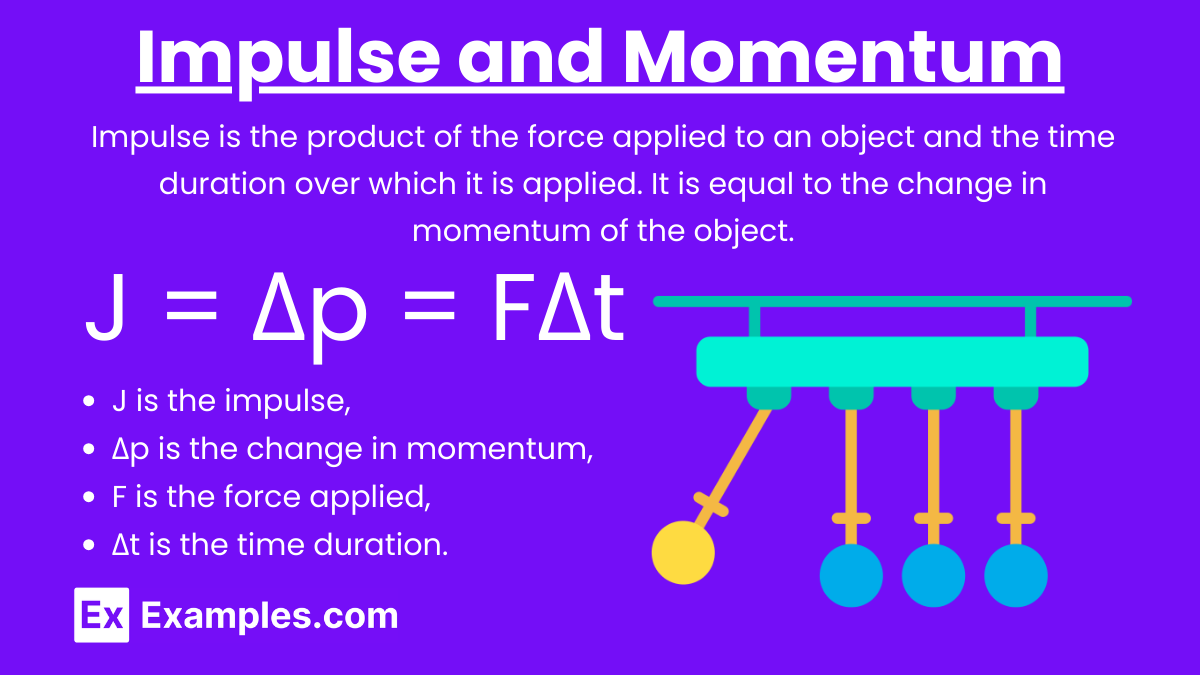
This theorem is incredibly powerful. It tells us that to produce a certain change in momentum (e.g., stopping a moving car), you can either apply a very large force for a short time or a smaller force for a longer time. The impulse () will be the same in both cases.
Real-World Application: Airbags and Crumple Zones
This principle is the "first principle" behind many life-saving engineering designs. How do airbags and a car's crumple zones protect you in a collision?
Engineering: Saving Lives Using the Concept of Impulse
This section from the OpenStax textbook 'Physics' explains exactly how the concept of impulse is used in vehicle safety features. This is a perfect example of applying physics to solve a real-world problem.
Read this short section to understand how airbags and crumple zones work. Focus on how they manipulate the variables in the impulse-momentum equation (F, Δt, and Δp) to reduce injuries.
In a crash, your body's momentum must change from a large value to zero. This means is fixed. The airbag or crumple zone doesn't change the impulse required to stop you. Instead, it works by dramatically increasing the time of impact (). According to the formula , if gets larger, the net force () on your body must get smaller. This reduced force is what saves you from serious injury.
3. Applying the Theorem: A Worked Example
Now that we have the theory, let's put it into practice. We'll watch a video that walks through a complete problem, applying all the concepts we've discussed.
Introduction to Impulse & Momentum - Physics
In this video, The Organic Chemistry Tutor solves a classic impulse-momentum problem from start to finish. It's a great way to see how the equations are used in a practical scenario.
Watch the example problem from 7:16 to 11:57. Follow along as the presenter calculates: The impulse on the block. The change in momentum (and confirms it equals the impulse). The final momentum. The final velocity.
This example demonstrates the typical workflow for these problems:
- Calculate the impulse ().
- Use the impulse-momentum theorem () to find the change in momentum.
- Use the definition of change in momentum () to find the final momentum.
- Use the definition of momentum () to find the final velocity.
4. Practice Problem
Let's try a problem that ties back to the airbag example.
Problem: A 60 kg person is in a car moving at 15 m/s. During a collision, they are brought to a complete stop.
a) What is the person's change in momentum?
b) If an airbag brings them to a stop in 0.5 seconds, what is the average force exerted by the airbag on them?
c) If they were not wearing a seatbelt and hit the dashboard, which stops them in 0.005 seconds, what is the average force exerted in that case?
Click here for the solution
a) Change in Momentum ()
The initial momentum is .
The final momentum is .
The change in momentum is:
The negative sign indicates the change is in the opposite direction of the initial motion.
b) Force with Airbag
We use the impulse-momentum theorem, .
The average force is 1800 N (about 400 pounds of force). The negative sign means the force acts opposite to the initial velocity.
c) Force with Dashboard
The change in momentum is the same, but the time is much shorter.
This is a force of 180,000 N (about 40,000 pounds of force), which is 100 times greater! This calculation clearly shows why extending the impact time is so critical for safety.
Conclusion
In this lesson, we introduced a new way to analyze motion and forces. Instead of focusing on energy, we looked at how forces applied over time cause changes in momentum.
Key Takeaways:
- Linear Momentum () is a vector quantity that measures an object's "mass in motion."
- Impulse () is a vector quantity that measures the total effect of a force applied over a time interval.
- The Impulse-Momentum Theorem () provides the crucial link: the impulse on an object equals its change in momentum.
- This theorem is a fundamental principle that explains the design of safety features like airbags, which reduce impact forces by increasing the time of the collision.
Preview of the Next Lesson:
The impulse-momentum theorem is excellent for analyzing a single object. But what happens when two objects interact, like in a collision? In our next lesson, we will explore one of the most fundamental laws in physics: the Principle of Conservation of Linear Momentum. We will see how it emerges directly from Newton's Third Law and use it to analyze collisions between objects.