Hello! Welcome back to our course on Managerial Accounting.
In our previous lesson, we explored Cost-Volume-Profit (CVP) analysis, a powerful tool for understanding the relationship between costs, sales volume, and profitability. We noted that the reliability of a CVP model is fundamentally dependent on the accuracy of its cost inputs, particularly the allocation of overhead.
Today, we will address that challenge directly. This lesson introduces Activity-Based Costing (ABC), a more refined and accurate method for allocating overhead costs compared to the traditional, simpler approaches. The learning outcome for this session is to apply activity-based costing (ABC) to allocate overhead costs more accurately than traditional methods.
We will examine why traditional methods often fail, walk through the mechanics of building an ABC system, and analyze how its superior accuracy leads to better strategic decisions. Finally, we'll look at a modern evolution of ABC that is particularly relevant in today's data-rich business environments.
1. The Flaw in Traditional Overhead Allocation
Traditional costing systems often allocate all manufacturing overhead using a single, volume-based cost driver, such as direct labor hours or machine hours. This approach is simple, but it can lead to significant cost distortions, especially in companies with a diverse range of products. It's like spreading a fixed amount of peanut butter evenly over different-sized slices of bread—some get too much, others not enough.
To understand why this is a problem, let's start with a conceptual overview.
Activity Based Costing: In-Depth Explanation with Examples
This article from AccountingCoach, 'Activity Based Costing: In-Depth Explanation with Examples', provides an excellent introduction to the topic. This first section explains the core problem that ABC solves.
Please read the 'Introduction' section. Focus on the example comparing the low-volume 'Product 124' and the high-volume 'Product 366' to see how a single cost driver can misallocate overhead.
As the article illustrates, a low-volume, complex product might consume significant overhead resources (engineering, testing, setups) but require few machine hours. A traditional system would under-cost this product. Conversely, a high-volume, simple product would be over-costed.
This is analogous to allocating the operational costs of a large-scale distributed system. If you allocated the entire cost of a data center based solely on the headcount of the engineering teams using it, you'd get a distorted picture. A small team running a compute-intensive machine learning model would be "undercharged," while a large team managing a simple, low-traffic service would be "overcharged." ABC provides a framework to assign costs based on actual consumption.
2. The Activity-Based Costing Framework
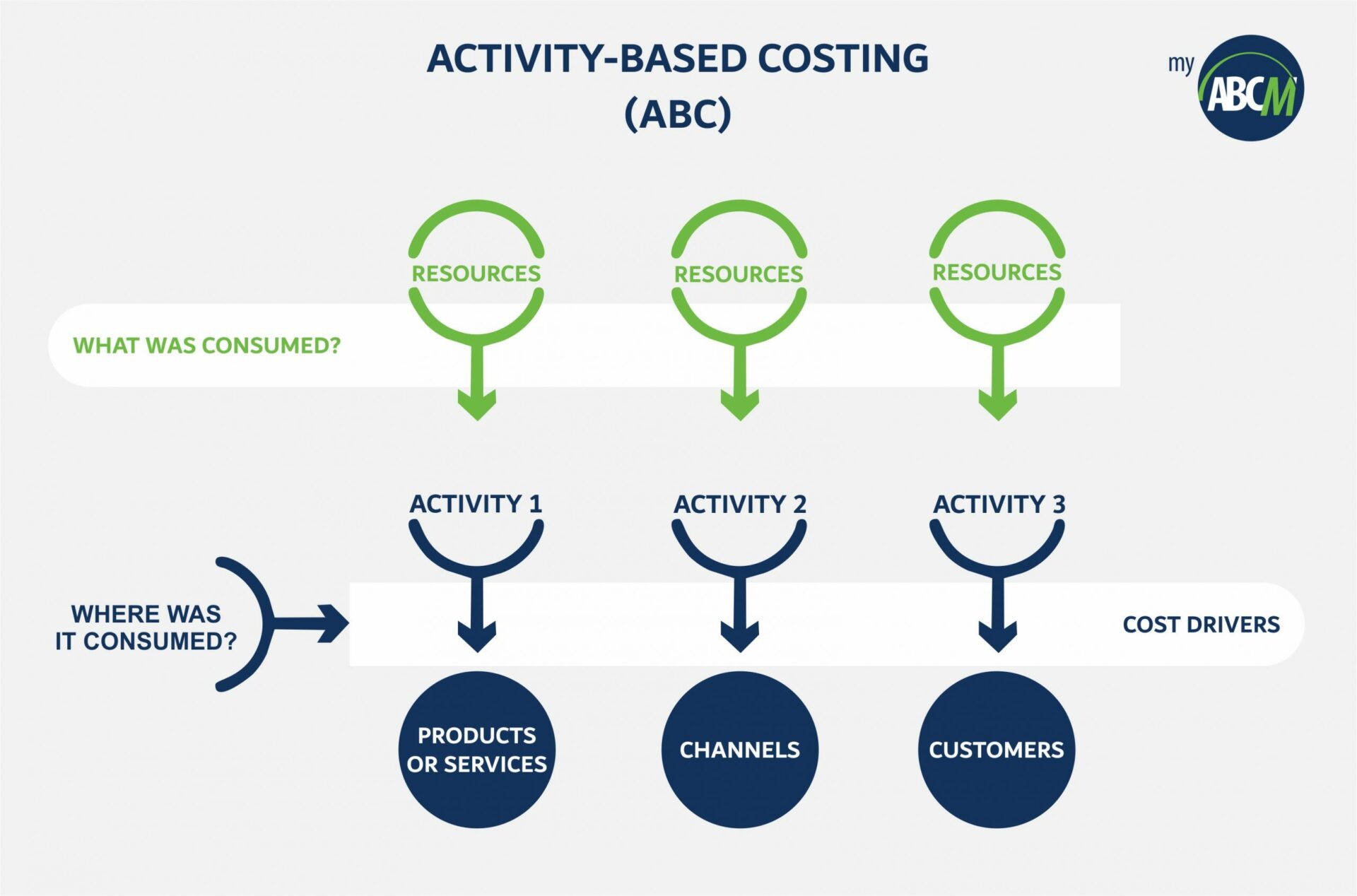
ABC resolves this issue by adopting a two-stage allocation process. The core logic is:
- Resources (like salaries, utilities, rent) are consumed by Activities (like processing orders, setting up machines, providing customer support).
- Cost Objects (like products, services, or customers) consume these Activities.
This creates a more direct causal link between the cost object and the overhead it generates.
Implementing an ABC system involves five key steps:
- Identify key activities that consume resources.
- Assign overhead costs to activity "cost pools."
- Identify a cost driver for each activity (the factor that causes the activity's cost to change).
- Calculate an activity rate for each pool by dividing the total cost in the pool by the total volume of its cost driver.
- Allocate overhead costs to cost objects by multiplying the activity rate by the amount of the cost driver consumed by that object.
The following video provides a clear, step-by-step walkthrough of setting up an ABC system.
Activity Based Costing (with full-length example)
The video 'Activity Based Costing (with full-length example)' from Edspira offers a great conceptual walkthrough of the ABC setup process.
Watch from 01:51 to 16:04. The first segment (ending at 08:42) covers identifying activities and creating cost pools. The second segment shows how overhead is assigned to these pools and how activity rates are calculated. Focus on understanding the logic of the process rather than memorizing the specific numbers.
3. A Comparative Application: Traditional vs. ABC
Now, let's work through a complete example that directly contrasts the results of traditional costing with ABC. This will demonstrate precisely how and why ABC is more accurate.
MA16 - Activity Based Costing - Example Problem - Managerial Accounting
This video, 'MA16 - Activity Based Costing - Example Problem' by Tony Bell, provides an excellent side-by-side comparison for a company producing two types of trampolines.
Please watch this video in segments to see the full comparison unfold: Traditional Costing (01:48 - 04:17 & 06:37 - 09:00): See how the single predetermined overhead rate is calculated and used to find the unit cost for both products. ABC Costing (04:59 - 06:25 & 09:15 - 13:54): Observe how multiple activity rates are calculated and then used to allocate overhead and find the new unit costs. The Comparison (13:54 - 16:17): This is the key part. Pay close attention to the analysis of how one product was over-costed and the other was under-costed.
The results of this kind of analysis are often striking, as shown in the video. The simple, high-volume product was absorbing too much overhead, while the complex, lower-volume product was not being assigned its fair share.

This miscosting has serious strategic implications:
- Pricing: The company might be overpricing its simple product (losing bids to competitors) and underpricing its complex product (winning unprofitable business).
- Product Mix: Management might mistakenly push to sell more of the "profitable" deluxe model, unaware that its true costs are eroding margins.
- Profitability Analysis: The company's entire understanding of which products and customers are driving its profitability is flawed.
4. Practical Limitations and the Modern Solution
Given its accuracy, why isn't ABC used by every company? The video you just watched touches on the primary reason.
MA16 - Activity Based Costing - Example Problem - Managerial Accounting
Let's revisit the Tony Bell video for a final, practical point.
Watch the short segment from 16:17 to 18:31, which discusses why ABC is not more widely used.
The traditional implementation of ABC can be expensive and time-consuming. The data collection, especially through employee surveys and interviews to determine how time is spent, is a major hurdle. This has been called the "Achilles' heel" of ABC.
For a data-driven organization, this raises a question: can we do better? The answer is yes. Time-Driven Activity-Based Costing (TDABC) is a more modern approach that addresses these limitations, making it highly practical for companies with sophisticated data systems like ERPs.
Instead of surveying employees, TDABC requires just two parameters:
- The cost of supplying resource capacity (e.g., the total cost of the customer service department per month).
- The time it takes to perform one unit of an activity (e.g., minutes per customer call).
The total cost of the department divided by the total minutes available gives a cost per minute. Then, you can use time equations to model how different transaction characteristics (e.g., a standard vs. a complex support ticket) affect the time required, and thus the cost.
This approach is highly relevant to your background in building and managing high-load systems, where you already measure and log transactional data that can be used to drive such a model.
Adding Time to Activity-Based Costing
This article from Harvard Business School's Working Knowledge, 'Adding Time to Activity-Based Costing', was co-authored by Robert Kaplan, one of the original developers of ABC. It explains the move to TDABC.
Please read the sections of the interview with Robert Kaplan that cover: The 'Achilles heel' of traditional ABC and the two parameters of the new model. The relationship between TDABC and ERP systems. The key benefits of implementing this model. Focus on how this evolution makes accurate costing more feasible in a modern enterprise.
TDABC transforms activity-based costing from a periodic, high-effort accounting project into a dynamic, data-driven management tool that can provide rapid insights into profitability at a very granular level.
Conclusion
In this lesson, we've dissected how Activity-Based Costing provides a more accurate method for allocating overhead.
Key Takeaways:
- Traditional costing systems use single, volume-based drivers that can significantly distort product costs in firms with diverse products or processes.
- ABC provides a more accurate cost picture by linking overhead costs to the specific activities that cause them, using a two-stage allocation process.
- More accurate product costs enable superior strategic decisions regarding pricing, product mix, process improvement, and customer relationship management.
- While traditional ABC can be costly to implement, Time-Driven ABC (TDABC) offers a more practical and scalable approach for modern, data-rich organizations.
Preview of the Next Lesson:
Having established a more accurate way to determine costs, we can now apply this knowledge to various managerial decisions. In the next lesson, we will focus on relevant cost analysis, a framework for making non-routine decisions such as whether to "make or buy" a component, accept a special one-time order, or drop a product line.