Hello! Welcome to the final lesson in our module on Network Automation and Programmability, and the concluding lesson for your CCNP ENCOR course.
In our last lesson, we explored high-level configuration management tools like Ansible, Puppet, and Chef. We saw how they abstract away the complexities of device interaction to enforce a desired state across the network. Now, we're going to peel back a layer of that abstraction to understand the standardized protocols and data models that provide the foundation for robust, vendor-neutral automation.
Today's learning outcome is to describe the components of a NETCONF/YANG solution for device configuration. We will investigate why protocols like NETCONF were created, how the YANG data modeling language provides structure and meaning to configuration, and how these two components work together as a powerful solution for modern network management.
The Need for a New Approach
Your work as a solutions engineer has likely exposed you to the limitations of traditional network management methods.
- CLI (Command-Line Interface): While intuitive for humans, it's difficult for machines to parse. Commands are vendor-specific strings, and error handling often involves screen-scraping, which is brittle and unreliable.
- SNMP (Simple Network Management Protocol): Though excellent for monitoring (getting state), its capabilities for configuration (setting state) are weak and rarely used in practice. It lacks the transactional integrity needed for complex configuration changes.
These limitations created a need for a programmatic, standardized, and reliable way to manage network devices.
To understand the problems NETCONF and YANG were designed to solve, let's start with a short video.
This video from Kevin Wallace Training introduces NETCONF and contrasts it with traditional CLI and SNMP, explaining the drivers for a modern, programmatic approach to network configuration.
Watch the first three minutes of the video (from 00:00 to 03:13). Focus on the limitations of CLI and SNMP that are highlighted and the introduction of NETCONF as a solution for deeper network integration.
The video sets the stage perfectly. The industry needed a solution that was:
- Programmatic: Designed for applications, not just humans.
- Standardized: To enable multi-vendor interoperability.
- Transactional: To ensure that configuration changes are applied atomically—either they all succeed, or they all fail, leaving the device in a known state.
Introducing the NETCONF/YANG Solution
The IETF's answer to these needs was a two-part solution:
- NETCONF (Network Configuration Protocol): A protocol (RFC 6241) that defines operations for installing, manipulating, and deleting the configuration of network devices.
- YANG (Yet Another Next Generation): A data modeling language (RFC 7950) used to define the structure, syntax, and semantics of the data used by NETCONF.
Think of it this way: YANG is the blueprint that describes every configurable parameter of a device—like an interface's IP address, its description, and its state. NETCONF is the transport mechanism and set of verbs (get, edit, commit) used to manipulate the data described by that blueprint.
The NETCONF Architecture
NETCONF is built on a simple client-server model and is conceptually divided into four layers.
To get a structured overview of NETCONF, this tutorial from Digitaltut provides a concise explanation of the protocol's layers.
Read from the beginning down to the 'How NETCONF works?' section. Pay close attention to the descriptions of the four layers: Transport, RPC, Operations, and Content. Notice how YANG fits into the Content layer.
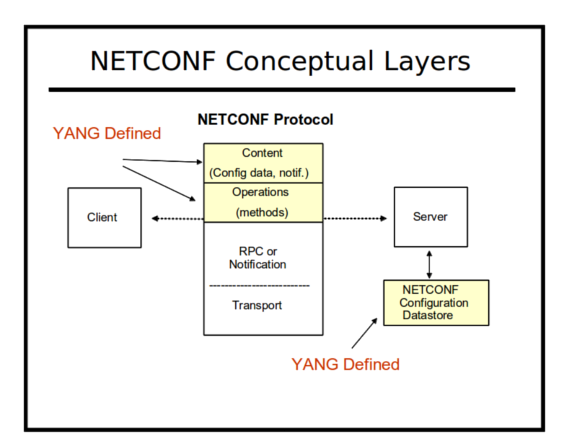
Here's a breakdown of the key components:
- Manager (Client): An application, such as a Python script or a network controller, that initiates the connection and sends requests.
- Agent (Server): Software running on the managed network device (e.g., a router or switch) that listens for and responds to manager requests.
- Transport Layer: NETCONF messages are transported over a secure, connection-oriented session. SSH is the mandatory transport protocol, typically using TCP port 830.
- RPC Layer: NETCONF uses a Remote Procedure Call (RPC) model. The manager sends
<rpc>requests, and the agent sends<rpc-reply>responses. All messages are encoded in XML. - Operations Layer: This defines a set of standard protocol operations, such as
<get-config>and<edit-config>. - Content Layer: This is the data being manipulated, which is structured according to YANG models.
Core Components in Practice
Now let's examine the key operational components that make a NETCONF/YANG solution work.
1. Configuration Datastores
NETCONF defines several datastores, which are distinct copies of the device's configuration. This is a major advantage over traditional methods, enabling transactional changes.
<running>: The active configuration currently running on the device. This is the only mandatory datastore.<candidate>: A staging area for configuration changes. You can modify this datastore without affecting the device's actual operation. This allows you to build a set of changes, validate them, and then apply them all at once.<startup>: The configuration that is loaded when the device boots.
The typical workflow is to lock the <candidate> datastore, make changes using <edit-config>, and then apply them to the <running> datastore with a single <commit> operation. This ensures atomic updates.

2. NETCONF Operations
The protocol defines a set of base operations that a manager can invoke.
| Operation | Description |
|---|---|
<get-config> |
Retrieve all or part of a specified configuration datastore (e.g., <running>). |
<get> |
Retrieve both configuration and state data from the device. |
<edit-config> |
Create, modify, or delete configuration within a target datastore (usually <candidate>). |
<copy-config> |
Replace an entire datastore with the contents of another. |
<commit> |
Apply the configuration from the <candidate> datastore to the <running> datastore. |
<lock>/<unlock> |
Lock and unlock a configuration datastore to prevent conflicting changes. |
<close-session> |
Gracefully terminate a NETCONF session. |
3. A Practical Walkthrough
Theory is essential, but seeing the components in action solidifies understanding. Given your background, a practical demonstration using Python will connect these concepts to real-world application.
This video section continues Kevin Wallace's demonstration. It shows how a Python script, acting as a NETCONF manager, uses the 'ncclient' library to connect to a Cisco router (agent) in the DevNet sandbox, perform a <get-config> operation, and parse the XML-encoded reply.
Watch from 03:13 to 04:50 to see how YANG-modelled data is encoded in XML. Then, skip to 08:08 and watch through to 17:35 for the practical demonstration. Focus on how the script constructs a connection, performs an operation, and handles the structured data returned by the device.
This demo brings all the pieces together: the manager (Python script), the agent (CSR 1000V), the SSH transport, the XML-encoded RPC, and the YANG-structured data.
Diving Deeper into YANG
YANG is what gives NETCONF its power and structure. It defines what is possible to configure.
A YANG model defines:
- Data structure: Using
containers(groupings),lists(sequences of items, like a list of interfaces), andleaves(individual data points, like an IP address). - Data types: Such as
string,int32,boolean, andenumeration. - Constraints: Rules like a VLAN ID must be between 1 and 4094.
- RPCs and Notifications: Can also define custom operations beyond the NETCONF base set.
Types of YANG Models
In a real-world network, you will encounter different categories of YANG models. Understanding them is key to building portable automation.
[PDF] Cisco Devnet Automation journey kickstart
This presentation deck from a Cisco DevNet session provides an excellent overview of the different types of YANG models you'll encounter.
Review slides 41 through 45. These slides categorize YANG models into 'Industry standard' (IETF, OpenConfig) and 'Vendor specific' (Cisco IOS-XE, etc.) and show comparisons.
The main categories are:
- IETF Standard Models: Developed by the IETF for fundamental network features (e.g.,
ietf-interfaces,ietf-routing). - OpenConfig Models: A collaborative effort by network operators to create a set of vendor-neutral models for common features like BGP, LLDP, and VLANs.
- Vendor-Native Models: Models developed by vendors like Cisco, Juniper, or Arista to expose the full set of their proprietary features. These are the most comprehensive but are not portable across platforms.
Test your understanding!
You are tasked with developing an automation script to configure BGP on routers from both Cisco and Juniper. Your goal is to write a single script that works on both platforms without modification.
Which type of YANG model—Cisco-native, Juniper-native, or OpenConfig—would be the most suitable for this task, and why?
Show answer
OpenConfig would be the most suitable choice.
OpenConfig models are vendor-neutral, industry-standard models developed by a consortium of network operators. By writing your script to interact with the OpenConfig BGP model, you can configure any device that supports this model, regardless of the vendor. Using vendor-native models (like Cisco-XE BGP or Junos BGP) would require you to write and maintain separate logic for each platform, defeating the purpose of a single, reusable script.
Conclusion
This lesson concludes our journey through the key topics of the CCNP ENCOR curriculum. We've dissected the components of a NETCONF/YANG solution, moving from the high-level goals of network automation to the specific protocols and data structures that make it a reality.
Key Takeaways:
- NETCONF is a standardized protocol that provides a programmatic and transactional way to manage network devices, overcoming the limitations of CLI and SNMP.
- YANG is a data modeling language that provides the "blueprint" for device configuration, defining the structure, syntax, and semantics of the data that NETCONF manipulates.
- A NETCONF/YANG solution consists of a manager (client) and an agent (server) communicating over SSH. The manager sends XML-encoded RPCs (like
<edit-config>) to manipulate data in datastores (candidate,running), and the agent responds accordingly. - The choice between vendor-native, IETF, and OpenConfig YANG models is a critical design decision, trading off feature completeness against vendor neutrality.
You have now covered the full breadth of the ENCOR exam blueprint, from foundational enterprise architecture and advanced routing to wireless, security, and finally, network automation. Your background as a solutions engineer, combined with the deep technical knowledge you've gained throughout this course, positions you excellently not only for the certification exam but for designing and managing the complex, automated networks of the future. Congratulations on completing the course