Hello! Welcome to our new module, "Spanning Tree Protocol and First-Hop Redundancy."
In the previous module, we discussed how EtherChannel bundles links to increase bandwidth and provide redundancy. We also saw how a misconfigured EtherChannel could create a Layer 2 loop, and we relied on the Spanning Tree Protocol (STP) to protect our network from this. Now, it's time to put STP itself under the microscope.
This lesson addresses the learning outcome: Compare Rapid Spanning Tree Protocol (RSTP) to legacy STP, focusing on convergence.
As you know from your CCNA studies and experience, legacy STP (defined in the IEEE 802.1D standard) works, but its primary drawback is its slow convergence time. A topology change can cause network outages lasting from 30 to 50 seconds. For a solutions engineer designing modern, resilient networks, this delay is often unacceptable. This lesson will explore how RSTP (IEEE 802.1w) was created to solve this very problem, enabling sub-second failover in many cases. We will dissect the key architectural changes that make RSTP "rapid."
1. The Need for Speed: Legacy STP's Convergence Problem
Before diving into RSTP, let's briefly recap why legacy 802.1D STP is so slow. It relies on a series of passive timers:
- Max Age: A port waits up to 20 seconds (by default) to age out old BPDU information before deciding a link is down.
- Forward Delay: A port moving from Blocking to Forwarding must first transition through the Listening (15 seconds) and Learning (15 seconds) states.
This leads to a total convergence time of at least 30 seconds (Listening + Learning) and potentially up to 50 seconds (Max Age + Listening + Learning). RSTP fundamentally changes this by replacing passive waiting with active negotiation.
2. Foundational Changes in RSTP
RSTP achieves its speed by redefining some of STP's core components: port states, port roles, and the introduction of link types.
To get a high-level overview of these differences, let's start with a video.
CCNP ENCOR // Rapid STP (RSTP) // ENCOR 350-401 Complete Course
This video from Jeremy's IT Lab provides a concise introduction to the key differences between classic STP and RSTP, which we will explore in detail throughout this lesson.
Watch the introduction from 0:06 to 3:02. The video will confirm that the fundamentals (Root Bridge election, path costs) are the same, while highlighting the major areas of change: port states, roles, and the convergence mechanism.
Now, let's break down those changes.
2.1. Port States: From Five to Three
Legacy STP has five port states: Disabled, Blocking, Listening, Learning, and Forwarding. RSTP streamlines this into just three states.
- Discarding: This single state combines the functions of STP's Disabled, Blocking, and Listening states. A port in the Discarding state does not forward traffic or learn MAC addresses. It simply listens for BPDUs.
- Learning: This state is identical to the Learning state in STP. The port still doesn't forward frames but begins populating its MAC address table. In a properly functioning RSTP network, this state is often skipped.
- Forwarding: This state is also identical to STP's Forwarding state. The port is fully operational, forwarding frames and learning MAC addresses.
This consolidation is the first clue to RSTP's efficiency. By merging states, the protocol simplifies the transition process.
Spanning Tree Deep Dive Pt.4 – Rapid PVST+
This article from 'My CCIE Journey' blog provides a very clear table comparing the port states between the two protocols.
Read the section titled 'RSTP Port States' and pay close attention to the comparison table. Note how the 'Discarding' state in RSTP encompasses three of the 802.1D states.
2.2. Port Roles: Getting Specific About Redundancy
In legacy STP, a port is either a Root Port, a Designated Port, or it's a non-designated (blocking) port. RSTP makes the role of blocking ports more specific, which is crucial for fast failover. The Root and Designated Port roles remain the same, but the non-designated role is split in two:
- Alternate Port: This port provides a backup path towards the Root Bridge. It is a pre-calculated alternative to the switch's own Root Port. If the Root Port fails, the Alternate Port can immediately transition to the Forwarding state without any recalculation.
- Backup Port: This port provides a backup path to a segment where another port on the same switch is already the Designated Port. This scenario requires a hub or some other shared-media device connecting two ports of the same switch, making it very rare in modern networks.
This distinction is key: an Alternate Port is a ready-to-go backup for the primary path to the root. The switch already knows about it, so failover is nearly instantaneous.
2.3. Link Types: Understanding the Connection
RSTP introduces the concept of link types, which it automatically determines based on the port's duplex mode:
- Point-to-Point: A port operating in full-duplex is considered to have a point-to-point link to a single other device (like another switch). These links can take full advantage of RSTP's rapid convergence mechanisms.
- Shared: A port operating in half-duplex is considered to be on a shared link (e.g., connected to a hub). On these links, RSTP falls back to the slower, timer-based 802.1D mechanism.
- Edge: A port configured with PortFast (or
spanning-tree portfastin Cisco IOS) is an edge port. It's assumed to connect to an end device, not another switch. These ports transition immediately to the Forwarding state.
Only point-to-point links can use the fast proposal-agreement handshake we'll discuss next.
3. The Core of Rapid Convergence
The most significant difference lies in how RSTP converges. Instead of relying on timers, it uses an active, event-driven handshake process.
3.1. BPDU Handling: A Proactive Approach
The way Bridge Protocol Data Units (BPDUs) are handled is fundamentally different and directly impacts failure detection speed.
- Legacy STP: Only the Root Bridge generates BPDUs. Non-root switches simply relay them after modifying the cost. If a switch stops receiving BPDUs on its root port, it must wait for the Max Age timer (20 seconds) to expire before considering the root path lost.
- RSTP: Every switch generates and sends its own BPDUs out of all its ports every
hellotime (2 seconds). This acts as a keepalive mechanism. If a switch misses 3 consecutive BPDUs from a neighbor (6 seconds), it considers that neighbor to be down.
This simple change reduces direct link failure detection from 20 seconds to 6 seconds.
Furthermore, the RSTP BPDU format leverages unused flags from the original 802.1D BPDU to carry information about the sender's port role and to manage the new handshake process.
RSTP Tutorial - Rapid Spanning Tree Protocol
To understand how RSTP communicates so efficiently, let's examine the BPDU itself. This article from Howtonetwork provides a good breakdown of the BPDU format and handling.
Read the sections 'The Modified RSTP BPDU' and 'RSTP BPDU Handling'. Focus on two key takeaways: the change in BPDU generation from 'relay-only' to 'every switch generates', and the much faster aging time (3x hello vs. Max Age).
3.2. The Proposal-Agreement Handshake
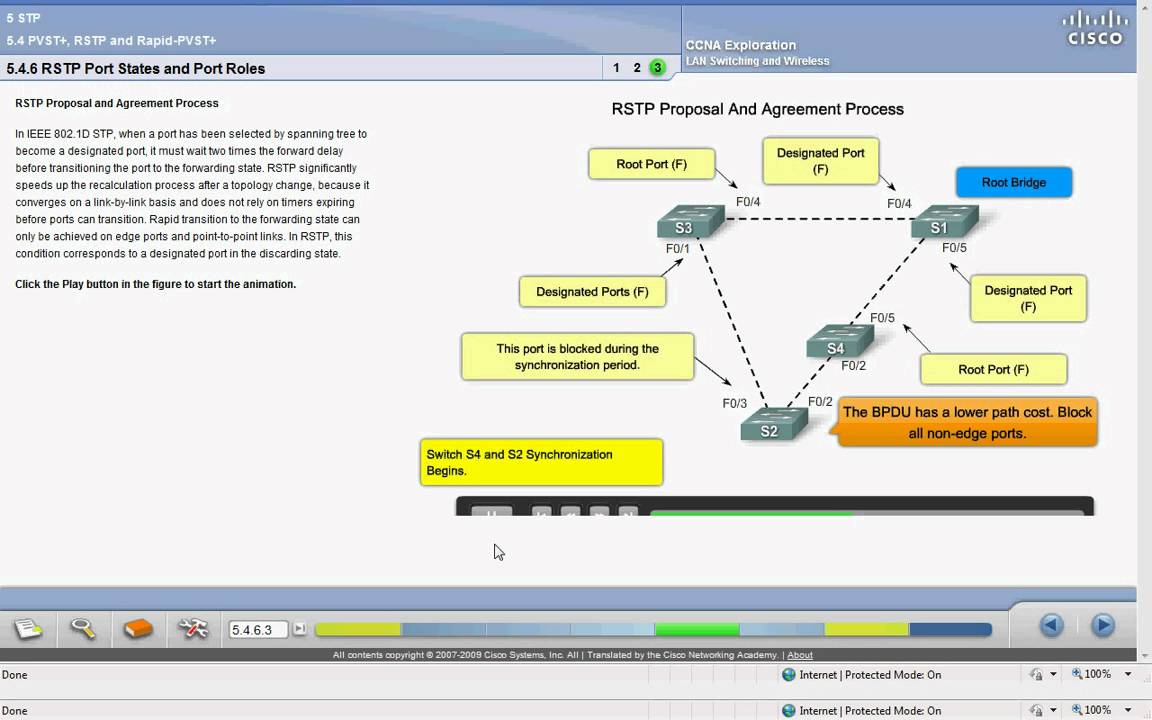
This handshake is the mechanism that allows a point-to-point link to move immediately to the forwarding state. It replaces the 30-second Listening/Learning delay of legacy STP.
The process, known as synchronization, works like this:
- When a switch (SW1) wants to make its port a Designated Port on a new link, it sends a BPDU with a Proposal flag set to its neighbor (SW2).
- SW2 receives the proposal. Before agreeing, it must ensure no loops will be created. It does this by putting all its other non-edge ports into a syncing state (which is a form of Discarding/Blocking).
- Once synchronized, SW2 changes the state of the port that received the proposal to Root Port, brings it to Forwarding, and sends a BPDU back with an Agreement flag set.
- SW1 receives the agreement and immediately transitions its Designated Port to the Forwarding state.
This entire negotiation happens in a fraction of a second.
The following video provides an excellent animated walkthrough of this process.
How Rapid STP reacts to change - Proposal/agreement process
Visualizing the proposal-agreement process is the best way to understand it. This video from Sunny Classroom demonstrates the handshake in action when a new switch is added to the network.
Watch the detailed example from 2:17 to 7:20. Follow the proposal and agreement BPDUs as they propagate through the network and observe how quickly the ports reach a stable, forwarding state.
Test your understanding!
In the RSTP proposal-agreement handshake, why must a switch block its other non-edge ports (the "synchronization" step) before it sends an agreement message?
Show answer
This is a critical loop-prevention step. By sending an agreement, the switch is about to bring a new port (its new Root Port) into the forwarding state. If any of its other ports were also forwarding (for example, if they were Designated Ports leading to other parts of the network), bringing the new Root Port up immediately could create a temporary loop. By blocking all other non-edge ports first, the switch guarantees a loop-free topology before it commits to the new path to the Root Bridge.
4. Summary: STP vs. RSTP Convergence
Let's consolidate everything into a direct comparison. The following table neatly summarizes the key operational differences that contribute to convergence speed.

As a final note, RSTP is designed to be backward-compatible. If an RSTP-enabled port receives a legacy 802.1D BPDU, it will revert to classic STP behavior on that link, losing its rapid convergence benefits. This ensures interoperability but highlights the importance of running RSTP consistently across your switched network.
Conclusion
In this lesson, we dissected the architectural changes that allow RSTP to far outperform its predecessor. We moved from a slow, timer-based protocol to a fast, event-driven one.
Key Takeaways:
- Legacy STP's convergence is slow (30-50s) due to its reliance on the Max Age and Forward Delay timers.
- RSTP improves on this by introducing more descriptive port roles (Alternate, Backup) and streamlined port states (Discarding, Learning, Forwarding).
- Failure detection is much faster in RSTP (6 seconds vs. 20 seconds) because every switch generates its own BPDUs as a keepalive.
- The primary mechanism for rapid convergence is the proposal-agreement handshake, which replaces the 30-second Listening/Learning delay on point-to-point links.
- Topology change notifications in RSTP are flooded directly by the detecting switch, rather than having to bubble up to the root, further speeding up network-wide reconvergence.
Preview of the Next Lesson:
Now that you have a solid theoretical understanding of how RSTP works, our next lesson will move to the command line. We will learn how to configure and verify RSTP and its rapid convergence mechanisms on Cisco IOS switches. You will see firsthand how these concepts translate into a live, functioning network.