Hello! Welcome to the next lesson in our course on Enterprise Network Architecture.
In our last lesson, we distinguished between hardware redundancy (like SSO and stacking) and software redundancy (like FHRPs). We established that these techniques create resilient nodes and services, which serve as the fundamental building blocks for a robust network.
Today, we will learn how to assemble these blocks into a coherent, large-scale design. Our learning outcome is to apply modular design principles to create scalable enterprise network topologies. We will move beyond single points of redundancy and explore an architectural approach that brings predictability, scalability, and manageability to the entire enterprise network. This is a cornerstone of professional network design and a critical topic for the CCNP ENCOR exam.
The Problem with "Organic" Growth
Many networks don't start with a grand design. They grow organically: a new switch is added here, a new link there, as needs arise. While this might work for a while, it often leads to a complex, tangled "flat" network that is difficult to understand, troubleshoot, and scale. Policies are inconsistent, traffic paths are unpredictable, and a single failure can have a widespread, unpredictable impact.
The solution is to adopt a structured, modular approach, breaking the network down into distinct functional units, or "modules."
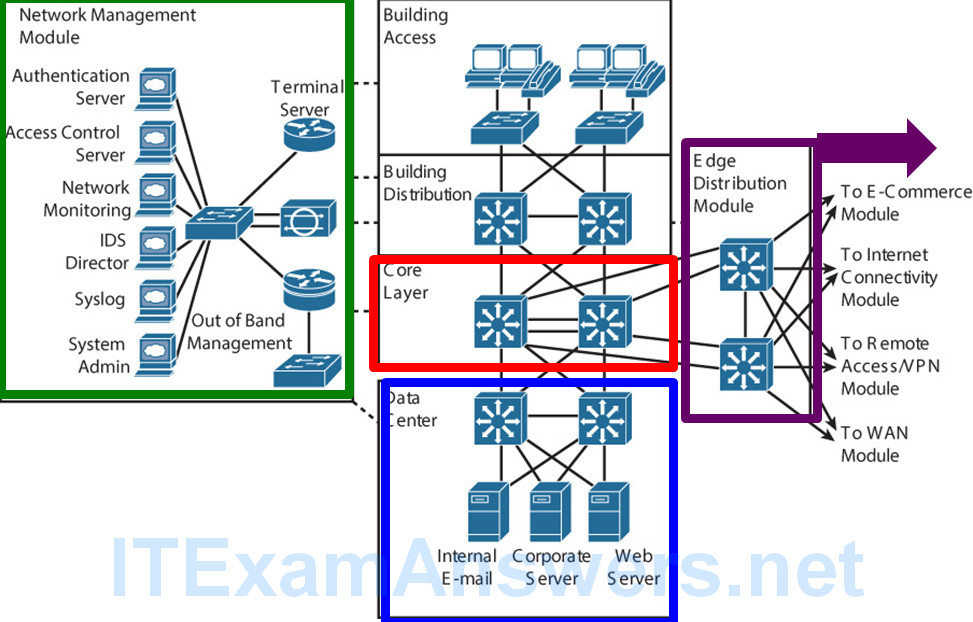
Each module has a specific purpose. This separation of concerns is a powerful design principle. For example:
- Campus Block: Connects users and end devices.
- Data Center Block: Hosts servers and applications.
- WAN Edge Block: Connects to remote sites.
- Internet Edge Block: Provides secure access to and from the internet.
This modularity is the key to building networks that can grow without becoming unmanageable.
The Hierarchical Model: A Modular Blueprint
The most common framework for achieving modularity within an enterprise campus is the hierarchical network design model. This model organizes the network into three distinct layers: Core, Distribution, and Access.
[PDF] Enterprise Campus Design - Cisco Live
Let's begin with a formal definition of the hierarchical model. This document from a Cisco Live presentation provides a concise overview of the model and its benefits.
Please read the slides under the heading 'Hierarchical Network Design', which cover the overall concept and the specific roles of the Access, Distribution, and Core layers. Focus on the list of benefits, such as creating small fault domains and promoting deterministic traffic patterns.
As you just read, each layer forms a modular building block with a specific role. Let's watch a video that brings these roles to life with practical examples of the services and technologies implemented at each layer.
ENCOR - Hierarchical Network Model
This video from KishSquared provides an excellent, detailed breakdown of the services and functions at each layer of the hierarchical model.
Please watch the following three segments: Access Layer (30:15 - 40:53): Pay attention to the services provided here, such as VLAN assignment, QoS marking, and port security. This is where users and devices connect, so policies are applied at the 'edge'. Distribution Layer (44:43 - 56:28): Notice how this layer aggregates connections from the access layer and acts as a crucial boundary. This is where you'll find SVIs and the FHRPs (HSRP, VRRP) we discussed in our last lesson. It's also a key point for route summarization. Core Layer (56:28 - 59:57): Understand why the core's primary—and often only—job is fast Layer 3 switching. The principle here is 'less is more' to ensure stability and speed.
To summarize the functions:
- Access Layer: Provides network access to end devices. Its focus is on edge policies, including port security, DHCP snooping, QoS classification/marking, and VLAN assignment.
- Distribution Layer: The aggregator and policy enforcer. It aggregates uplinks from multiple access layer blocks, provides a Layer 2/Layer 3 boundary, and implements routing policies and ACLs. This is where our redundant building blocks (e.g., a pair of switches running HSRP/VRRP) live.
- Core Layer: The high-speed backbone. Its sole purpose is to forward packets between distribution blocks and other modules as quickly as possible. It should be kept simple, without complex policies.
Scaling with a Modular Approach
The true power of the hierarchical model becomes apparent when the network needs to grow.
When Do You Need a Core?
For a small network, you might only have access and distribution layers (a "collapsed core" design). However, as you add more distribution blocks (e.g., for new buildings), connecting them in a full mesh becomes complex and expensive.

Adding a core layer creates a simple, scalable hub-and-spoke topology for your distribution blocks. Adding a new building with its own access and distribution switches simply means connecting that new distribution block to the core.
Enterprise-Wide Modularity
This hub-and-spoke concept extends across the entire enterprise. The campus core acts as the central hub connecting not just campus buildings, but all the other functional modules of your network.
ENCOR - Hierarchical Network Model
Let's return to the KishSquared video to see how this modular expansion works in practice.
Watch the segment from 15:11 to 21:34. The presenter clearly illustrates how different functional blocks—Data Center, WAN, Internet, and multiple campus buildings—are plugged into the core block. This demonstrates the scalability of the design.
Principles of Effective Modular Design
Applying modularity is more than just drawing three layers. It's an architectural discipline. To deepen your understanding, let's explore some guiding principles.
The Art of Network Architecture: Applying Modularity - Cisco Press
This article from Cisco Press, 'The Art of Network Architecture', elevates the discussion from a simple three-tier model to a set of architectural rules. This aligns with your preference for deep theoretical understanding.
Please read the following three sections: Start with 'Assign Each Module One Function' to understand why limiting a module's role reduces complexity. Continue with 'All Modules at a Given Level Should Share Common Functionality' to see the importance of consistency. Finally, read 'Hide Information at Module Edges'. This is a critical concept for creating fault isolation and stability through techniques like route summarization.
Let's recap those key principles:
- One Function Per Module: Assigning a single, clear function (e.g., user access, data center services) to a module simplifies its design, configuration, and troubleshooting.
- Consistency Across Layers: Modules at the same level of the hierarchy should have similar functions and policies. This creates predictability. For example, all your campus distribution blocks should connect to the core and perform similar aggregation and policy functions.
- Information Hiding: This is arguably the most important principle for scalability and resilience. By summarizing routing information at module boundaries, you create separate fault domains. A problem in one module (like a flapping link causing routing instability) is contained within that module and not propagated across the core to the rest of the network. This is why we perform route summarization on the distribution switches, presenting a single summary of all its local subnets to the core.
Test your understanding!
Your company is building a new engineering wing on its campus. Following modular design principles, you will create a new distribution block for this wing.
- Where will this new distribution block connect into the existing network?
- What is a key routing configuration you should implement on the new distribution switches to ensure network stability, and why?
Show answer
- The new distribution block should connect directly to the Core layer. This follows the scalable hub-and-spoke design, avoiding a complex mesh between distribution blocks.
- You should configure route summarization. By summarizing all the user subnets within the new engineering wing into a single prefix advertised to the core, you are practicing information hiding. This reduces the size of the core's routing table and, more importantly, isolates the core from any routing instability that might occur within the new wing, creating a separate fault domain.
Conclusion
In this lesson, we've seen how to move from individual redundant devices to a fully scalable and resilient network architecture using modular design principles.
Key Takeaways:
- Modular Design involves breaking the network into functional blocks (e.g., campus, data center, WAN edge) to improve scalability, manageability, and fault isolation.
- The Hierarchical Model (Core, Distribution, Access) is the primary framework for modularity within the campus.
- Each layer has a specific role: Access for connectivity and edge policy, Distribution for aggregation and routing policy, and Core for high-speed transport.
- A modular design scales by adding new blocks as spokes to a central hub (the Core), a much cleaner approach than building a complex mesh.
- Effective modular design relies on principles like one function per module, consistency, and especially information hiding to create stable fault domains.
Preview of the Next Lesson:
Now that we understand how to structure a scalable network, the next logical question is: "How big should the links and devices be?" In our next lesson, we will address this by learning how to incorporate capacity planning and network performance metrics into design decisions. This will equip you to not only design a well-structured network but also to size it appropriately for current and future needs.