Welcome back. In our previous lesson, we explored the "low-fidelity" textures that give lo-fi hip hop its name, analyzing how sonic artifacts like vinyl crackle and tape hiss create a warm, immersive soundscape. We established that these "imperfections" are deliberate choices designed to make music feel less intrusive and more like part of the physical environment.
Now, we shift our focus from the texture of the sound to its very architecture. This lesson will explain how lo-fi's repetitive beat structures and looping harmonies form the engine that drives sustained concentration. You'll see how the genre's deliberate simplicity creates a predictable and stable auditory world, allowing your brain to focus without being pulled away by the music itself. This principle of predictability is a cornerstone of functional music, and understanding it is key to effective curation.
The Rhythmic Foundation: Predictable Loops
At the heart of every lo-fi track is a simple, steady, and highly repetitive drum pattern. This is the genre's rhythmic DNA, inherited from the "boom bap" style of 1990s hip hop.
Let's break down what this looks like. The image below shows a typical one-bar hip-hop drum pattern as it would appear in a music production software's step sequencer. The grid represents one bar of music in 4/4 time, divided into sixteen steps (sixteenth notes). Each row corresponds to a different drum sound.
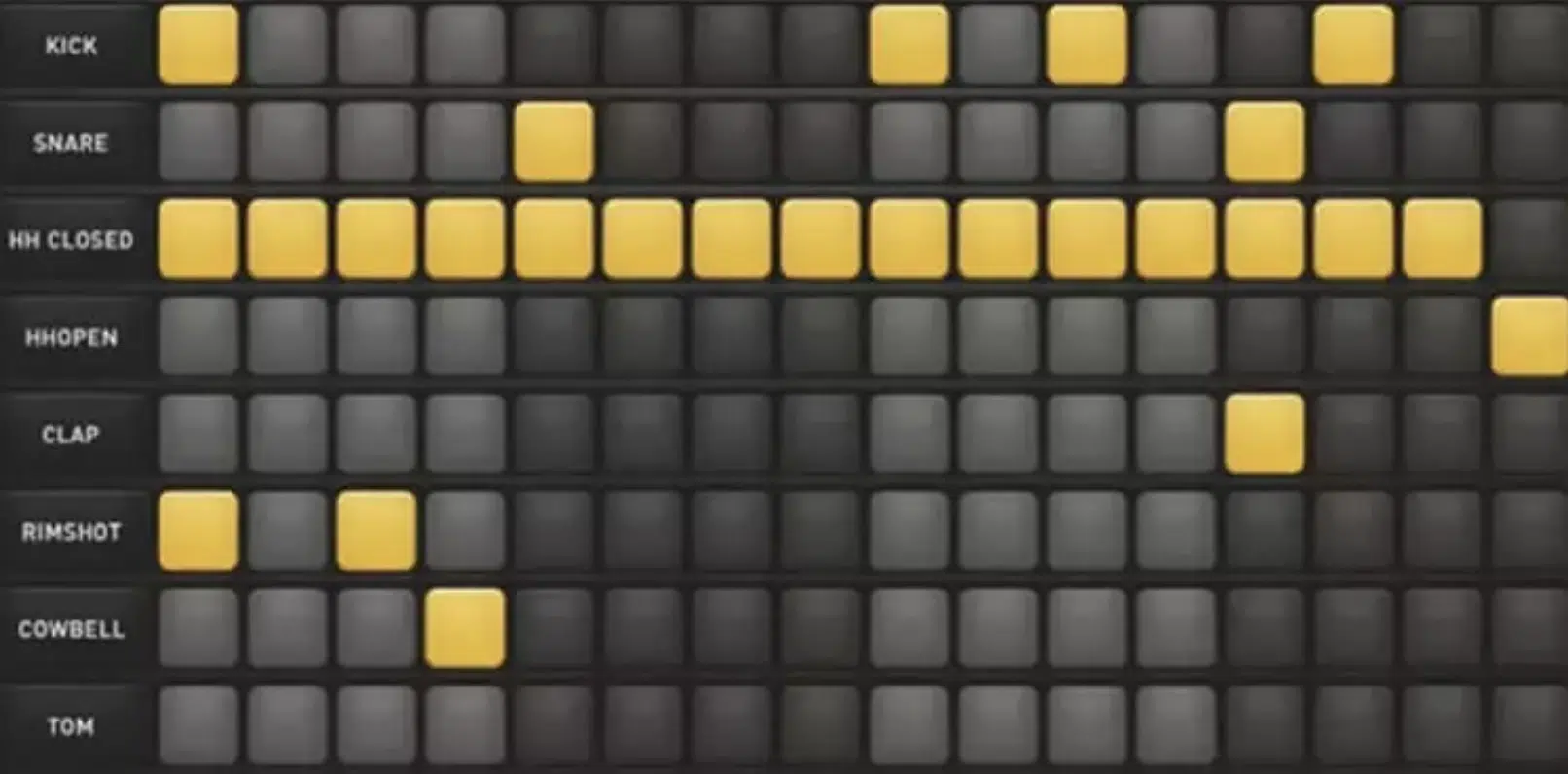
Look closely at the pattern:
- Kick: The kick drum provides the main pulse, typically landing on beat 1 and often on or around beat 3. It's the "boom."
- Snare: The snare provides the backbeat, landing squarely on beats 2 and 4. This is the "bap."
- HH Closed (Closed Hi-Hat): The hi-hats play a steady pattern of eighth or sixteenth notes, filling in the rhythmic space and providing a constant, shimmering pulse.
This entire one-bar pattern simply repeats, or loops, for the duration of the track with very little variation. This creates a powerful sense of stability. Your brain quickly learns the pattern and can predict it with almost no cognitive effort.
The website Melodigging, in its guide to the genre, formalizes these characteristics.
This resource provides a concise technical breakdown of the core ingredients of a lo-fi track. It's an excellent reference for connecting the sound to its musical components.
Please read the section titled "Core Ingredients." Pay close attention to the descriptions under Rhythm and Harmony. Note the typical tempo range (60-90 BPM), the "boom-bap-derived grooves," and the mention of "short two- or four-chord loops."
As the guide points out, the groove is often "swung," giving it a relaxed, human feel that avoids mechanical rigidity—a nuance your jazz background will make immediately apparent. However, the underlying structure remains simple and constant.
The Harmonic Loop: Familiarity Without Distraction
Just as the rhythm is built on a simple loop, so is the harmony. Lo-fi producers typically use short chord progressions, often just two or four chords, that repeat throughout the song.
Given your expertise in jazz, you'll recognize the harmonic language instantly. The progressions are built from the warm, rich chords central to jazz: major sevenths, minor sevenths, and their extensions (9ths, 11ths). However, unlike in a jazz performance where a soloist might improvise complex melodies over these changes, lo-fi keeps the melodic content sparse and repetitive.
This combination of familiar, pleasing harmony with minimal melodic development is crucial. The jazzy chords create a feeling of warmth and sophistication, but the short, looping structure ensures they never demand your full attention. The music becomes, in essence, a form of pleasant, predictable, and harmonically rich background texture.
The Psychology of Predictability: Avoiding "Salient Events"
Why is this combination of repetitive rhythm and harmony so effective for focus? The answer lies in how our brain processes sound. Our auditory system is a finely tuned pattern-recognition machine, constantly scanning for changes in the environment that might signal an opportunity or a threat. Neuroscientists call these attention-grabbing changes "salient events."
A salient event in music could be:
- A sudden change in volume or tempo.
- The introduction of a new, piercing instrument.
- A complex, catchy melody that you can't help but follow.
- The presence of lyrics, which our brains are hard-wired to process for meaning.
Lo-fi music is engineered to have as few salient events as possible. The structure is so predictable that your brain can essentially "tune it out." The following video explains this concept clearly.
Does Lofi Music Really Help You Study?
In this video, "Does Lofi Music Really Help You Study?", the creators break down why the genre's simplicity is its greatest strength for concentration.
Watch the segment from this point. The speaker introduces the idea of avoiding "salient events" and explains how lo-fi's structure—no lyrics, no catchy melodies, and a chill drum groove—is designed to create a "steady trance-like state of focus."
By avoiding these auditory hooks, the music can create what one of the video's sources calls an "aural cocoon." It's present enough to mask distracting external noises (like a conversation in the next room) but not engaging enough to become a distraction itself.
This idea is central to understanding almost all forms of functional music. The goal is to occupy the brain's auditory processing just enough to prevent mind-wandering and block external noise, but not so much that it pulls cognitive resources away from the primary task.
Let's watch one more short clip that ties all these ideas together.
This video, "the science behind lofi music," provides an excellent summary of how the genre's components work together to support focus.
Watch from here. The narrator explains how lo-fi blocks intrusive noises by anchoring them to a predictable rhythm and acts as a mild stimulant. Crucially, she notes that "the jazzy instrumentals and drum loops are refreshing and fun, but slow and repetitive enough that they become subconsciously predictable."
As the science blog The Oxford Scientist puts it, "The looped nature of these beats provides a sense of predictability that keeps you 'in the zone'." This predictability is not a bug; it's the defining feature.
Conclusion
Today, we've connected the dots between lo-fi's musical structure and its function as a focus aid. We've seen that the genre's effectiveness comes not from complexity, but from a masterfully executed simplicity.
Here are the key takeaways for your curator's toolkit:
- Repetitive Rhythmic Structure: Lo-fi is built on simple, looping "boom bap" drum patterns at a relaxed tempo (60-90 BPM). This creates a stable, predictable rhythmic foundation.
- Repetitive Harmonic Structure: The harmony consists of short, repeating loops of 2-4 jazz-inflected chords (maj7, min7, etc.), providing a pleasant but non-distracting background.
- Minimizing "Salient Events": This combination of rhythmic and harmonic predictability avoids abrupt changes, catchy melodies, or lyrics that would otherwise capture your attention.
- The Focus "Zone": The predictable nature of the music allows it to mask external distractions and prevent mind-wandering without becoming a cognitive load itself, supporting a sustained state of concentration.
In our next lesson, we will build on this understanding by comparing lo-fi hip hop to its close cousins, such as chillhop and "study beats." This will help you develop a more nuanced ear for curation and identify the subtle differences that make each style suitable for slightly different contexts.