Introduction
In our last lesson, we took a detailed look at the music of J.S. Bach, uncovering how the intricate architecture of counterpoint and steady rhythmic drive create a powerful engine for focus. We saw that his music isn't just pleasant; it's a highly structured system that can engage and stabilize the mind. Now, we will zoom out from Bach to understand the broader historical context he represents and contrast it with what came after.
This lesson directly addresses your goal of curating effective playlists by differentiating the focus-supporting properties of three major eras in Western music: the Baroque, the Classical, and the Romantic. We will explore why the first two are your primary toolkit for focus music, and why the third, despite its immense beauty and power, is generally something to avoid for deep work. By the end, you'll have a clear framework for distinguishing these styles and understanding their respective impacts on a listener's cognitive state.
To start, let's orient ourselves with a simple timeline.
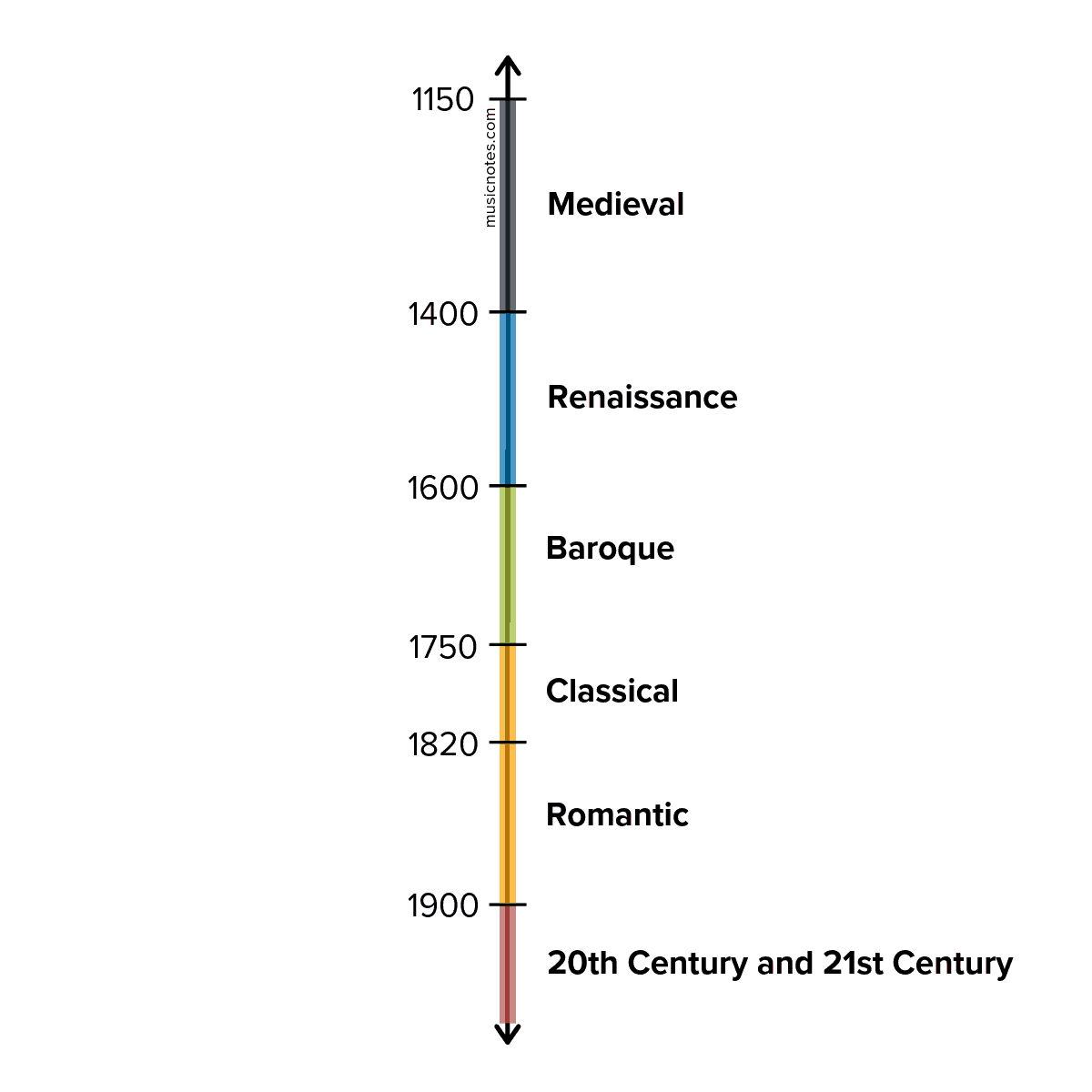
We will be focusing on the Baroque (c. 1600-1750), Classical (c. 1750-1820), and Romantic (c. 1820-1900) periods.
The Baroque Style: Structured Complexity (c. 1600-1750)
The music of Bach, which we analyzed previously, is a pinnacle of the Baroque style. As we generalize from his work, we find a consistent set of characteristics that make this era's music particularly potent for engaging a restless mind. Baroque music is often characterized by a sense of order, discipline, and mathematical precision, reflecting the scientific ideals of the Enlightenment.
Key features from a curator's perspective include:
- A Steady, Driving Pulse: Often described as a "motoric" rhythm, there's a continuous, unwavering pace that provides a stable, predictable foundation.
- Polyphonic Texture: As we saw with counterpoint, Baroque music layers multiple independent melodic lines. This creates a dense, intricate tapestry of sound that is complex enough to capture your attention and prevent mind-wandering.
- Terraced Dynamics: Rather than gradual crescendos, the music shifts more suddenly between loud and soft sections. While this can sometimes be slightly jarring, the overall volume within sections remains consistent.
- Elaborate Ornamentation: Melodies are often decorated with trills and other embellishments, but these are typically applied according to established rules, adding richness without creating emotional chaos.
To hear these characteristics in action, the following video provides excellent examples.
How to Identify Classical Music
The video "How to Identify Classical Music" from the Enjoy Classical Music channel offers a concise auditory guide to the main musical periods.
Please watch the first section on Baroque music, from the beginning of the segment. Listen for the steady pace, the continuous bassline (continuo), the "frilly" ornamentation, the block-like shifts in volume (terraced dynamics), and the layering of melodies (counterpoint).
For a focus playlist, Baroque music is an excellent choice when you need to occupy a "busy brain." Its complexity engages the mind, while its rhythmic and harmonic regularity prevents it from becoming a distraction. Think of it as an intricate yet predictable system.
The Classical Style: Elegant Simplicity (c. 1750-1820)
Reacting against the dense complexity of the Baroque, the Classical period ushered in a style that valued clarity, balance, and elegance. If Baroque music is an intricate tapestry, Classical music is a model of graceful architecture. For a curator, this provides a different, but equally valuable, tool for focus.
Composers like Mozart and Haydn simplified the musical language:
- Homophonic Texture: The focus shifts from many interwoven melodies to a single, clear melodic line over a subordinate accompaniment. This is less cognitively demanding to follow than Baroque counterpoint.
- Balanced Phrasing: Melodies are often constructed in neat, symmetrical phrases (think of question-and-answer patterns). This creates a sense of order and predictability that is very calming.
- Simpler Harmonies: The harmonic language is more straightforward, often centered around basic tonic-dominant relationships, providing a stable and uncluttered sonic environment.
- Gradual Dynamics: The development of the piano allowed for gradual changes in volume (crescendo and diminuendo), making for a smoother, less abrupt listening experience than the terraced dynamics of the Baroque.
Let's continue with the same video to hear the contrast.
How to Identify Classical Music
Continuing with "How to Identify Classical Music"...
Now watch the section on the Classical period, from the beginning of the segment. Note the "lighter, clearer quality" the narrator mentions. Listen for the shift to a single, prominent melody, the simpler harmonic background, and the overall "neater, more ordered" feel compared to the Baroque examples.
From a curation standpoint, Classical music is ideal when the goal is to create a calm, orderly, and uplifting atmosphere that doesn't demand too much attention. Its structure is soothing and its emotional palette is generally bright and optimistic, making it an excellent backdrop for tasks that require a clear and untroubled mind.
The Romantic Style: Emotional Turmoil (c. 1820-1900)
The Romantic era represents another dramatic shift, this time away from the restraint and balance of the Classical period toward intense personal and emotional expression. This is music that seeks to tell stories, convey powerful feelings, and overwhelm the listener. While incredibly moving, this makes it fundamentally unsuitable for background focus.
The core purpose of Romantic music is to grab your attention and take you on an emotional journey.
- Emphasis on Emotion: The primary goal is no longer structural perfection but the expression of human feeling—love, grief, triumph, and tragedy.
- Extreme and Unpredictable Dynamics: Composers used a massive dynamic range, from a whisper (ppp) to a roar (fff), often in sudden, dramatic shifts designed to startle or thrill.
- Fluctuating Tempo (Rubato): The steady pulse of the earlier eras is replaced by an expressive flexibility of tempo. The music speeds up and slows down to enhance emotional impact, breaking the stable rhythm needed for focus.
- Complex and Dissonant Harmony: To convey a wider range of emotions, composers used richer, more complex, and often more dissonant chords, creating tension and suspense.
- Focus on Timbre: The orchestra grew in size, and composers became fascinated with using the unique colors of different instruments to create specific moods. This constant shifting of sonic texture is designed to draw your attention.
The final segment of the video illustrates this powerful but distracting style.
How to Identify Classical Music
Finally, let's explore the Romantic style in the same video.
Watch the section on Romantic music, from the final segment. Pay attention to how the music is described as "more obviously expressive." Listen for the longer, more drawn-out melodies, the growing size of the orchestra (especially the brass), and the richer, more minor-key harmonies, all contributing to a "heartfelt quality."
For a curator, the verdict is clear: Romantic music is for active, engaged listening. It is designed to interrupt, to move, and to demand your full cognitive and emotional resources. Using it for a focus playlist is like trying to read a book while watching a dramatic film—the two activities are fundamentally at odds.
A Curator's Guide: Comparing the Eras
To summarize these differences and their implications for your curation practice, let's turn to an article that specifically discusses the use of classical music for studying. It provides a concise, practical application of the concepts we've just explored.
The Science Behind Classical Music for Studying
This article from Serenade Magazine directly connects the characteristics of different classical periods to their effectiveness as a study aid.
Please read the section titled "Best Classical Music for Studying". Notice how it confirms our findings: Baroque music is recommended for its "intricate yet structured compositions" and "steady tempo." Classical music is praised for its "clarity and balance" and "logical progression." Romantic music is treated with caution, noting that while some gentle pieces exist, it can be "highly dramatic and emotionally intense," making it potentially distracting.
This table synthesizes the key differences from a curator's perspective:
| Feature | Baroque (e.g., Bach, Vivaldi) | Classical (e.g., Mozart, Haydn) | Romantic (e.g., Wagner, Tchaikovsky) |
|---|---|---|---|
| Primary Goal | Structure, intellect, craft | Balance, elegance, clarity | Emotion, expression, storytelling |
| Texture | Polyphonic (many-voiced, complex) | Homophonic (melody with accompaniment) | Highly variable, often thick and complex |
| Rhythm | Steady, continuous, "motoric" | Clear, balanced, regular phrases | Flexible, expressive, use of rubato |
| Dynamics | Terraced (abrupt shifts) | Gradual (crescendo/diminuendo) | Extreme and dramatic range (ppp to fff) |
| Focus Suitability | High. Excellent for engaging a busy mind. | High. Excellent for creating a calm, orderly atmosphere. | Low. Designed to be distracting and emotionally demanding. |
Conclusion
You now have a clear framework for differentiating between the Baroque, Classical, and Romantic eras and understanding their distinct properties for functional listening. We've seen how the structured complexity of the Baroque and the elegant simplicity of the Classical period provide two different but equally effective toolkits for promoting focus. We've also established why the emotional intensity and unpredictability of the Romantic era make it largely unsuitable for this purpose.
Key Takeaways:
- Baroque music uses a steady pulse and complex, interwoven melodies (counterpoint) to engage the mind without causing emotional distraction. It's a "thinking person's" focus music.
- Classical music reacts with simplicity, featuring clear, elegant melodies over a stable accompaniment. It creates a sense of order and calm, making it a less demanding but highly effective backdrop for concentration.
- Romantic music prioritizes emotional expression above all. Its dramatic shifts in volume and tempo, along with its rich, storytelling nature, are designed to capture your full attention, making it the enemy of deep work.
In our next lesson, we will put this knowledge into practice. We will move from theory to application by identifying specific, representative pieces from the Baroque and Classical eras that are prime candidates for your focus playlists.