Welcome to the first lesson of our new module. We're taking a significant leap back in time from the modern, atmospheric grooves of lo-fi and chillhop to explore an entirely different, yet remarkably effective, sound world for concentration: the music of the Baroque era. In our last module, you created a cheat sheet for selecting focus tracks based on principles like steady rhythm and avoiding "salient events." Now, we'll see how composers from the 17th and 18th centuries achieved a similar outcome through highly structured and logical means.
This lesson addresses why the specific structure of Baroque music, characterized by a steady pulse and contrapuntal clarity, is so conducive to deep focus. We'll examine the psychological effects of this music and then dive into the key compositional technique—counterpoint—that gives it its unique power.
The Science of Structured Sound
Why would music written over 300 years ago be a go-to for modern productivity? The answer lies in its unique combination of complexity and predictability. Baroque music often creates a soundscape that is intricate enough to occupy the mind and prevent it from wandering, yet structured enough to not demand active attention.
Recent studies have provided interesting evidence for this. Let's start with an article from ABC Classic that discusses a compelling real-world example.
Baroque music helps to improve concentration - ABC Classic
This article highlights a fascinating study demonstrating the practical benefits of Baroque music for concentration.
As you read, focus on the details of the study involving radiologists using Baroque music. Note the specific improvements they reported in their work. Finally, pay attention to the proposed neurological mechanism involving alpha waves, a concept we briefly touched on in our first module.
The study with the radiologists listening to Vivaldi and Handel shows that this isn't just a matter of taste; there can be measurable improvements in performance. The article connects this to the stimulation of alpha brain waves, which are associated with a state of calm, present-moment awareness—precisely the state needed for deep work.
Two key musical elements of the Baroque era contribute significantly to this effect: tempo and structure. Another article expands on these points.
8 Ways Classical Music Helps You Focus and Study Better
This reading breaks down the specific characteristics of classical music that make it suitable for studying.
Please read section 6, focusing on how tempo can encourage a calm heart rate. Then, read section 7, which explains how the predictable, formulaic structure of Baroque music provides a stable sonic background for the brain.
As the articles point out, the common tempo of 60-80 beats per minute aligns with a resting heart rate, promoting a physiological state of calmness. Furthermore, the use of established formulas and patterns makes the music predictable. Your brain learns the rules quickly and can then relegate the music to the background, allowing you to focus on the task at hand. This is a different path to the same goal we saw with lo-fi: creating a non-distracting "aural cocoon."
Contrapuntal Clarity: The Art of Weaving Melodies
Now, let's delve into the most important structural element of Baroque music for focus: counterpoint.
Your expertise in jazz gives you a deep understanding of harmony, which is often a "vertical" phenomenon—notes stacked on top of each other to form chords that progress through time. Counterpoint, in contrast, is primarily "horizontal." It is the art of combining two or more independent melodic lines, each interesting on its own, that sound harmonically pleasing when played together.

Instead of a single melody supported by chords, you hear multiple melodic voices weaving around each other in a logical, intricate dance. This texture is the hallmark of Baroque music and a key reason for its effectiveness as a focus tool. It's complex enough to engage your brain on a subconscious level but lacks the singular, attention-grabbing melody or jarring chord changes that would pull you out of a state of flow.
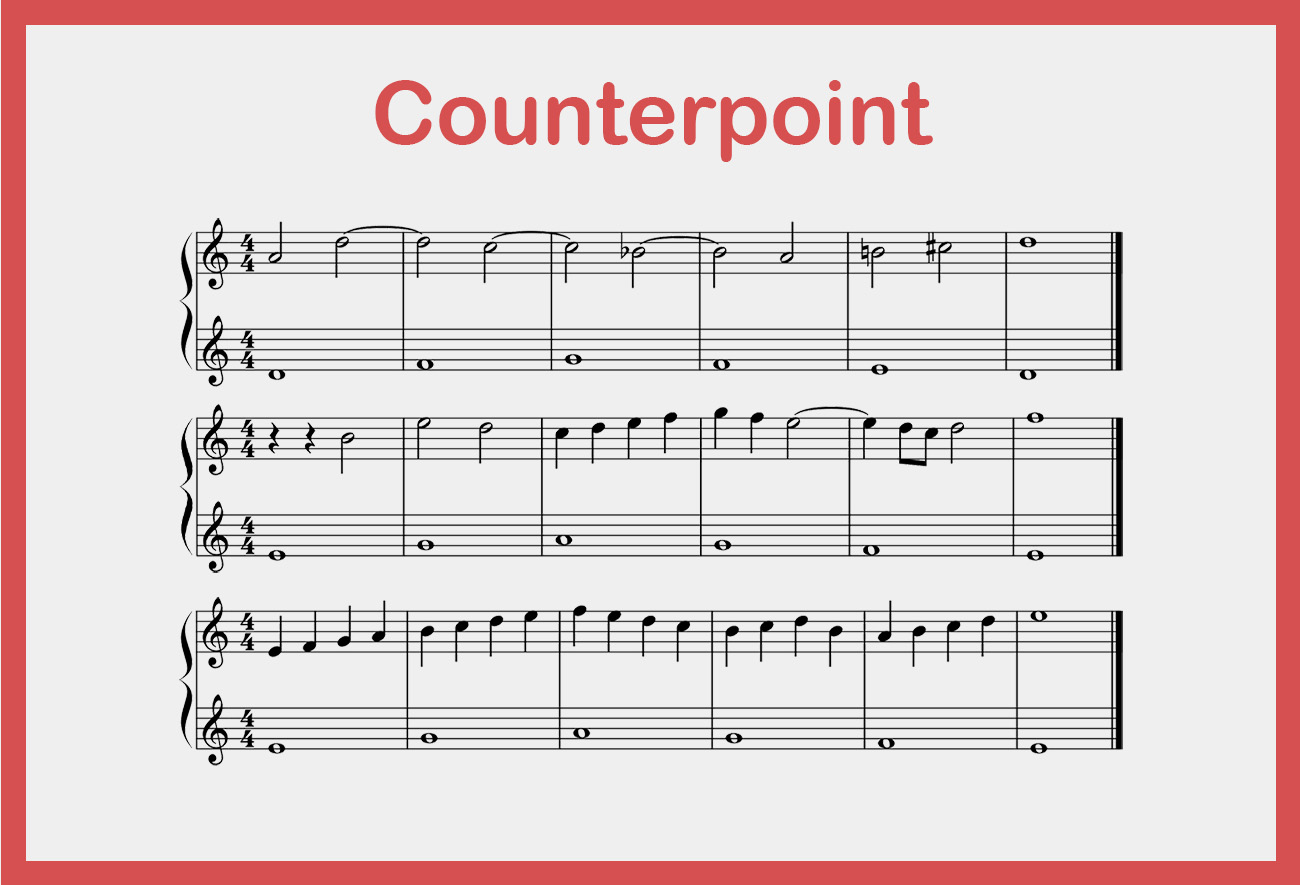
The ultimate expression of this technique is the fugue, a form perfected by Johann Sebastian Bach. Understanding the basics of a fugue will give you a clear window into the mind of a Baroque composer and the logic of the music.
The following video provides an excellent and concise explanation of fugues and the underlying principles of counterpoint.
How to Listen to Classical Music: Fugues
This video from the "Inside the Score" channel breaks down the fugue, the quintessential form of Baroque counterpoint.
Please watch these segments to grasp the concept of "horizontal" musical thinking: Start with the concise definition of what a fugue is. Pay close attention to the excellent explanation of counterpoint. The distinction between horizontal (melodic) independence and vertical (harmonic) dependence is crucial. Next, watch the segment on the fugue's structure. This overview of the exposition, subject, answer, and counter-subject clearly illustrates the music's predictable, rule-based nature. Finally, review the various contrapuntal techniques like canon, augmentation, and stretto. You don't need to analyze them deeply, but recognize them as tools for the logical, almost mathematical, development of musical ideas.
As the video explains, a fugue is a systematic exploration of a single melodic idea (the subject) through a set number of voices. The strict rules governing how these voices enter and interact create a listening experience that is both intellectually satisfying and structurally coherent. This logical unfolding of musical ideas is what we mean by contrapuntal clarity.
Representative Pieces for Your Playlist
To bring these concepts to life, here are a few representative pieces that exemplify the focus-supporting qualities of Baroque music. As you listen, try to tune your ear to the interplay of the voices rather than searching for a single melody.
-
J.S. Bach - Fugue in C Minor, BWV 847, from The Well-Tempered Clavier, Book 1: You were introduced to this piece in the video. Now, listen to it in its entirety. Notice how the four voices enter one by one in the exposition and then continue to weave the subject throughout the piece. Its driving, steady rhythm and intricate texture make it a superb example of a focus track.
-
Antonio Vivaldi - Lute Concerto in D Major, RV 93: II. Largo: This piece, mentioned in one of our readings, showcases a different side of the Baroque era. Here, the texture is simpler, but the principle remains. Listen to the steady, slow pulse and the clear, uncluttered dialogue between the solo lute and the string accompaniment. It creates a feeling of serene, untroubled space.
-
George Frideric Handel - Concerto Grosso in G Major, Op. 6, No. 1, HWV 319: This work demonstrates the concerto grosso form, where a small group of soloists alternates with the full orchestra. Listen for the constant, flowing eighth-note rhythm that propels the music forward. The dynamic shifts are present but contained within the overall structure, providing variety without being disruptive.
Conclusion
In this lesson, we have moved from the atmospheric qualities of modern genres to the architectural logic of the Baroque. You've learned that this music's power to support concentration comes not from an absence of information, but from its highly organized and predictable presentation.
Key Takeaways:
- Baroque music supports concentration through its structured predictability and steady pulse, often around 60-80 BPM, which can promote a calm physiological state (alpha brain waves).
- The core technique is counterpoint, the art of weaving multiple independent melodic lines together horizontally, which creates an engaging but non-distracting texture.
- The fugue, perfected by J.S. Bach, is the ultimate example of this contrapuntal logic, systematically developing a single melodic idea through a set of voices.
- Composers like Bach, Vivaldi, and Handel are pillars of this style and excellent sources for focus playlists.
In our next lesson, we will move forward to the Classical era to investigate the famous "Mozart effect." We'll critically examine the research behind it and its modern interpretation, further refining our understanding of how different classical styles can be used for functional listening.