In our last lesson, we established the rhythmic foundation for your curator's rulebook, focusing on how tempo and complexity create the temporal grid of functional music. We concluded that for focus, a stable, simple rhythmic framework is essential to minimize cognitive load. Now, we move from the when of the notes to the what, exploring how harmony and texture—the vertical and sonic dimensions of music—can be sculpted to guide the mind toward focus, relaxation, and deep meditative states.
This lesson is designed to equip you with principles for using harmony and texture to manage your listener's mental energy. As a jazz musician, you have an intuitive grasp of how complex chord changes can captivate and challenge the listener. Here, we'll leverage that expertise to understand how to do the opposite: how to use harmonic stability and textural spaciousness to create a sense of calm and clarity.
The Harmonic Anchor: Drones and Pedal Tones
In jazz, much of the excitement comes from harmonic movement: the elegant resolution of a ii-V-I progression, the tension of a tritone substitution, or the intellectual thrill of navigating complex changes in a tune by Wayne Shorter or Pat Metheny. This is music that demands engagement. For functional music, our goal is different. We need to reduce harmonic complexity to free up cognitive resources.
The most powerful tool for this is the drone, a sustained tone or chord that acts as a harmonic anchor. A drone provides a constant reference point, assuring the brain that it doesn't need to work to track harmonic changes. This creates a stable sonic environment upon which thoughts can unfold without interruption.
The following video provides an excellent overview of how drones and their close relative, pedal tones (drones that occur over shorter sections), are used across different musical styles.
Musical Drones and Pedal Tones [Theory and Songwriting]
This video, "Musical Drones and Pedal Tones" from Signals Music Studio, is a fantastic primer on the function and feel of sustained tones.
Please watch the following segments, paying close attention to how a single, unchanging note can radically alter the listening experience: Introduction to Drones: Watch from the beginning to understand the basic definition and its historical roots in Indian music and early adoption by The Beatles. The Psychological Effect: The section from "how it makes us feel" describes the trance-like, meditative state that drones can induce. Pedal Tones as a Tool: The segment on pedal tones, from "a very close concept", shows how a sustained bass note can stabilize a chord progression and allow for greater dissonance on top without sounding chaotic. This is a key principle: the pedal tone manages the cognitive load of the changing chords. Melody as a Drone: A fascinating inversion of the concept is presented from the melodic pedal tone, where a constant melody note ties together a series of otherwise unrelated chords. The "Blank Canvas" Effect: Finally, watch from the "blank canvas" section. This explains a crucial advantage of drones: by removing the complexity of full chords, they open up more melodic and modal possibilities without creating clashes.
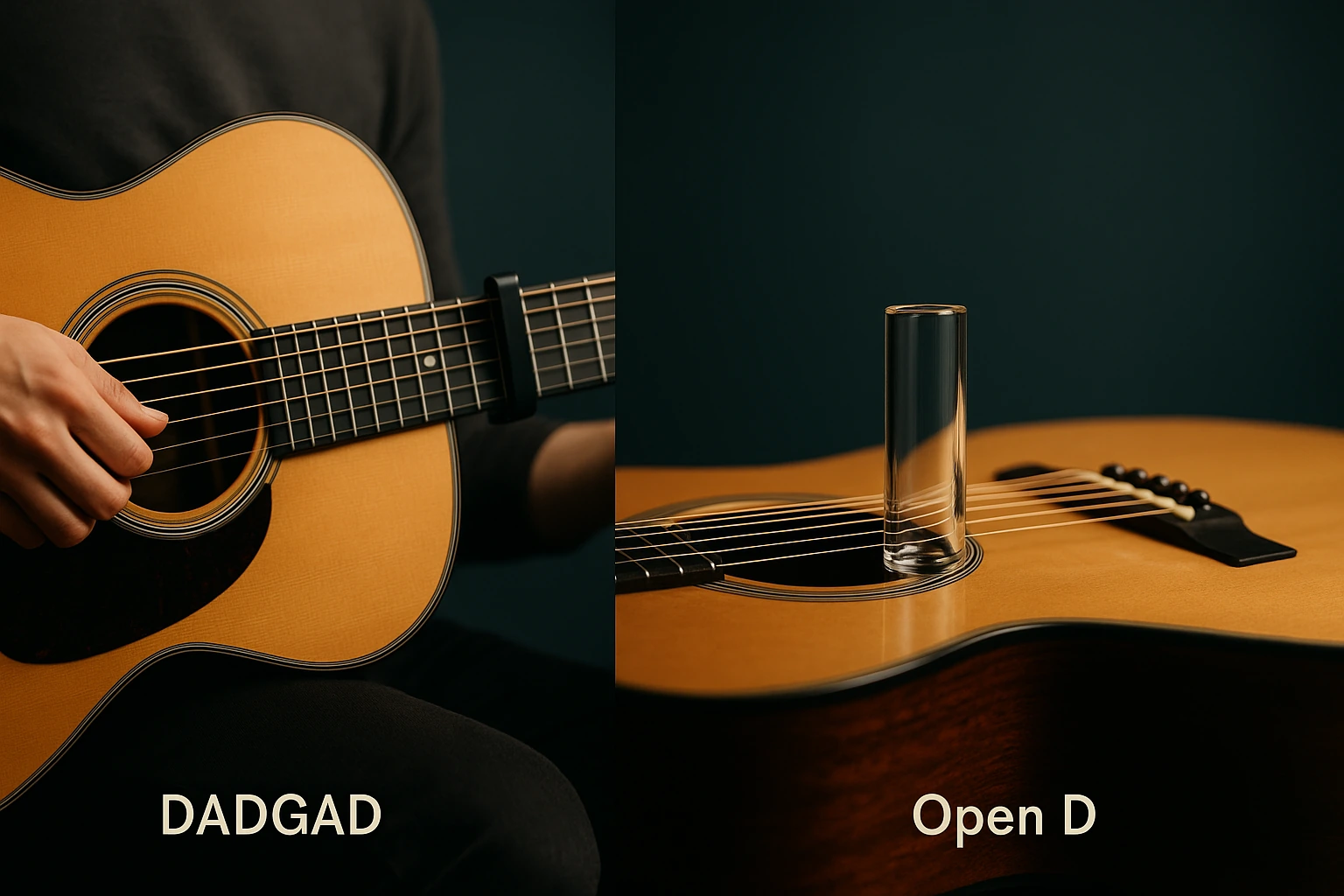
The video demonstrates a core principle: a sustained tone simplifies the harmonic landscape, reducing cognitive load and grounding the listener. This is true whether it's a low bass pedal, a high ringing guitar string, or a constant melody note.
Drones in Meditative and Therapeutic Contexts
The power of the drone to induce meditative states has been explored for centuries, from the tanpura in Indian classical music to the organ points in sacred choral music. In the 20th century, minimalist composers like La Monte Young made the drone the central focus of their work, creating immersive sound environments designed for deep listening.
Tones, Drones and Arpeggios: The Magic of Minimalism - 1. California (BBC)
The documentary "Tones, Drones and Arpeggios: The Magic of Minimalism" explores the origins of this powerful musical movement. The following clip discusses La Monte Young's pioneering work with drones and its connection to ancient traditions.
Please watch the section from the introduction of La Monte Young's "Dream House". Notice the description of how walking through the room changes the listener's perception, creating an active yet meditative experience. The sustained tones create a psychoacoustic space rather than a musical narrative.
This idea of creating a stable, immersive sonic environment is central to the use of music in therapeutic settings. Research into music for psychedelic therapy has sought to identify the specific musical qualities that support peak mystical experiences. The findings provide an empirically-backed set of principles for our curator's rulebook. A key finding is that music best suited for these peak states is harmonically stable and texturally consistent, often relying on drones.
Qualitative and Quantitative Features of Music Reported to ...
This research paper analyzes music recommended by experienced therapists for supporting peak psychedelic experiences. It offers a detailed breakdown of the music's characteristics.
Please read the "Qualitative analysis" section, beginning with the paragraph that starts "Table 1 describes...". Then, carefully study Table 1 itself. Focus on the characteristics listed for "Peak music" under the headings "Orchestration", "Tonality", and "General observations".
The findings from the paper are striking. Music for "peak" experiences is characterized by:
- Constant Tonality: A prevalent tonic drone and few, if any, modulations.
- Homogeneous Orchestration: Instruments are blended into an ensemble sound (like a string section or synth pad) where individual parts are hard to distinguish. This creates a "wash" of sound.
- Unfamiliar Timbres: The use of non-Western instruments (tanbura, didgeridoo) or synthesized sounds helps to avoid triggering specific real-world associations, keeping the listening experience abstract.
- Consistency: The musical elements established at the beginning of a piece remain more or less constant throughout.
This aligns perfectly with our principle of managing cognitive load. The music is deliberately non-narrative; it creates a stable state rather than telling a story with a beginning, middle, and end. The website article on modulation types categorizes this approach as "Prolonged tension through modal/dronal shifting," contrasting it sharply with the abrupt, functional, or complex modulations found in pop and jazz.
Texture: Sparsity, Openness, and Timbre
Beyond the harmonic foundation, the overall texture of the music is critical. Texture refers to the density and layering of sound. For our purposes, we can focus on three aspects: sparsity, voicing, and timbre.
-
Sparsity: Just as with rhythm, a sparse texture with fewer musical events is easier for the brain to process. It creates a sense of sonic space. Music for focus and relaxation should avoid being dense or "busy."
-
Open vs. Close Voicings: As a jazz musician, you are intimately familiar with voicings.
- Close voicings, where chord tones are clustered together (often within a single octave), can create a thick, dense sound.
- Open voicings, where the notes are spread out across a wider range, create a sense of airiness, space, and clarity. The overtones of each note have more room to resonate without interfering with one another.
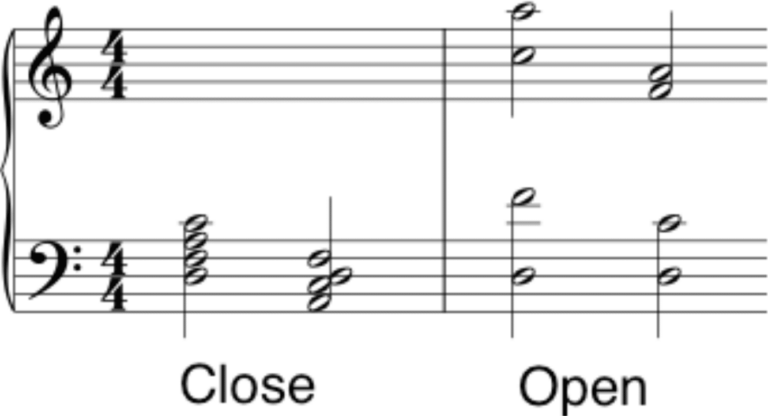
For relaxation and sleep, open voicings are almost always preferable. They contribute to a feeling of expansiveness and calm.
3. Timbre: The research on therapeutic music highlights the importance of blended, homogeneous timbres. A string orchestra, a choir singing "oohs," or a soft synthesizer pad all create a unified texture. This is less cognitively demanding than a collection of distinct, heterogeneous timbres (e.g., a jazz combo with piano, bass, drums, and saxophone), where the brain is invited to track each instrument's individual line. Techniques like adding heavy reverb can also serve to wash sounds together, smoothing out distinct attacks and creating a more cohesive texture.
A Curator's Framework for Harmony & Texture
Let's synthesize these ideas into the next section of your rulebook.
| Desired State | Harmony | Texture |
|---|---|---|
| Deep Focus | Static or very slow-moving. Pedal tones or unobtrusive drones are effective. Simple, non-functional progressions are acceptable if they are repetitive and predictable. | Sparse and clear. Good separation between elements. Open voicings are preferred. Timbre should be consistent. |
| Relaxation | Highly static, centered around a prominent drone. Modal harmony (e.g., Lydian, Mixolydian) is common, as it is less goal-oriented than functional harmony. | Open-voiced, sustained pads and string textures. Homogeneous, blended timbres. Generous use of reverb to create space. |
| Sleep | Purely dronal and textural. No discernible chord changes or harmonic progression. Often based on a single fundamental tone and its overtones. | An amorphous "wash" of sound. No distinct melodic or harmonic elements. Very soft, smooth timbres. The goal is a sonic fog. |
Conclusion
Today we've added a crucial layer to your curatorial framework. While rhythm provides the temporal scaffolding, harmony and texture define the emotional and cognitive space of the music. By prioritizing harmonic stability and textural simplicity, you can create soundscapes that support rather than demand mental resources.
Here are your key takeaways:
- Drones are the ultimate tool for stability: A sustained tone or pedal point acts as a harmonic anchor, reducing cognitive load and inducing a calm, meditative state.
- Texture should be sparse and open: Spreading out notes with open voicings and keeping the arrangement simple creates a sense of spaciousness and clarity.
- Timbre should be blended: Homogeneous textures (like synth pads or string sections) are less distracting than a collection of distinct, individual instruments.
In our next lesson, we will refine this further by examining the role of timbre in more detail, along with dynamics and the large-scale structural evolution of a piece. We will formulate principles for how to sustain a desired mental state over time without causing distraction or boredom.