Welcome back. In our previous lesson, we investigated binaural beats, a psychoacoustic phenomenon that aims to influence brainwave activity through auditory illusion. This tool is rooted in modern neuroscience. Today, we turn our attention to another set of sound tools that have gained significant popularity in wellness circles: Solfeggio frequencies. Their story, however, is not one of neurology but of purported ancient history and mysticism.
This lesson will address your interest in Solfeggio frequencies by exploring their origins and the effects commonly associated with them. By the end of our session, you will be able to describe the popular historical narrative behind these tones and list their attributed healing properties. This provides the essential context we'll need before we can critically evaluate their place in your curation practice. Given your formal training in music, you are uniquely positioned to appreciate the musicological claims—and controversies—that surround this topic.
The Modern Narrative: A Scale of Healing Tones
In contemporary wellness and New Age practices, the Solfeggio frequencies are presented as a set of nine specific tones, each believed to vibrate at a frequency that can bring about positive physical, emotional, and spiritual changes. The claims are wide-ranging, from pain relief and emotional release to DNA repair and spiritual awakening.
These supposed benefits are widely publicized. The infographic below is typical of how these frequencies are presented, linking each one to a specific outcome.
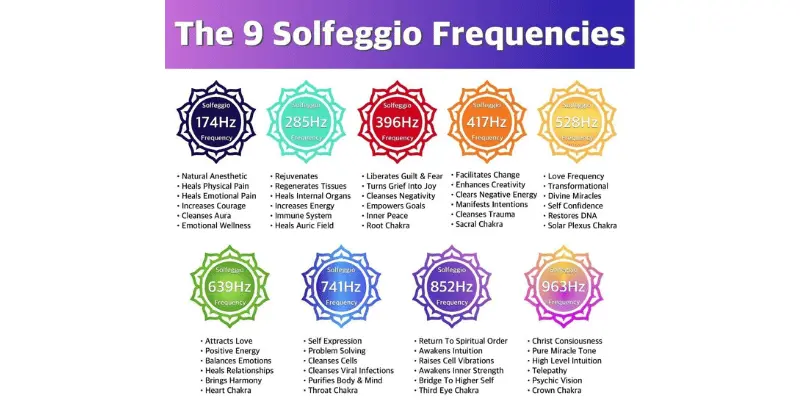
To understand these claims in more detail and to experience the tones for yourself, the following resource provides an excellent overview. It encourages an intuitive, experiential approach to listening.
Sound Sanctuary: Exploring the Solfeggio Frequencies
This article from the blog Wandering But Not Lost presents the Solfeggio frequencies from a user's perspective, focusing on their intended effects.
First, read the section Explore the Solfeggio Frequencies for a brief introduction. Then, review the descriptions for each of the nine frequencies listed, from 174 Hz to 963 Hz. As you read, use the "🎧 Hear..." links to sample a few of the tones. Pay attention to your own subjective experience of the sound, without judgment. Finally, review the section CREATE YOUR DAILY FREQUENCY RITUAL, which shows how these frequencies are categorized for practical use.
To synthesize this information for your future curation, here is a summary of the nine frequencies and their most commonly attributed effects:
| Frequency | Associated Keywords & Claims |
|---|---|
| 174 Hz | Grounding, Pain Relief, Safety, Natural Anesthetic |
| 285 Hz | Tissue Regeneration, Energy Field Repair, Renewal |
| 396 Hz | Liberating Guilt & Fear, Grounding, Emotional Release |
| 417 Hz | Facilitating Change, Clearing Trauma, Wiping Negative Energy |
| 528 Hz | Transformation & Miracles, DNA Repair, Love Frequency, Clarity |
| 639 Hz | Reconnecting Relationships, Harmony, Empathy, Communication |
| 741 Hz | Problem Solving, Expression, Detoxification, Clarity |
| 852 Hz | Awakening Intuition, Returning to Spiritual Order, Insight |
| 963 Hz | Unity, Oneness, Connecting with Higher Self, Christ Consciousness |
This table represents the popular understanding of these tones. It's the "why" behind their use in countless meditation tracks, sound baths, and healing playlists. But where did this story come from?
The Historical Context: Myth vs. Musicology
The origin story of the Solfeggio frequencies is a key part of their mystique. To understand it, we need to separate the popular narrative from the historical and musicological facts. The following resource does an excellent job of first summarizing the myth and then carefully dissecting it.
Truth About the Ancient Solfeggio Frequencies
This article by music researcher and composer D.S. Billingsley examines the historical claims made about the Solfeggio frequencies from a music theory perspective.
First, read the "Cliff Notes version" presented at the beginning, under the list of bullet points. This is the popular origin story you will commonly encounter. Next, read the author's critical analysis of this story. Focus on these three points: The issue with the biblical code claim, discussed in the paragraph starting here. The clarification of Guido d'Arezzo's actual historical contribution, in the section starting here. The core music theory problem, explained in the section Here's the problem. Finally, read the short Conclusion for the author's final synthesis.
Let's break down the key discrepancies between the popular narrative and the historical record.
1. The Origin Story: A 20th-Century Vision
The popular narrative, as outlined in the article, credits Dr. Joseph Puleo with "rediscovering" these frequencies in the late 20th century through a mystical vision that pointed him to a numerical code in the Book of Numbers of the Bible. This story immediately frames the frequencies as ancient, lost, and sacred.
However, the article points out a critical anachronism: Puleo's method relies on the modern chapter-and-verse system of biblical notation. This system was not developed until the 13th to 16th centuries, well over a millennium after the Bible was written and hundreds of years after Guido d'Arezzo, the historical figure to whom the frequencies are often linked.
2. The Guido d'Arezzo Connection: Fact and Fiction
The narrative links these frequencies to Guido d'Arezzo, a Benedictine monk from around 1000 AD. Guido is a monumental figure in music history, credited with inventing the staff notation system we use today and developing the practice of solmization (solfège) to teach sight-singing. He used the hymn Ut queant laxis (Hymn to St. John the Baptist), where each line started on a successive step of the scale, to name the notes: Ut-Re-Mi-Fa-Sol-La.
The myth claims Guido used the "Solfeggio frequencies" for this hymn. However, historical and musicological analysis shows this is incorrect. The melody Guido used corresponds to a standard diatonic scale of his time, based on Pythagorean tuning.
3. The Music Theory Problem
This is perhaps the most definitive point, especially for someone with your background. The set of Solfeggio frequencies (396, 417, 528, 639, 741, 852 Hz) does not conform to any known scale or temperament in music history—not Pythagorean, not just intonation, and not the equal temperament we use today.
As the article notes, there's a confusion between tuning (setting the pitch of a single reference note, like A=440 Hz or A=432 Hz) and temperament (the system of intervals between the notes in a scale). The specific intervals between the Solfeggio frequencies create a "scale" that would sound highly dissonant and unfamiliar if used to play a melody like the Hymn to St. John the Baptist. They are a set of numerically-derived pitches, not a musically-derived scale in the traditional sense.
The conclusion is stark: the "ancient" Solfeggio frequencies appear to be a modern invention, with a fabricated historical narrative.
Conclusion
Today, we've explored the Solfeggio frequencies from two angles. You are now equipped to describe both their popular identity and their contentious historical claims.
Here are the key takeaways for your curatorial practice:
- Attributed Effects: There is a well-defined set of nine frequencies, each associated with specific healing, emotional, or spiritual benefits in popular culture. This narrative drives listener interest.
- Historical Context: The popular origin story linking these frequencies to ancient chants and Guido d'Arezzo is not supported by musicological or historical evidence. The frequencies appear to be a 20th-century creation.
- Musical Status: The frequencies do not form a scale according to any known system of temperament. They are a collection of discrete pitches with a numerical, rather than musical, logic connecting them.
Understanding this duality is crucial. The popular narrative is the "user story"—it's why people seek out this music. The historical critique provides the objective context you need to curate responsibly.
In our next lesson, we will complete our foundational module by critically assessing the scientific evidence for both binaural beats and Solfeggio frequencies. Having examined their proposed mechanisms and historical contexts, we will now ask: do they work, and what does the research say?