Bonjour !
In our last lesson, we learned how to put forward ideas and make recommendations using phrases like On pourrait... and Je propose de.... This is a crucial first step in influencing technical decisions. But what happens when your proposal meets a constraint, like a tight deadline or a fixed budget? That's when negotiation begins.
Today's lesson will equip you with the language to navigate these critical conversations. Our learning outcome is to negotiate project scope or deadlines using polite and persuasive language. This skill is fundamental for moving into senior engineering or project management roles, as it's at the heart of successfully delivering projects. We will explore both the strategic framework for these negotiations and the specific French phrases that will make you a persuasive, collaborative partner.
1. The Context: Understanding the 'Triangle de Fer'
In any project, there are three main constraints that you must constantly balance. In project management, this is known as the "Iron Triangle," or le triangle de fer in French. As a software engineer, you've certainly lived this reality.
The three points of the triangle are:
- Le périmètre (Scope): What we have to build.
- Les délais (Timeline/Deadlines): When it needs to be delivered.
- Les coûts (Costs): The budget or resources available.

This triangle is the basis of negotiation. You cannot change one point without affecting at least one of the others. For example, if a client wants to add to the scope (le périmètre), you must negotiate for either more time (les délais) or more resources (les coûts).
Failing to manage these trade-offs leads to "scope creep," or la perte de vue du périmètre.
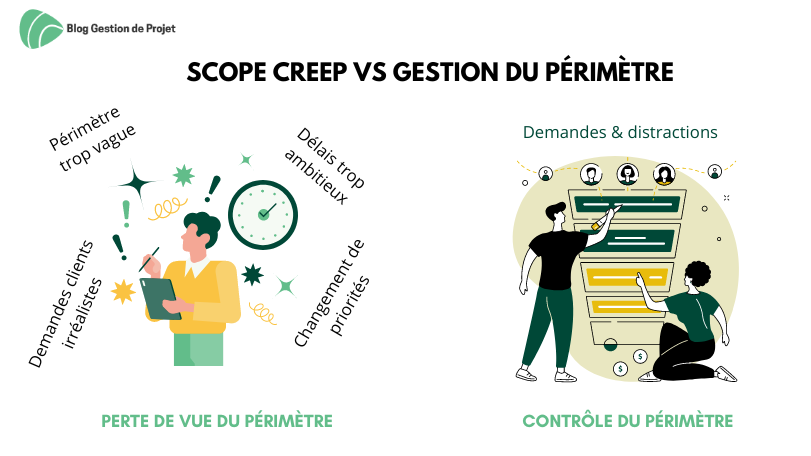
Your goal as a negotiator is to maintain le contrôle du périmètre by having open and clear discussions about these trade-offs.
2. The Mindset: Collaborative Language
Effective negotiation isn't about winning a battle; it's about finding the best possible outcome for the project. This requires a collaborative mindset, which is reflected in the language you use. A short article from Acolad, "Le langage de la négociation," provides excellent insights into this.
Le langage de la négociation : Comment choisir les mots justes
Let's read excerpts from this article to understand the foundation of persuasive and polite negotiation language.
Please read the following sections: Start with 'Des négociateurs efficaces' to understand the core principles. Continue to 'Un langage ouvert et inclusif' and focus on the shift from 'je' to 'nous'. Finally, read 'L’écoute active' to learn phrases that show you are considering the other person's viewpoint. Pay close attention to the example phrases provided in each section.
Here are the two most important principles from that reading:
-
Use Inclusive Language: Replace
je(I) withnous(we). This immediately frames the discussion as a shared problem to be solved together.- Instead of:
Je veux lancer le processus. - Say:
Notre objectif est de lancer le processus.(Our objective is to launch the process.)
- Instead of:
-
Practice Active Listening: Show that you have heard and understood the other person's needs before presenting your own constraints.
Nous prenons bonne note de ce que vous avez à dire.(We take good note of what you have to say.)Je comprends la nécessité de...(I understand the need to...)Nous avons conscience de la situation...(We are aware of the situation...)
By starting with this kind of language, you build trust and show that you are a partner, not an obstacle.
3. Key Phrases for Negotiating Scope and Deadlines
Now, let's build on this foundation with specific phrases for negotiating scope (périmètre) and deadlines (une échéance).
Scenario A: The deadline is fixed, so the scope must change.
This is common in agile environments where sprints have fixed end dates.
-
To state the constraint firmly but politely:
L'échéance est non-négociable.(The deadline is non-negotiable.)Nous devons impérativement livrer pour le 15 décembre.(We absolutely must deliver by December 15th.)
-
To propose a scope adjustment:
Compte tenu du délai, je propose de prioriser les fonctionnalités A et B.(Given the deadline, I propose prioritizing features A and B.)Pour respecter cette échéance, il faudrait reporter le développement de la fonctionnalité C au prochain sprint.(To meet this deadline, we would need to postpone the development of feature C to the next sprint.)Si nous gardons l'ensemble de ce périmètre, nous ne pourrons pas garantir la qualité.(If we keep this entire scope, we won't be able to guarantee quality.)
Scenario B: The scope is fixed, so the deadline must change.
This is more common in predictive or "waterfall" projects where a specific feature set is promised.
-
To explain the need for more time:
Pour livrer ce périmètre avec le niveau de qualité requis, nous aurions besoin de plus de temps.(To deliver this scope with the required level of quality, we would need more time.)Notre estimation actuelle montre qu'un délai supplémentaire de deux semaines est nécessaire.(Our current estimate shows that an additional two weeks are necessary.)
-
To formally request a deadline extension:
Serait-il envisageable de décaler l'échéance ?(Would it be conceivable to shift the deadline?)Nous proposons de fixer la nouvelle date de livraison au 30 janvier.(We propose setting the new delivery date to January 30th.)
Phrases for Finding a Compromise
Negotiation often ends in a compromise. Here are phrases to help you find a middle ground.
Trouvons un compromis.(Let's find a compromise.)Je comprends votre contrainte. De notre côté, la difficulté est...(I understand your constraint. On our side, the difficulty is...)Une autre solution serait de livrer le projet en deux phases. Qu'en pensez-vous ?(Another solution would be to deliver the project in two phases. What do you think?)Que diriez-vous de réduire le périmètre de la fonctionnalité X pour l'inclure dans cette version ?(What would you say to reducing the scope of feature X to include it in this release?)
4. Mise en Pratique: Your Turn to Negotiate
Imagine you are the tech lead of a team. Your product owner comes to you with an urgent request.
Product Owner:
"Bonjour. Le client vient de demander une nouvelle fonctionnalité d'export en PDF. C'est très important pour lui. Il faut l'ajouter au sprint actuel, qui se termine dans une semaine."
Your Mission:
Write a short, 2-3 sentence response in French. Your goal is to negotiate.
- Acknowledge the importance of the request (active listening).
- State your constraint (the one-week deadline).
- Propose a collaborative solution (e.g., move to the next sprint, trade for another feature).
Take a moment to formulate your response before looking at the example below.
Exemple de Réponse :
"Bonjour. Je comprends tout à fait l'importance de cette demande pour le client. Cependant, l'intégrer maintenant, à une semaine de la fin du sprint, risque de compromettre la stabilité de la livraison. Je propose de la placer en priorité absolue pour le prochain sprint, qui commence dès la semaine prochaine. Serait-ce une solution envisageable pour vous ?"
This response is effective because it:
- Starts with empathy and understanding (
Je comprends...). - Clearly states the risk without being confrontational (
risque de compromettre...). - Offers a concrete, positive alternative (
placer en priorité absolue...). - Ends with a question that invites collaboration (
Serait-ce envisageable...).
Conclusion
Excellent work today! You've learned how to approach one of the most challenging but essential aspects of professional communication in a tech environment.
Key Takeaways:
- Frame the Conversation: Project negotiations are almost always about balancing the 'iron triangle': scope (
périmètre), deadlines (délais), and cost (coûts). - Be a Partner, Not an Adversary: Use inclusive language (
nous,notre objectif) and active listening (Je comprends,Nous prenons note) to build a collaborative atmosphere. - State Constraints, Propose Solutions: Clearly and calmly explain the limitations (e.g., "Given the deadline...") and then immediately offer a constructive path forward (e.g., "I propose we prioritize...").
In our next lesson, we will focus on what happens after a tough negotiation, particularly when the outcome involves a delay. You will learn how to manage stakeholder expectations regarding delays or challenges, ensuring that communication remains clear and professional even when the news isn't ideal.
À bientôt